Get Full Government Meeting Transcripts, Videos, & Alerts Forever!
Get email alerts on the Medical Licensure topic
No spam. Unsubscribe anytime.
Panel advances bill expanding training sites for provisional licenses for international medical graduates
Summary
House Bill 1201 would expand settings where international medical graduates (IMGs) with provisional licenses may train and practice under supervision; the subcommittee voted 7-0 to send the bill on to the full Health Committee.
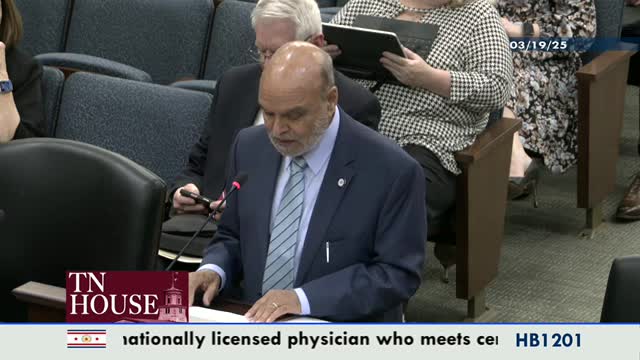
House Bill 1201, sponsored by Chairman Dot Kumar, would broaden the types of facilities that may host international medical graduates working under Tennessee's provisional license program. The measure passed the House Health Subcommittee by voice vote recorded as 7-0 and now moves to the full Health Committee.
Chairman Dot Kumar explained the bill as an effort to increase training slots for provisional-license physicians recruited from international medical schools. He reviewed current law passed in 2023–24 that authorizes provisional two-year licenses under supervision at institutions with ACGME-approved training programs; qualifiers include graduation from a recognized medical school, passage of required exams such as the USMLE, a job offer from a qualifying medical institution and lawful visa status. Kumar said the state produced a limited yield from that program because only "less than 15 medical centers in the state" have approved training programs.
"I think what this bill does is to catch up with them so we can also take advantage of having more spots where these physicians can be appointed and trained to relieve the physician shortage," Kumar said. The bill expands eligible training and practice sites to include federally qualified health centers, rural clinics, community health centers, postgraduate training programs and specialty clinics, provided a board-certified physician supervisor is available. Kumar emphasized that after two years of satisfactory supervised practice, the provisional-license physicians would be eligible for an unrestricted Tennessee license under current qualification rules.
Representative McKenzie questioned the bill's phrase requiring "sufficient evidence of good moral character," calling it subjective and asking for clarity; Kumar replied the intent is to ensure applicants lack convictions or discipline for unethical or criminal behavior. Representative Terry asked whether the provisional license would allow specialty training; Kumar said the physician would receive an unrestricted license after two years but would still need to pursue specialty board eligibility through the usual channels.
Madam Clerk recorded a roll call of 7 ayes, 0 nays; the committee chair announced the bill "moves on to health full."