Get Full Government Meeting Transcripts, Videos, & Alerts Forever!
Get email alerts on the Property Tax Relief topic
No spam. Unsubscribe anytime.
Montana bill would tie property-tax relief to income; renters included
Summary
Representative Jonathan Karlen introduced House Bill 154, a proposed income-tax credit that would cap property-tax burdens relative to household income and would apply a similar calculation to a rent-equivalent for renters.
Representative Jonathan Karlen formally introduced House Bill 154 on behalf of House District 98 in Missoula County, proposing an income-tax credit designed to prevent property-tax burdens from exceeding an ‘‘affordable portion’’ of household income. ‘‘The bill I have before you today, House Bill 154, ensures that constituents don't pay a property tax bill or don't face a property tax burden that exceeds an affordable portion of their income,’’ Karlen said.
Karlen described the bill as a sliding-scale ‘‘circuit breaker’’ that calculates a cap on property-tax liability as a percentage of income and then issues an income-tax credit to make up the difference. He gave a concrete example from a handout: a household with $80,000 in income and a $4,500 property-tax bill would face a cap of roughly 3.1% of income (about $2,500); using the bill’s 0.75 multiplier the example produces an $875 credit. Karlen also described an approach for renters: the bill would use an existing statutory concept of ‘‘rent-equivalent property tax’’ by taking 15% of a household’s annual rent and running that figure through the same credit calculation.
Proponents who testified said the bill would target relief to households that face disproportionate property-tax burdens. Rose Bender of the Montana Budget and Policy Center testified that property taxes are regressive and that HB 154 would make relief more targeted than broad rate reductions. ‘‘Property taxes are not connected to ability to pay,’’ Bender said. Danny Hess of Montanans United for Sustainable Taxes (MUST) said the bill’s inclusion of renters is important because renters also bear rising property-tax costs through rent. Sam Momeyer, representing the city of Missoula, said the credit could cover up to 75% of property-tax or rent-equivalent tax paid for households earning up to $150,000 under the proposal.
Additional supporters included Shelter Whitefish, AARP Montana, Montana Nonprofit Association, Ford Montana (a youth voter-engagement group), and individual renters and housing advocates who described rising rents and difficulty staying in communities. Aubrey LaBarre, a renter in Bozeman, said higher housing costs were preventing coworkers from completing training and educational programs.
The Montana Society of CPAs registered as an opponent and said it ‘‘reluctantly stands in opposition’’ on administrative grounds. Executive Director Allen Lloyd warned that the credit could be complicated to administer for shared housing situations and would create additional validation work for the Department of Revenue.
Department of Revenue staff (Dylan Cole and Shaelyn Daigle) appeared as informational witnesses and said they were available to answer implementation questions.
Committee members asked about technical interactions with other tax bills and possible effects on local levies. Senator McCamey and others raised concerns that a statewide credit could allow voters or local governments to increase spending without the same pressure from taxpayers; Karlen said he is considering an amendment to exclude newly voted levies from the credit and suggested capping the credit as another option. Karlen said the credit would work ‘‘alongside’’ other property-tax changes and that he was willing to model amendments and revenue sources with committee members.
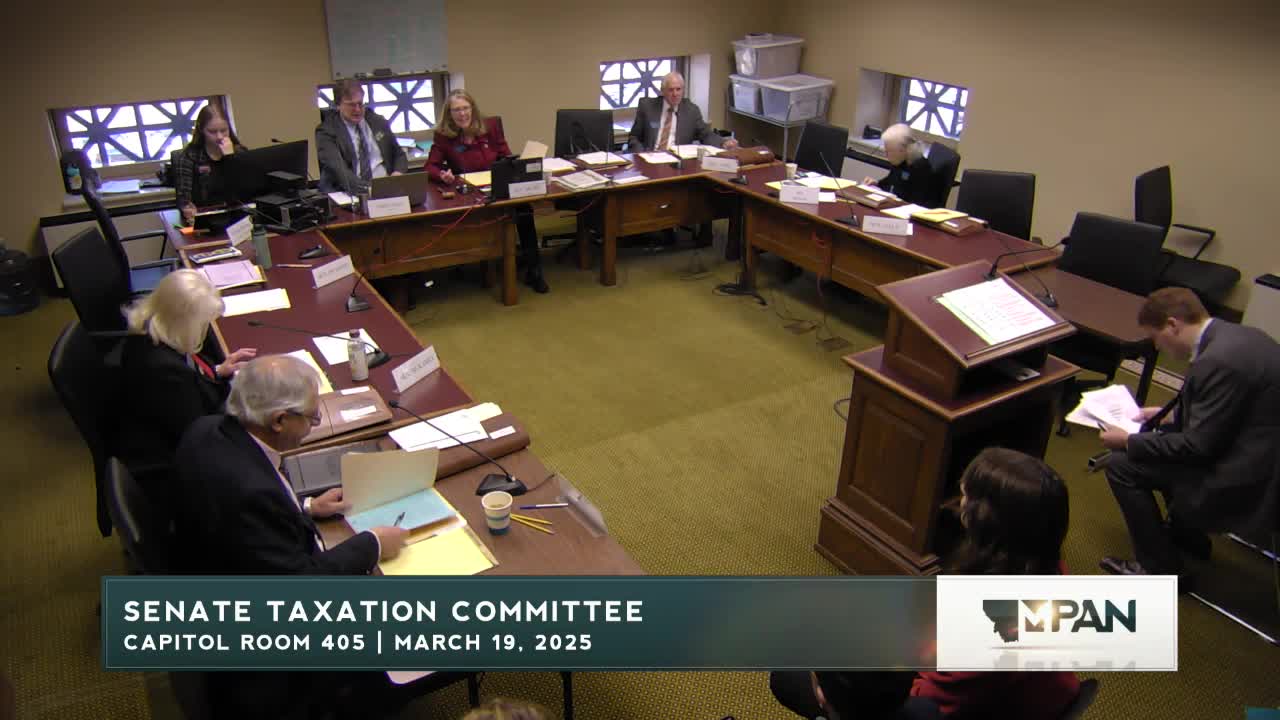
The hearing closed with Karlen offering to work with the committee on potential amendments and further modeling. No formal vote on House Bill 154 was taken at the hearing.