Get Full Government Meeting Transcripts, Videos, & Alerts Forever!
Get email alerts on the Election Law Updates topic
No spam. Unsubscribe anytime.
Elections director briefs board on litigation, party recognition and bills that would cut early voting
Summary
Rockingham County elections staff updated the board on a lawsuit over changes to the State Board of Elections, proposed bills to shorten early voting windows, changes to party recognition and other state-level items; no county action was taken.
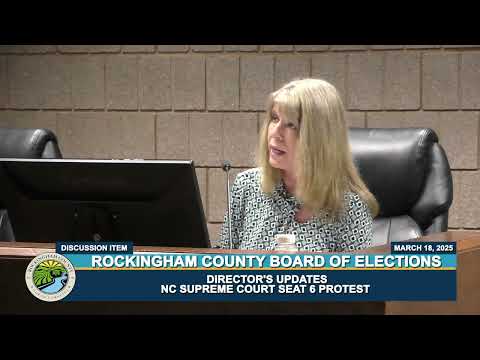
Paula Seemster, director of the Rockingham County Board of Elections, updated the board on several state-level legal and legislative developments that could affect election administration.
Seemster said a protest related to North Carolina Supreme Court Seat 6 will be heard by a three-judge panel of the North Carolina Court of Appeals. She named the judges who will hear the case—John Tyson, Fred Gore and Toby Hampton—and said oral arguments will proceed before the panel. The board was told an earlier motion to have the full Court of Appeals hear the case was overruled.
Seemster reviewed pending legislation. She said House Bill 66, introduced in February, would reduce early voting to begin on the second Monday before an election and end the Saturday before Election Day, for a total of six early voting days; the bill had been referred to the House Rules, Calendar and Operations Committee as of the morning of March 18. Seemster also described House Bill 411, filed March 2025, which is similar to HB 66 but would apply to primaries and special elections and would cut early voting for those contests from 17 days to six; general-election early voting would remain unchanged under HB 411 if enacted.
On House Bill 127, Seemster said the bill would require the State Board of Elections to develop a sample voter-registration form for organized registration drives. She reported the bill has been subject to referral votes and remained in the House rules committee at the time of the meeting.
Seemster briefed the board on litigation and law changes tied to Senate Bill 382 and Session Law 2024-457. She said the session law, and a related lawsuit filed by former governors, argues that recent changes to the State Board of Elections and county boards conflict with the separation of powers in the North Carolina Constitution. Seemster said that under the new law the state auditor is now the appointing authority for the State Board of Elections and will appoint the county board chair; she summarized the statute as establishing a five-member State Board of Elections with staggered four-year terms and limits on party representation.
Seemster also said the state now recognizes three political parties under North Carolina General Statutes 160-396 and 160-397—the Democratic Party, the Libertarian Party and the Republican Party—and that five other parties (Constitution, Green, No Labels, Justice for All, and We the People) will be removed from recognized-party status and that voter records will be updated automatically by state board staff in June under 8 NCAC 01.0107. She said that in the county, anyone attempting to register as one of the removed parties will be registered as unaffiliated or may select another recognized party.
Board members asked procedural questions about referrals and the meaning of "stricken" on committee actions; Member Hampton explained that a motion to refer had been struck down and therefore the bill remained in the original House Rules Committee. Seemster said she would keep the board updated as these items proceed through courts and the legislature. No formal board action was taken on these updates.