Get Full Government Meeting Transcripts, Videos, & Alerts Forever!
Get email alerts on the Wetlands Regulation topic
No spam. Unsubscribe anytime.
Committee advances wetlands reform after lengthy debate; opponents warn of cumulative impacts
Summary
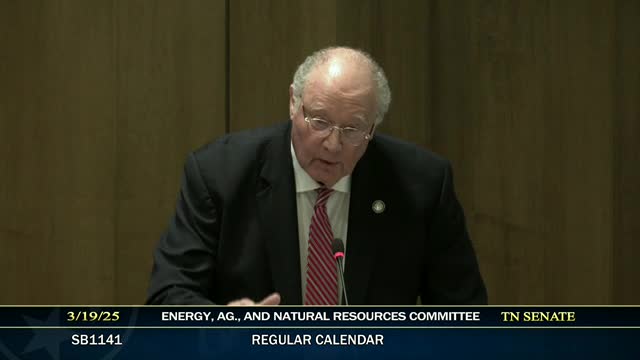
Senate Bill 6-70, a comprehensive rewrite of how the state regulates isolated wetlands, passed the committee after wide-ranging testimony and compromise amendments; the measure was sent to the Finance Committee.
Senator Jeff Taylor sponsored Senate Bill 6-70, a contentious, multi-section proposal that redefines how Tennessee treats isolated wetlands, establishes categories by size and quality, allows limited third-party wetland resource reporting, and directs TDEC to adopt rules for classification and mitigation. After months of stakeholder meetings and a late amendment, the committee debated the bill at length and heard more than a dozen witnesses for and against the measure.
Taylor said the bill creates four categories — artificial isolated wetlands, low‑quality, moderate‑quality, and high‑quality isolated wetlands — and provides a tiered permitting and mitigation approach. Under the amendment and bill text, small low‑quality wetlands (0–1 acre) would not require permits for certain impacts, wetlands from 1–2 acres would be subject to a general permit with one-to-one mitigation for the second acre, and larger impacts would require individual permits and mitigation ratios. The bill also prohibits "accumulation" of multiple isolated wetlands on a single tract for purposes of mitigation aggregation when separate parcels or lots are involved.
Supporters — including the Tennessee Chamber of Commerce, Build Tennessee Housing and industry representatives — said the measure reduces uncertainty and cost for landowners and developers while preserving protection for high‑value wetlands. Mallory Kirby of the Tennessee Chamber described the bill as a tailored, limited deregulatory approach designed to bring Tennessee closer to peer states on permitting for isolated wetlands.
Opponents — mitigation bankers, restoration practitioners, conservation groups and water‑resource scientists — warned the proposed changes would exempt large numbers of small wetlands (roughly 94% of isolated wetlands are under 2 acres, TDEC witnesses said), risk cumulative impacts to groundwater recharge, stream baseflow and water quality, and could drive up the cost of mitigation credits by shrinking supply. Witnesses urged caution and inclusion of a voluntary wetland conservation fund (a recommendation from TDEC's stakeholder work) that the bill in its current form did not include.
TDEC representatives said the agency supported many recommendations from the summer stakeholder process but noted the current draft lacked some pieces — notably the proposed conservation fund — and that rulemaking would be required to set precise size thresholds and mitigation requirements.
Action: After an amendment process, the committee voted to move SB 6-70 to Finance; the roll call recorded seven ayes and two noes. Senator Campbell moved to roll the bill for further study but the motion failed and the bill remained on the day’s calendar.
Implications: The bill alters the state's approach to isolated wetlands, relying on administrative rulemaking to set the operational thresholds. Opponents argued the changes could reduce protection for wetlands that support groundwater recharge and stream flow, especially in karst and West Tennessee aquifer areas, and urged addition of mitigation-conservation funding and tighter cumulative-impact evaluations.
Next steps: SB 6-70 was referred to the Finance Committee for budget and broader review.