Get Full Government Meeting Transcripts, Videos, & Alerts Forever!
Get email alerts on the Drinking Water Fluoride topic
No spam. Unsubscribe anytime.
Fluoride testing bill fails in committee after testimony and debate
Summary
A sponsor-led measure that would require public water systems that fluoridate to reduce fluoride levels to 0.7 mg/L and impose testing, notice and penalties failed to advance out of committee.
Senator Crowe introduced Senate Bill 11-41 to require public water systems that add fluoride to drinking water to ensure fluoride concentrations are at 0.7 milligrams per liter (mg/L), aligning with current Environmental Protection Agency guidance described by supporters as the "optimal" level for dental health.
Crowe said the bill would require systems with higher levels to reduce concentrations to 0.7 mg/L by specified dates (the sponsor cited a window "by May 1, 2025, no later than July 31, 2025"), increase monitoring frequency to quarterly (and monthly if above the target), and require systems to notify customers within 30 days of any reduction. The sponsor described an enforcement threshold of 0.75 mg/L that would trigger civil penalties under the Tennessee Safe Water Act.
The bill drew extended testimony from dentists and public-health officials. Dr. Leon Stanislav, a retired dentist who said he served 15 years on the American Dental Association's fluoridation advisory committee, told the committee that 0.7 mg/L is the recommended optimal concentration for preventing tooth decay and that maintaining a target around 0.7 protects children while still providing benefit. He also said operators prefer a modest range rather than a single precise number to avoid falling below protective levels.
Department of Health staff said they would not object to an optimum level being set in statute but echoed concerns about making compliance too narrow and about water systems' ability to comply. Opponents at times cited recent litigation (Food & Water Watch v. EPA) and emerging federal review of fluoride standards; supporters argued the measure simply would require testing and transparency.
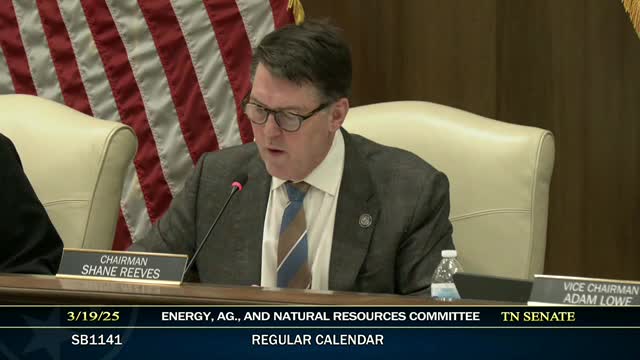
Action: The sponsor moved the bill and an amendment; the committee voted by roll call and the motion failed. The final roll call produced three ayes (Senators Bolling, Lowe and Pote) and six nays (Senators Campbell, Harshbarger, Oliver, Seal, Wally and Chairman Reeves) and the bill remained in committee.
Discussion and outcome: The debate centered on public-health tradeoffs and whether stricter statutory monitoring would prompt systems to stop fluoridation or lead to compliance difficulties. The Department of Health recommended care in drafting a compliance range; dental witnesses urged keeping 0.7 as the target but practical flexibility for operators. After testimony and discussion, the committee did not advance SB 11-41.