Get Full Government Meeting Transcripts, Videos, & Alerts Forever!
Get email alerts on the Criminal Justice topic
No spam. Unsubscribe anytime.
Committee backs bill to create statewide sexual‑assault response coordinator
Summary
Lawmakers advanced House Bill 696 (as amended) to establish a statewide Sexual Assault Response Team (SART) coordinator to provide technical assistance and consistency across jurisdictions; victim‑advocates testified in support.
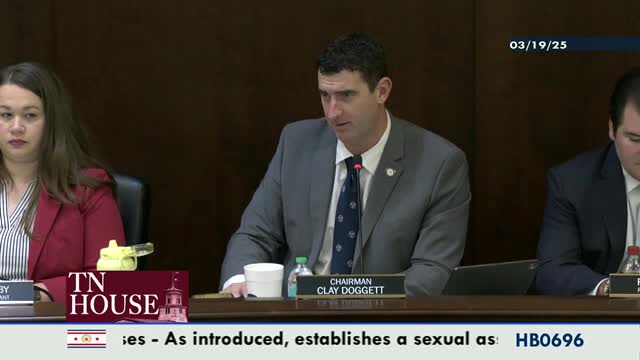
The House Criminal Justice Subcommittee voted to advance House Bill 696 as amended to the full judiciary committee. The bill would establish a statewide sexual‑assault response team coordinator position to provide oversight, technical assistance and training to local SART teams across Tennessee.
Representative Gillespie, sponsor of the bill, said the legislation implements a statewide coordinator position to support the SART teams required by last year’s SART Act. He said the amendment (drafting code 4438) added language creating the statewide coordinator position and the committee attached the amendment before voting.
Three witnesses—Rachel Freeman (president and CEO of a sexual assault center), Katrina Brown (registered nurse at Vanderbilt University Medical Center), and Jennifer Eskew (CEO, Tennessee Coalition to End Domestic and Sexual Violence)—testified in favor. They told the committee that coordinated SARTs increase reporting by victims, improve trauma‑informed investigations and strengthen partnerships among advocates, health care providers, law enforcement and prosecutors. Freeman said jurisdictions with high‑functioning teams have higher reporting rates; she cited up to a 70 percent increase in reporting in Davidson County associated with a functioning SART.
Witnesses described the coordinator as a technical‑assistance role housed at the Tennessee Coalition to End Domestic and Sexual Violence; they emphasized the position would not supervise or exercise authority over local teams but would provide training, best practices, and bridge relationships among partners.
Representative Powell and other members expressed support and encouraged funding for the coordinator post. The measure passed on a recorded vote the clerk reported as 9 ayes, 0 nays and was ordered to full judiciary as amended.
Advocates said the position would standardize resources for urban and rural jurisdictions and help survivors access services and evidence‑based care.