Get Full Government Meeting Transcripts, Videos, & Alerts Forever!
Get email alerts on the Criminal Justice topic
No spam. Unsubscribe anytime.
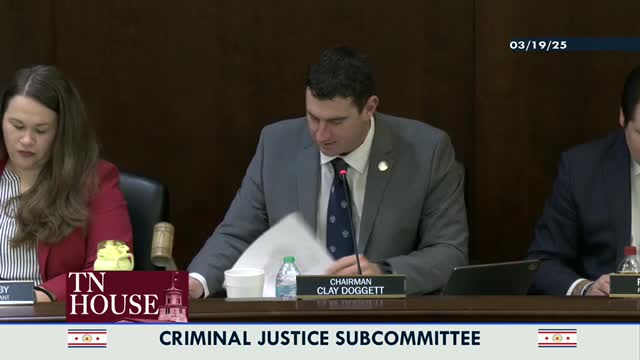
Subcommittee advances bill creating distinct crime of human smuggling after public testimony
Summary
The House Criminal Justice Subcommittee voted to send House Bill 322, amended to add a new human-smuggling offense, to full judiciary after sponsor testimony and public opposition focusing on a provision criminalizing harboring undocumented people.
House Criminal Justice Subcommittee Chairman Todd’s House Bill 322, which the sponsor said creates a separate criminal offense for human smuggling, cleared the committee as amended and will go to the full judiciary committee.
The bill’s sponsor described human smuggling as distinct from human trafficking, saying smuggling “involves crossing international borders” and often large numbers of people controlled by organized crime. The sponsor said the measure was developed with input from law enforcement, including the Tennessee Bureau of Investigation, and sought to close a gap in state law. He asked the committee for approval after offering amendment drafting code 4483 and securing attachment of that amendment.
During public testimony, Ashley Warbington said she opposed section 7 of HB 322, which she said would criminalize harboring people who entered or remained in the U.S. without authorization. Warbington (identified herself for the record) described mixed‑status family concerns and said federal law already criminalizes harboring and that immigration enforcement is a federal responsibility; she warned the provision could expose Tennessee to litigation and could “criminalize basic human decency.” Johanna Cohen of Robertson County also opposed section 7 and urged removal of that section, drawing historical comparisons and saying the first six sections of the bill “do a lot of good.”
Committee members questioned both the sponsor and witnesses. Representative Powell asked Warbington to describe everyday life impacts; Warbington said families in mixed‑status households fear routine activities such as children’s play dates, visits to school events and being stopped in a car by federal immigration agents. Representative Salinas asked the sponsor whether the bill would affect nonprofit organizations that help immigrants; the sponsor said the bill targets conduct that fits the statutory definitions (for example, intent to conceal for commercial advantage) and that “NGOs that are not participating in this type of activity will not be held accountable,” while acknowledging that whether an organization’s conduct met the statute could be decided later in court. Members raised the prospect the bill could face federal preemption challenges.
After debate, a vote to send HB 322 as amended to full judiciary passed on a roll call reported by the clerk as 7 ayes and 2 nays. The committee record shows the ayes prevailed and the bill advanced.
The measure remains subject to further amendment and legal challenges; opponents said section 7 should be removed while supporters said it targets organized criminal enterprises that profit by moving people and shielding them from detection.