Get Full Government Meeting Transcripts, Videos, & Alerts Forever!
Get email alerts on the Physician Assisted Suicide topic
No spam. Unsubscribe anytime.
Montana committee hears hours of testimony over bill to bar physician-assisted suicide
Summary
Lawmakers heard extensive, divided testimony on Senate Bill 136, which would make clear that physicians who prescribe lethal drugs intending a patient’s death could be charged with homicide; proponents urged protection for vulnerable people while opponents and patients said ending access would force traumatic deaths.
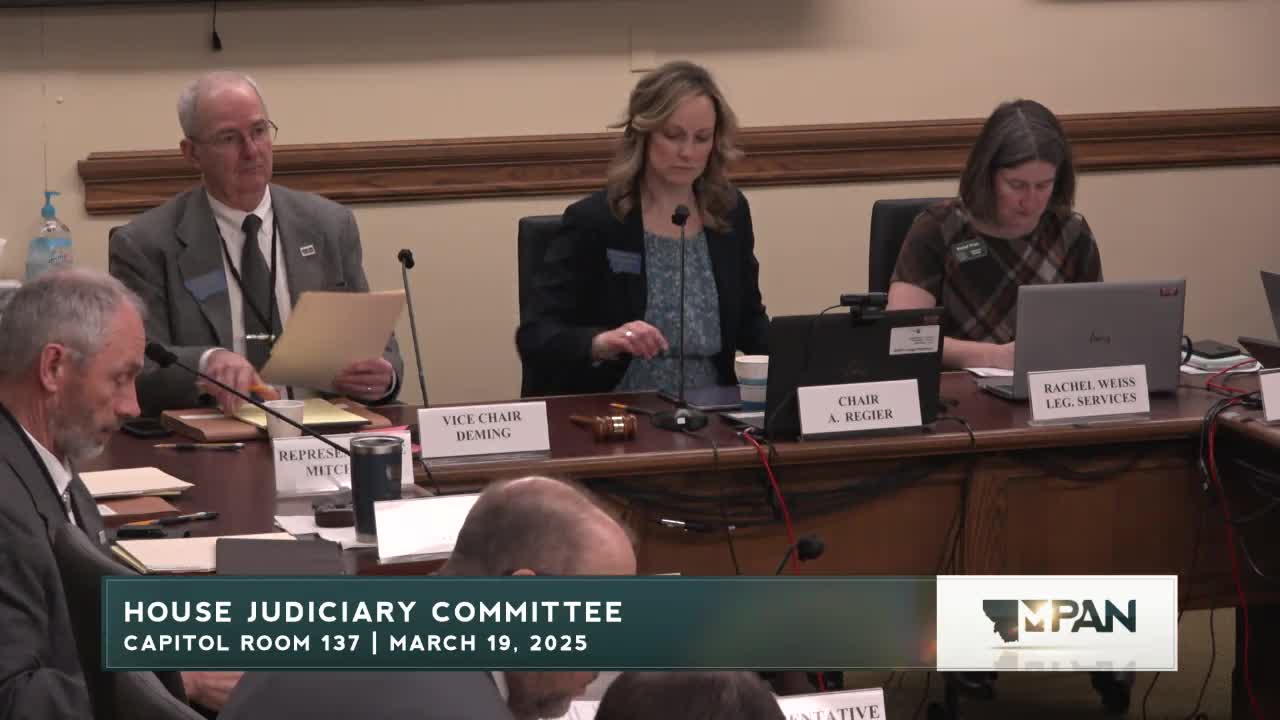
Senate Bill 136, a proposal to clarify that physician-assisted suicide is not lawful in Montana, drew more than three hours of testimony and sharp disagreement at a House Judiciary Committee hearing.
Supporters told lawmakers the measure is needed to protect vulnerable Montanans and to make clear that a physician who intentionally prescribes a lethal drug to cause death can be prosecuted. Opponents — including hospital staff, hospice and palliative clinicians, people with terminal diagnoses and family members who used medical aid in dying — said the bill would criminalize accepted end-of-life care, strip patients and families of a private option, and likely push some people to choose violent, solitary means.
Senator Glim (bill sponsor) opened the hearing saying state law criminalizes deliberate homicide and aid or soliciting suicide and that the Montana Supreme Court’s Baxter decision left policy choices to the legislature. “Montana state law 45-5-102 reads, under the code deliberate homicide, ‘A person commits the offense of deliberate homicide if the person purposely or knowingly causes the death of another human being,’” the sponsor said, adding the bill would remove the defense premised on the victim’s consent. Proponents argued that criminal exposure for physicians is appropriate because writing a lethal prescription with the knowledge and intent that it will end a life is different from ordinary palliative care.
Kristen Juras, appearing on behalf of the governor’s office, urged support and framed the bill as consistent suicide-prevention policy, citing Montana’s high suicide rate. Dr. Carley Robertson, a Montana Medical Association board member and past president, said the bill protects routine medicine and palliative care and guards patients from coercion; she told lawmakers she had seen examples she described as experiments by physicians trying to identify lethal drug regimens. Other medical witnesses, clergy, disability-rights advocates and public-interest groups also testified in favor.
Opponents included hospice clinicians, hospital representatives and patients who described using medical aid in dying as a private, peaceful option when suffering became intolerable. Joseph Carver of Bozeman Health said the bill would chill patient autonomy and complicate doctor–patient decision-making. Heather O’Hara of the Montana Hospital Association said the measure risks deterring appropriate pain management because it could expose clinicians to homicide charges. Multiple people with terminal diagnoses, and family members who described choosing medical aid in dying for relatives, urged lawmakers not to “criminalize” the option; several told personal stories of peaceful home deaths following prescriptions.
A number of witnesses invoked Baxter v. Montana, the 2009 state Supreme Court decision, arguing opposite interpretations: proponents said Baxter left a legal “loophole” that should be closed by statute; opponents said Baxter and existing practice have allowed aid in dying for years without widespread abuse. Supporters cited trends in Canada and Europe as evidence of a slippery slope; opponents and clinicians disputed those comparisons and said U.S. jurisdictions with reporting have safeguards and limited utilization.
Committee members asked about distinctions between palliative care and an intentional, lethal prescription; access for rural Montanans; the role of nonphysician clinicians; and confidentiality or reporting. Legislative auditors and health experts were not present to give data about frequency in Montana; several witnesses said many people who receive prescriptions do not ultimately take them. The sponsor and opponents both said they were motivated by preventing misuse and protecting patients, but they reached different conclusions about which policy best does that.
The hearing closed without a committee vote; the bill will next follow the committee’s internal scheduling for executive action.
The testimony record includes detailed policy and clinical claims, widely divergent personal stories, and repeated references to state criminal statutes and Baxter v. Montana. Lawmakers pressed witnesses on implementation details — who could be prosecuted, how palliative care would be distinguished from intentional prescribing, and whether curtailing physician options would increase nonmedical suicides. No formal committee action was recorded at the hearing.
Lawmakers and staff will need to reconcile constitutional and statutory questions raised by Baxter, and to decide whether to criminalize specific prescribing conduct while preserving established palliative practices.