Get Full Government Meeting Transcripts, Videos, & Alerts Forever!
Get email alerts on the Pensions And Taxation topic
No spam. Unsubscribe anytime.
Committee hears bill to make line-of-duty disability benefits nontaxable federally one year earlier
Summary
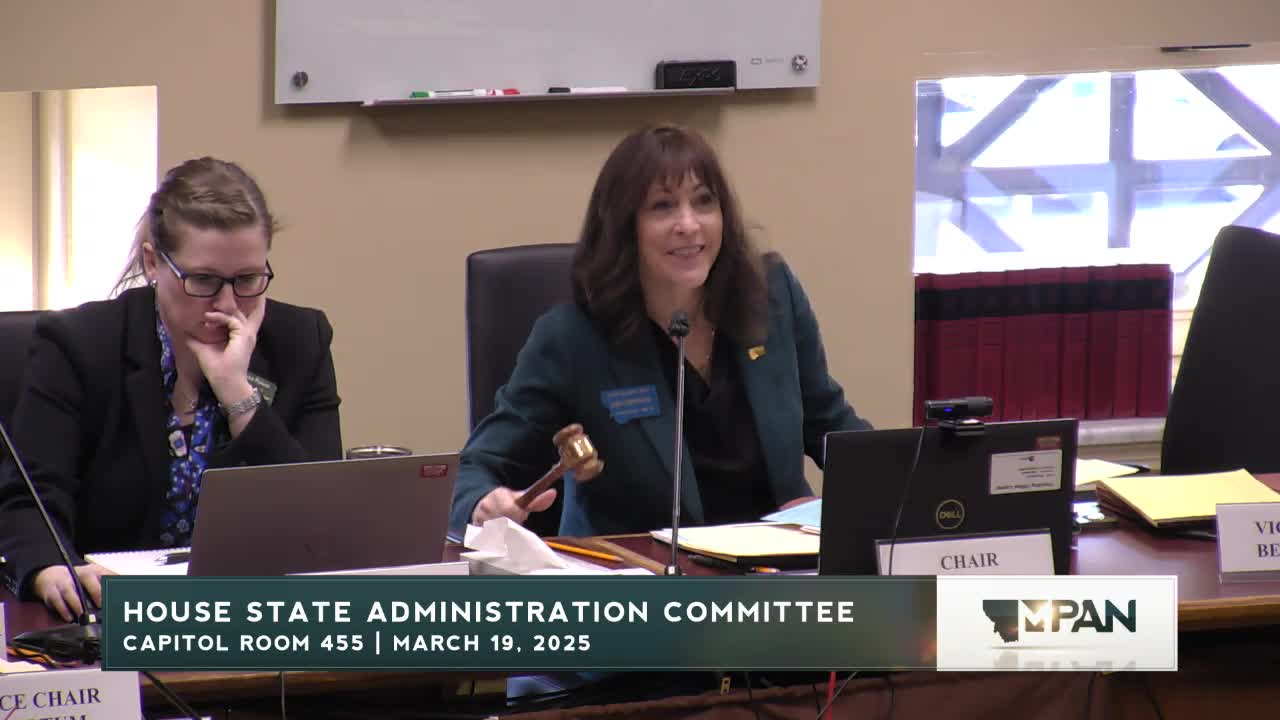
House State Administration Committee heard testimony on Senate Bill 316, which would amend state code so certain line-of-duty disability benefits for municipal police officers and firefighters can be reported to the IRS as nontaxable beginning Jan. 1, 2026, instead of waiting for federal changes in 2027.
Senate Bill 316 received a hearing before the House State Administration Committee on Thursday. Sponsor Sen. Daniel Zolnikov opened the hearing, saying the bill would allow certain line-of-duty disability benefits paid by the municipal police officers and firefighters retirement systems to be reported to the Internal Revenue Service as nontaxable beginning Jan. 1, 2026, rather than waiting for a federal change that takes effect in 2027.
The bill’s proponents told the committee the change would not increase retirement benefits or cost the retirement funds. William Hollahan, executive director of the Montana Public Employee Retirement Administration, said the agency administers the police and firefighters retirement systems and that “these statutory changes are the only way we can report in box 2a of 1099‑R as being nontaxable” for members disabled in the line of duty. Hollahan said the change reflects guidance received from the IRS and that the bill “would mirror the current benefit formula for regular disability statutes in each system so there's not gonna be a fiscal impact to the fund.”
Representatives of public-safety employee groups urged passage. Shelby Demars of the Montana Police Protective Association said the language is “fairly straightforward” and that taxes on disability benefits have imposed large, unexpected bills on officers injured in the line of duty. Family members of injured officers described hardships. Rhonda Wiggers recounted a case of an officer shot on duty and said of the current tax treatment, “When they gave him the medical retirement … the one thing they told them was it's it's not a lot of money but it's tax free so that does help. That's not true. That's not how it ended up because of some stupid line in Montana's law.”
Committee members asked technical questions about how the state change interacts with federal reporting. Hollahan told Representative Perry that the agency had consulted with the IRS and that, under current code language, misreporting could expose the state to penalties; changing state statute is the mechanism the IRS indicated would allow the benefits to be reported as nontaxable in box 2a. Representative Byrne asked whether the bill could be made retroactive to Jan. 1; Hollahan said the agency would be “amenable” to retroactive applicability but flagged potential complications, such as issuing two separate 1099‑R forms for the same year depending on IRS interpretation. Committee staff (Miss Powers) said she was working on a possible amendment.
The hearing record shows no committee vote; sponsors and proponents urged a do‑pass recommendation and asked staff to prepare technical amendments, including possible retroactivity. The hearing closed without a formal committee action recorded.
If enacted as written, the bill would change state reporting so that some line-of-duty disability benefits could be treated as federally nontaxable for the year beginning Jan. 1, 2026, potentially reducing tax bills for those members until Secure Act 2’s federal provisions take effect in 2027.
A next step identified in the hearing was drafting technical language to address retroactivity and IRS reporting mechanics; staff indicated they would work with the administering agency on that language.