Get Full Government Meeting Transcripts, Videos, & Alerts Forever!
Get email alerts on the Assault Nonconsensual Drugging topic
No spam. Unsubscribe anytime.
Sponsor seeks to classify nonconsensual drugging as assault; committee debates scope and exceptions
Summary
House Bill 174 would make it an assault to intentionally provide certain drugs to another person without that person’s consent, while exempting medical providers and naloxone administration.
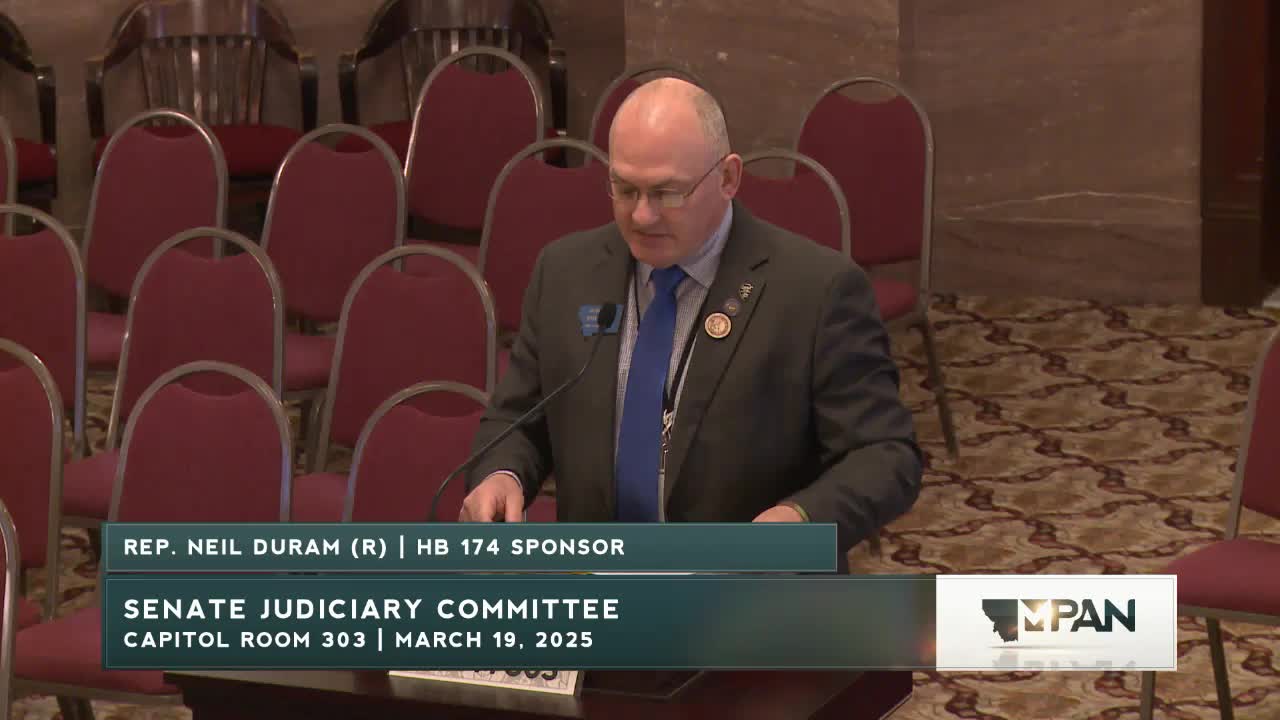
Representative Neil Duram opened the hearing on House Bill 174, saying the measure would revise Montana’s assault law to make it an offense to purposely or knowingly provide certain drugs to another person without that person’s consent. Duram read the bill’s core language and said the bill’s intent is that “any drugs that go into my body, I need to give consent for.” He described exceptions for medical providers and for administration of opioid reversal medication such as naloxone.
Duram cited commonly referenced “date-rape” drugs (Rohypnol, flunitrazepam, gamma-hydroxybutyrate) and broader controlled-substance schedules (schedules 1–5) plus alcohol and diphenhydramine (Benadryl) as covered by the bill. He said the measure is intended to address nonconsensual drugging in contexts that can harm a person’s health, reputation or employment prospects.
Informational witness Eldena Bear Don’t Walk from the Office of the Public Defender provided the committee with the fiscal-note overview. Committee members asked whether the statutory approach duplicates general assault statutes and whether listing schedules, rather than using an informed-consent framework, is preferable. Senator Olson asked whether the conduct could already be prosecuted under existing assault provisions; Bear Don’t Walk said assault statutes could cover many cases but noted that specificity can prevent gaps.
Several senators raised concerns about parental or guardian administration of medications to minors and about day-care or caregiver conduct. Senator Emrich asked whether a parent who gives a child a prescribed medication or an over-the-counter dose could be criminalized; Duram said he intended parental consent to cover standard caregiver decisions but was open to drafting clarifications and welcomed friendly amendments. Senator Mansella suggested adding explicit parental consent language for minors; the sponsor said parental consent could address many scenarios but hesitated to require written consent.
Senators also discussed whether a simpler statutory framing focused on “informed consent” would accomplish the sponsor’s goal without enumerating schedules. Duram said he favors specificity to avoid vagueness and potential loopholes. No formal committee vote on HB 174 was recorded during the hearing.
Ending: The sponsor invited amendments to clarify parental-consent exceptions and other drafting details; committee work was left to staff and counsel.