Get Full Government Meeting Transcripts, Videos, & Alerts Forever!
Get email alerts on the Juvenile Justice topic
No spam. Unsubscribe anytime.
Bill would restore businesses, governments as eligible victims in youth-court restitution
Summary
Representative Neil Duram introduced House Bill 173 to allow corporations, businesses and government entities to be considered victims eligible for restitution under the Youth Court Act.
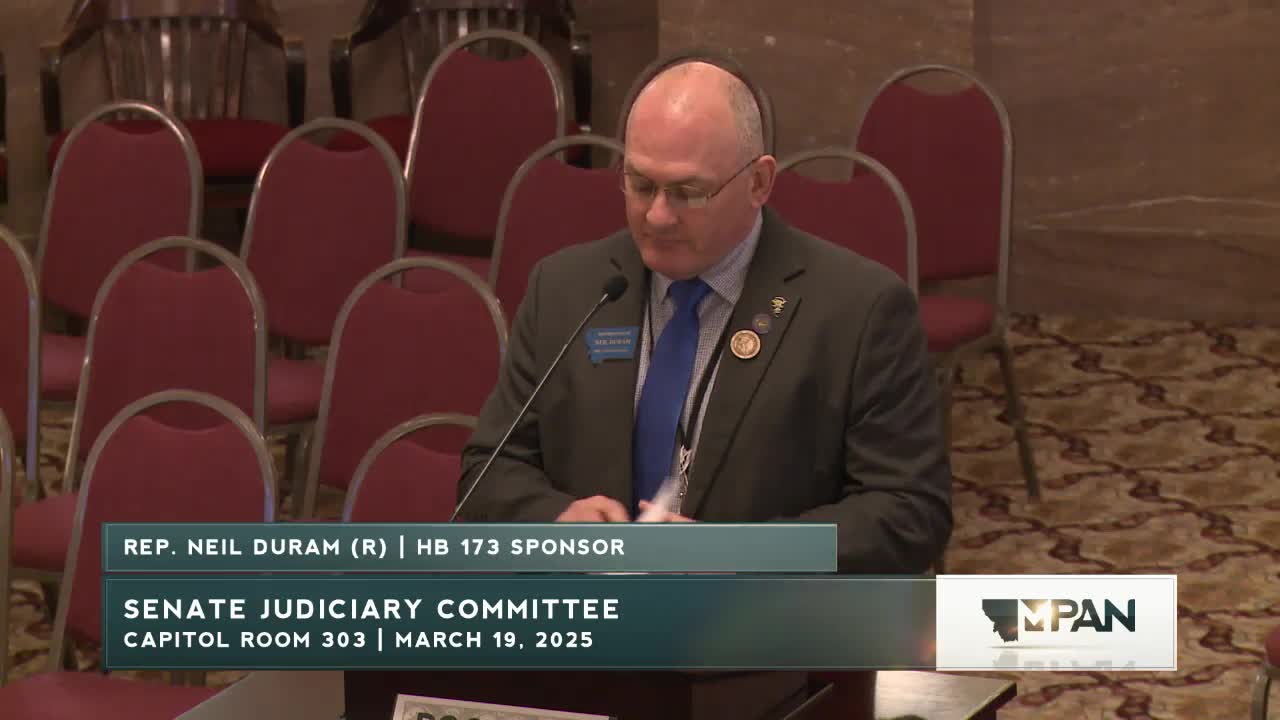
Representative Neil Duram introduced House Bill 173 to the Senate Judiciary Committee, saying the bill would strike the word “natural” from the statutory definition of “victim” in the Youth Court Act (41-5-103) so corporations, businesses and government entities can be compensated when a young person damages property.
Duram said the change responds to incidents in which public or corporate property (he cited ball fields) could not be awarded restitution because the statute limited “victim” to a “natural person.” “That was the moment that I had the realization that I had caused some harm, and I explained that I would do my best to get that fixed. Hence, House Bill 173,” Duram said.
The bill drew opposition from civil-rights and defense witnesses who told the committee HB 173 is duplicative of existing civil remedies and risks imposing financial penalties that research shows can harm youth reentry. Henry Seaton of the ACLU of Montana said the bill is “ineffective and not evidence based,” arguing increased restitution obligations often hinder, rather than help, rehabilitation. “These financial punishments have been proven to be ineffective deterrents of crime and all they really do is harm a youth’s ability to reenter society successfully,” Seaton said.
Michelle Lyday of the Office of State Public Defender, testifying on her own time, said the 2023 change that added the word “natural” aligned youth court with its rehabilitative purpose and noted that corporations, governments and organizations can pursue civil claims outside youth court. Lyday cited statistics from the Montana Supreme Court Office of Court Administrators’ youth-court report, saying restitution ordered in early 2022 totaled about $1,027,141 and that monthly totals in early 2023 averaged more than $13,000 for the period she reviewed; she urged more time to study effects of the earlier change.
Tom Billtein, Youth Court Services bureau chief in the Office of Court Administrators, described existing safeguards in youth-court restitution practice, including judicial assessment of a youth’s ability to pay and judicial authority to reassess orders over time. “There’s a lot of safeguards within the Youth Court Act that provide for...we have to assess the youth’s ability to pay,” Billtein said.
Committee members discussed drafting options. Senator Mansella requested an amendment; the chair said the committee would leave amendment work to the sponsor and staff and scheduled follow-up. No formal committee action on HB 173 was recorded during the hearing.
Ending: The committee left HB 173 open for amendment; Senator Mansella indicated he would prepare an amendment and the sponsor said staff would coordinate details after the hearing.