Get Full Government Meeting Transcripts, Videos, & Alerts Forever!
Get email alerts on the Property Tax Relief topic
No spam. Unsubscribe anytime.
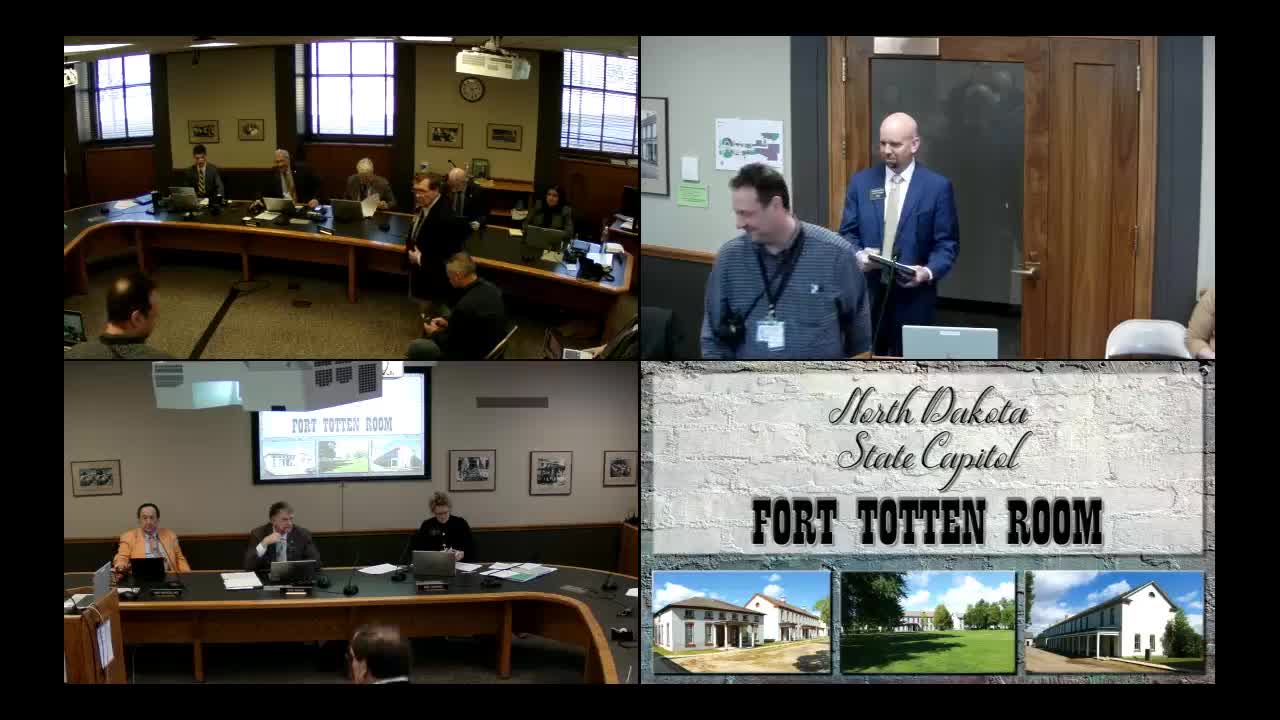
Committee reviews amended HB1168 to buy down property taxes by 30 mills; raises questions about K‑12 funding
Summary
Representative Scott Louser presented amendments to House Bill 1168 that would buy down property tax levies by 30 mills (about $360 million), add a municipal-cost-index cap on local levies, expand certain exemptions and change voting and carryforward rules; officials warned the state would need to fully backfill K–12 funding lost to local levies.
Representative Scott Louser, R‑Minot, told the House Finance and Tax Committee on Wednesday that his amendments to House Bill 1168 would reduce property tax levies by 30 mills for all property classes — an amount he estimated at roughly $360 million — and change how local levy caps are calculated and applied.
Louser said the package would apply the municipal cost index plus 1 percentage point, or 6 percent whichever is less, as the cap on year‑to‑year levy growth for political subdivisions (page 20, lines 13–14; defined page 22, lines 21–24). The amendment would also allow two years of carryforward for unused cap space (page 21); replace a supermajority voter threshold for certain levy increases with a simple majority (page 22); extend a local governmentauthority to request additional mill levy authority from five to six years; and exempt political subdivisions with an expense budget under $2,000,000 or a population under 1,000 from the cap (page 22).
Louser summarized how the relief would distribute across property classes using 2023 tax‑department figures: agricultural land contributed about 20.4 percent of property taxes (about $264 million in 2023), residential about 47.2 percent (about $611 million) and commercial about 32.4 percent (about $419 million). He told the committee that 1 mill equals $12,000,000 in state revenue and that 30 mills therefore approximates $360,000,000. Louser pointed committee members to specific amendment locations in the draft: for example, the 30‑mill buydown language appears on page 11, line 3; related references appear on pages 12, 18 and 23.
Adam Tesher, school finance officer at the Department of Public Instruction, said he was not aware of "any unintended consequences" from the draft but warned that school districts remain affected by changes to taxable valuation and by the existing K–12 levy structure. "If your taxable valuation increases, that's also an increase to your tax liability for school districts," Tesher said, noting that K–12 is technically capped at 60 mills and that mill buydowns are typically backfilled by the state under the school funding formula.
Tesher and other committee members discussed a funding stream referenced in the amendment language: a $121 million deposit to the State Tuition Fund. Tesher told the committee the State Tuition Fund — which includes the common schools trust fund and certain traffic fines and penalties — contributes roughly $600 million to K–12 funding and that the full amount of the proposed buydown would require roughly $360 million in state funding to replace what districts could no longer levy locally. "We're actually going to need the full $360,000,000," Tesher said, adding that $121,000,000 would only partially offset the need and that the amendment language appeared to mirror earlier, smaller buydown language.
Brian Kroshus, Tax Commissioner, said he had not yet done a detailed review of the updated amendment but that early calculations "certainly seem correct." Committee members asked whether the exemption tests (budget under $2,000,000 or population under 1,000) would catch small political subdivisions such as rural fire, ambulance and water districts; Louser and a representative for township officers said the exemption was intended to protect small units with limited budgets.
Committee members pressed Louser on mechanics and distribution. Senator Wallen asked why the bill capped taxes measured as levied rather than changes in valuation; Louser explained that capping budgets (authorized levy dollars) forces levies to fall when valuations rise and avoids separate caps on assessments or mill rates.
No committee action or votes were taken on the amendments Wednesday. Chairman Weber said the committee would reconvene Monday at 9:00 a.m. to hear a gas tax proposal and would return later to continue work developing tax relief language.
Sources: committee meeting transcript; on‑record statements by Representative Scott Louser (District 5, Minot), Adam Tesher (school finance officer, Department of Public Instruction) and Brian Kroshus (Tax Commissioner).