Senate committee recommends due pass for bill expanding arson and endangerment liability to protect joint owners and first responders
Loading...
Summary
House Bill 1528 would close a gap in state arson law by allowing criminal charges when a person intentionally burns jointly owned property even if no insurance claim is made, and would add emergency first responders to the endangering-by-fire statute; the committee voted 4-0 (1 absent) to recommend the bill.
Representative Matt Ruby, District 40, told the Senate Industry and Business Committee that House Bill 1528 was drafted with input from the Bureau of Criminal Investigation and the attorney general’s office to address situations in which a person intentionally burns property shared with another party and existing arson law does not allow criminal charges.
Craig Zachmer, a BCI agent who submitted written testimony, told the committee that under current North Dakota law (North Dakota Century Code § 12.1-21-01, arson) a person who burns property they own may not be criminally charged if they do not seek an insurance payment. House Bill 1528 would allow criminal liability in situations where one joint owner intentionally destroys property in which another party has an interest.
The bill also would amend the endangering-by-fire statute (North Dakota Century Code § 12.1-21-02) to add emergency first responders — including paid and volunteer firefighters, law enforcement and emergency-medical personnel — as a protected class when an intentionally set fire forces those responders to put themselves at risk. Zachmer explained the change is intended to permit criminal accountability where someone intentionally starts a fire that creates a foreseeable danger to emergency personnel.
Zachmer said the culpability element in the draft is ‘‘intentional’’ conduct; earlier drafts used terms such as recklessness or knowing conduct but the present language focuses on intentionally starting a fire. He told senators that the amendment would provide a criminal remedy without requiring the aggrieved joint owner to pursue only civil restitution.
Committee members asked how criminal liability would attach if responders were not injured but nevertheless required to respond; Zachmer said courts and investigators would evaluate the facts case by case, and an endangerment exposure could exist even absent physical injury. Senators also asked about felony classes and penalties; Zachmer summarized statutory penalties in testimony noting class B and class C felony ranges referenced in the statute (testimony summarized: class B — up to 10 years and a $10,000 fine; class C — up to 5 years and a $5,000 fine).
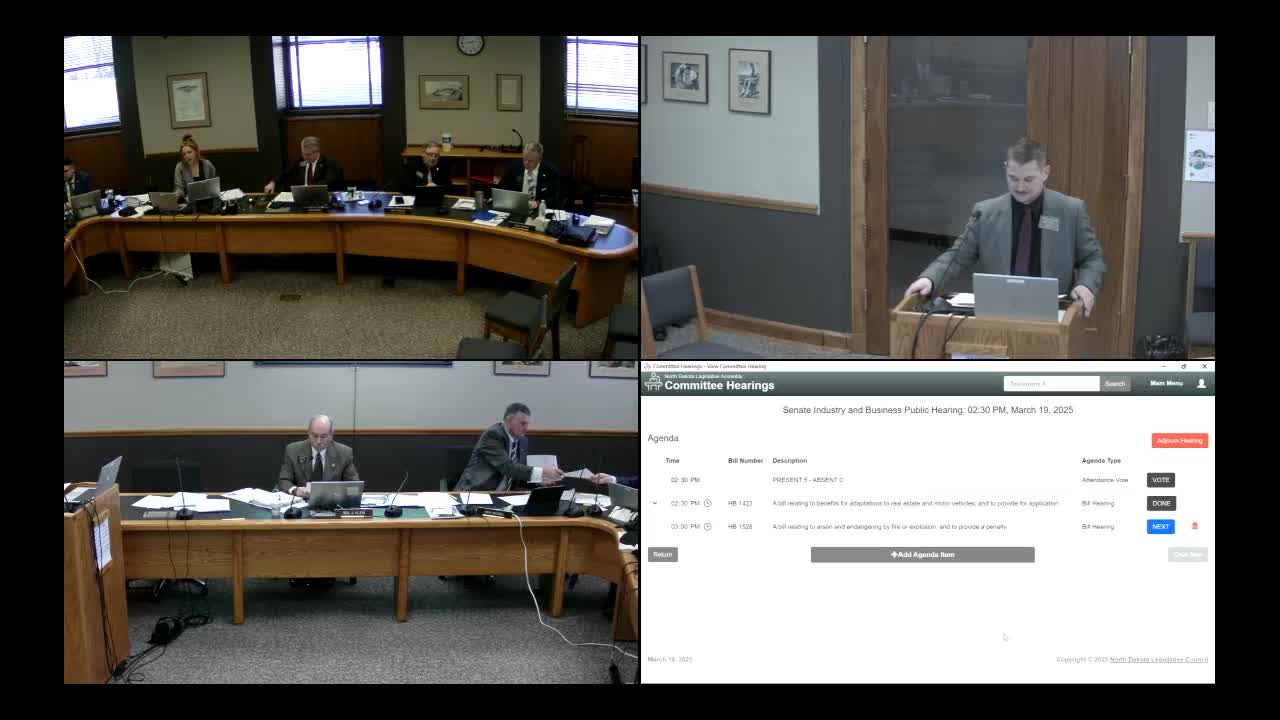
Senator Klein moved a due-pass recommendation and Senator Kessel seconded. The committee recorded a 4-0 vote in favor with one member absent and closed the hearing. No opposition testimony was presented during the hearing.
Votes at a glance: House Bill 1528 — Motion: due pass; mover: Senator Klein; second: Senator Kessel; committee vote: 4 yes, 0 no, 1 absent; outcome: due pass.