Get Full Government Meeting Transcripts, Videos, & Alerts Forever!
Get email alerts on the Wildlife Funding Tax topic
No spam. Unsubscribe anytime.
LRO outlines small personal-income tax for wildlife funding; committee hears mixed reactions
Summary
Representative Ken Helm introduced a proposal (House Bill 3856) to add a small personal-income tax dedicated to the state wildlife fund; the Legislative Revenue Office summarized the mechanism and revenue estimates and the Oregon Hunters Association asked the committee to pass the bill to Revenue for further review.
Representative Ken Helm introduced House Bill 3856 in the House Agriculture, Land Use, Natural Resources, and Water Committee on March 19, proposing a small new personal income tax to provide dedicated funding to the State Wildlife Fund.
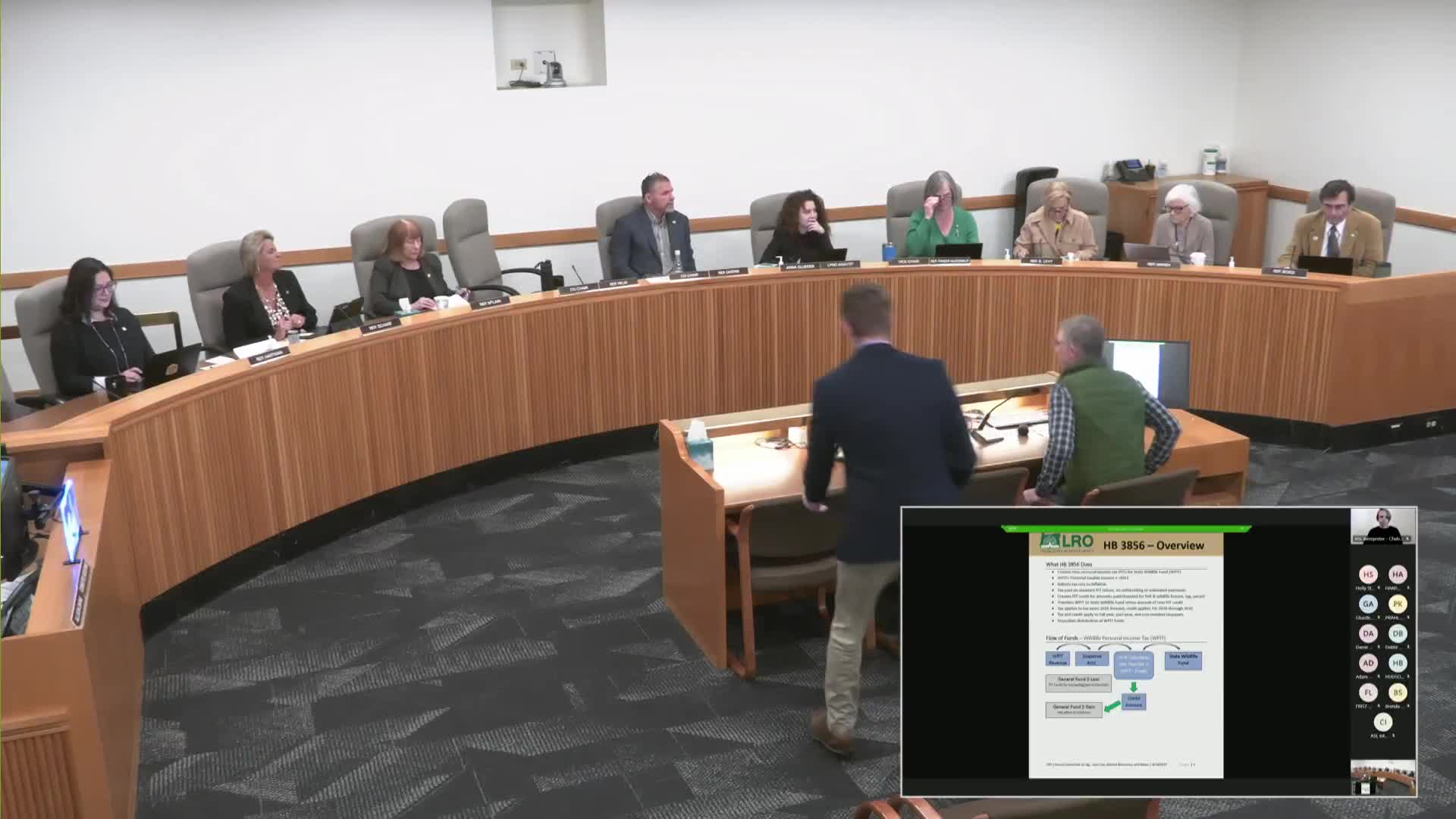
Representative Helm described a long-standing funding shortfall for the Oregon Department of Fish and Wildlife and said the bill would create a new personal income tax—labeled in Legislative Revenue Office materials as the wildlife personal income tax—set at a rate of 0.13 percent (0.0013) and indexed to inflation. Kyle Easton of the Legislative Revenue Office provided a technical overview: the tax would be filed as part of Oregon's existing personal income tax return, would not require withholding or estimated payments, and includes a credit mechanism to offset the tax by the cost of certain licenses, tags and donations. Easton said an initial revenue range would be on the order of $200 million to $300 million before credits and that indexing the rate to inflation would raise more revenue over time than a static rate.
Amy Patrick of the Oregon Hunters Association said her group was officially neutral on the bill and on a companion transient lodging tax proposal, requesting that both measures be advanced to the House Revenue Committee to allow more time for analysis and stakeholder discussion. Committee members asked for additional detail on the projected net revenue after credits and the distribution of funds; the LRO noted further coordination with fiscal staff would be needed to identify net revenue available after credits for licenses and fees. The committee closed the public hearing on the bill; no committee vote is recorded in the transcript excerpt.
Practical effect: if adopted, the measure would create a small, dedicated personal-income tax to fund the state wildlife fund, with a credit to offset the tax for certain purchased licenses; revenue estimates and the net fiscal impact depend on the value of credits claimed.