Get Full Government Meeting Transcripts, Videos, & Alerts Forever!
Get email alerts on the Code Enforcement topic
No spam. Unsubscribe anytime.
Bethlehem committee hears administration review of code enforcement; residents press for stricter short‑term rental enforcement
Summary
City staff told the Community Development Committee that most code enforcement is complaint driven but that the city runs a proactive rental inspection program; residents urged enforcement of short‑term rentals after a Commonwealth Court ruling on 251 East Church Street.
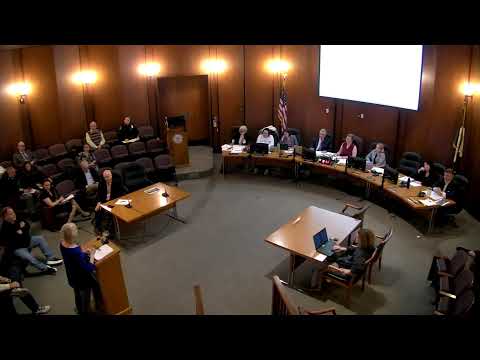
Chairperson Hillary Kwiatek convened the Community Development Committee to review potential amendments to a set of code‑enforcement ordinances and to hear administration and public comments on enforcement practices.
The administration told the committee that Bethlehem enforces most quality‑of‑life rules through a mix of proactive inspections for rental housing and mainly complaint‑driven enforcement for other topics such as trash, sidewalks and street trees. "We are proactively in every rental unit at least once every 3 years, and we're in student rentals every year," Laura Collins, city staff, said, describing the city's residential rental inspection cycle and its focus on minimum habitability standards from the 2018 International Property Maintenance Code.
The nut graf: the presentation illustrated how several city bureaus share enforcement responsibilities across a dozen ordinances and how limitations on staffing, legal procedure and property ownership sometimes slow immediate remedies. After the presentation, multiple neighborhood residents and historic‑district advocates urged the city to enforce short‑term lodging rules more aggressively, citing noise, party activity and the loss of long‑term housing.
City officials gave specific enforcement metrics and procedures. Mike Simonson, a housing inspections official, said the proactive rental program inspects properties on a three‑year rotation (student rentals are inspected annually) and reported that the bureau completes roughly 9,500 inspections a year (including rechecks), which staff estimated corresponds to inspections of about 6,000 distinct properties. He described the inspection standard as the "2018 International Property Maintenance Code," covering essentials such as heat, running water, vents and smoke detectors.
Sarah Satullo, deputy director of community development, said the inspection workflow moved from paper to tablets and a custom Esri survey so inspectors and administrators can track overdue violations and send inspection reports, including cited code sections and photographs, quickly to property owners and requesters.
On trash enforcement, Mike Al Foster, director of recycling, described a largely complaint‑driven series of steps: an initial site visit and a 10‑day correction period, a second violation letter with a seven‑day period, a courtesy call and, if unresolved, referral to the magistrate. He said the bureau received about 715 trash complaints in the last year and that most complaints are resolved before citation; he reported about six properties currently at the magistrate stage. "When most individuals receive that letter... they will clean it up within that 10‑day period," Al Foster said.
Mike Alcorn, director of public works, described sidewalk and street‑tree enforcement. He said replacing sidewalks can cost "at least in the thousands of dollars, 5 thousand to anywhere $15,000" depending on linear feet, and that the city will repair sidewalks and place a lien on the property if owners do not respond. Snow and ice complaints are handled by complaint, with a 24‑hour clearance expectation after an event.
Committee members asked clarifying questions about timelines and about abandoned properties; staff said banks that hold foreclosed properties must register them under the abandoned property ordinance but noted that lien totals and asking prices can deter buyers and slow remediation. City staff described coordination with community groups and new tenant‑advocacy funding to assist renters displaced by condemnations.
Public comment focused heavily on short‑term lodging. Kelly Bridal, hotel director at Historic Hotel Bethlehem, and Frank Boyer, a resident, cited a Commonwealth Court decision upholding enforcement action related to 251 East Church Street and asked the city to use zoning and code tools to remove illegal short‑term rentals from RT residential districts. "I am respectfully asking that we begin to issue the violations and notices to impose the fines," Bridal said, noting listings she found on VRBO in multiple neighborhoods. Boyer added that weekend and evening enforcement is needed because many rental problems occur Friday–Sunday.
Several neighborhood speakers, including Cheryl Dugan of 253 East Church Street and Frank Feliciato, vice president of the Bethlehem Historic District Association, described noise, property changes made without permits, and difficulty reaching out‑of‑state owners. "Not enforcing this zoning code is likely to have detrimental short and long term effects on our unique neighborhood community," Feliciato told the committee.
Administration members told the committee that the short‑term lodging enforcement piece is currently handled by zoning and that they would follow up with the zoning officer on counts of licensed versus unlicensed short‑term rentals. Chairperson Kwiatek closed by encouraging continued staff reports and said the meeting was intended as a fact‑finding session, not a forum for immediate ordinance amendments.
The meeting ended without a formal vote; committee members and staff said they would continue work on policy options and follow up with written responses and additional meetings.