Get Full Government Meeting Transcripts, Videos, & Alerts Forever!
Get email alerts on the Education.higher Education Records topic
No spam. Unsubscribe anytime.
Bill would make admissions applications exempt from open‑records requests and allow applicants to request destruction
Summary
House Bill 15‑42 would exempt records related to applications for admission to State Board of Higher Education institutions from public disclosure and permit applicants or guardians to request destruction of those records.
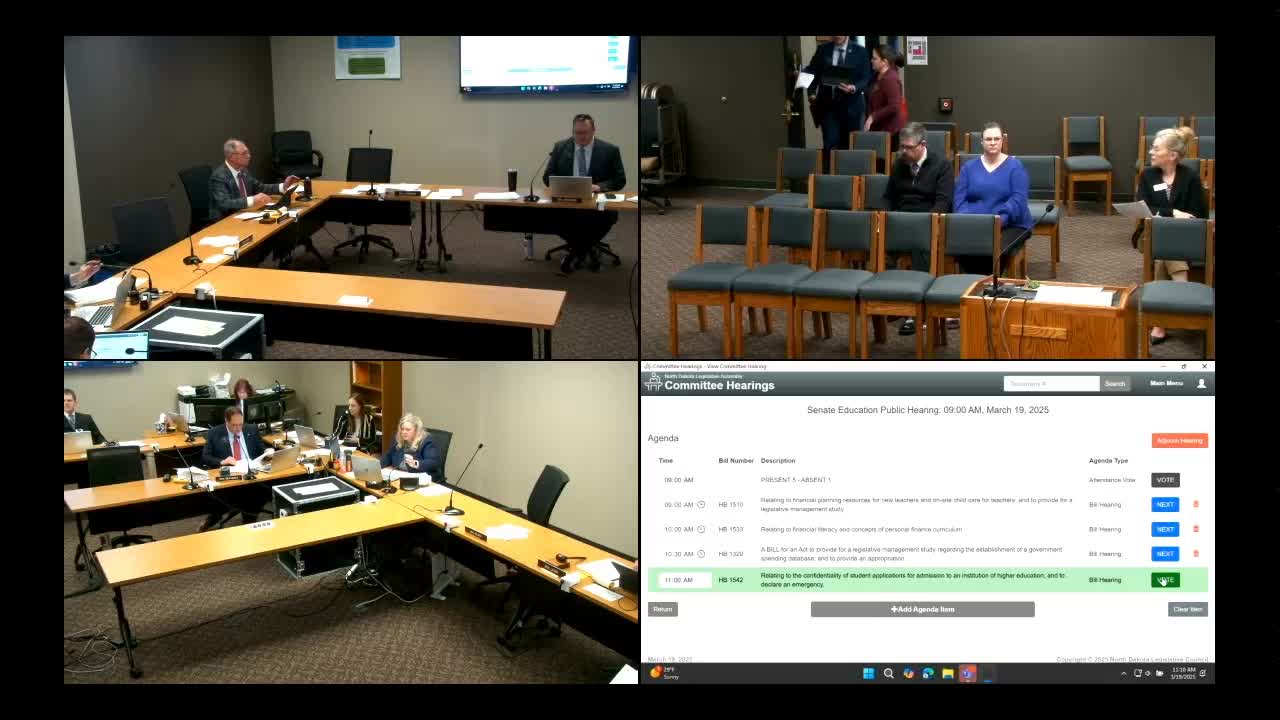
Representative Jared Hendricks introduced House Bill 15‑42 to the Senate Education Committee, proposing to exempt records related to an individual’s application for admission to institutions under the State Board of Higher Education from public‑records disclosure and to allow applicants (or a parent/guardian) to request destruction of those application records.
Hendricks said the change is designed to close a gap: federal law (FERPA) protects enrolled students’ education records, but application materials for people who never matriculate are not uniformly protected under state open‑records law. Hendricks described a case in which an applicant’s communications and application materials were available through an open‑records request and said applicants should have an option to protect sensitive personal details such as accounts of assault, victimization, or other private matters that applicants included in personal statements.
The bill’s core provisions as presented: make application records exempt from Chapter 44‑04‑18 public disclosure rules (subject to existing statutory retention windows), require destruction of an application record if the applicant or a parent/guardian requests it, and prohibit officials from accessing or redisclosing exempt application records unless needed to perform their official duties.
Lisa Johnson, vice chancellor for academic and student affairs (testifying neutrally for the North Dakota University System), said NDUS and the institutions asked for clarifying amendments. NDUS suggested changing “confidential” wording to ‘‘exempt’’ to align with state records language, and recommended a clear temporal cutoff wording (for example, clarifying whether protections apply prior to acceptance or matriculation) to avoid conflict with existing retention requirements. Johnson explained campuses commonly retain records for the current fiscal year plus one year if the applicant never enrolls; if a student enrolls, application materials typically roll into longer FERPA‑protected student records for the duration of enrollment plus additional retention years.
Johnson said campuses rarely receive blanket commercial requests for applicant lists and that marketing requests are more often targeted at enrolled student directory information; she also noted students can suppress directory information once admitted. NDUS did not oppose the concept of greater applicant privacy but asked for language that avoids conflict with existing retention statutes and with FERPA protections that apply once students are admitted.
Committee members asked about technical feasibility and digital backups. Hendricks acknowledged data deletion can be complex but said a statutory right to request destruction would push institutions to create consistent retention and destruction policies and to protect applicants’ privacy where appropriate. The committee did not record a vote; the sponsor and NDUS said they would continue to work on precise drafting to reconcile retention requirements and FERPA.
Clarifying details: testimony cited an existing one‑year retention requirement for certain communications; NDUS advised that non‑enrolled applicant files are often retained for a fiscal year plus one and that enrolled students’ records follow FERPA retention practices. The bill sponsor included a working amendment to preserve the one‑year retention carve‑out and to use ‘‘exempt’’ language; NDUS offered related drafting clarifications and said campuses would welcome clear statutory instructions to avoid conflicting duties.