Get Full Government Meeting Transcripts, Videos, & Alerts Forever!
Get email alerts on the Diversion And Deflection topic
No spam. Unsubscribe anytime.
Senate hearing spotlights House Bill 1425 to expand diversion, deflection and pretrial services
Summary
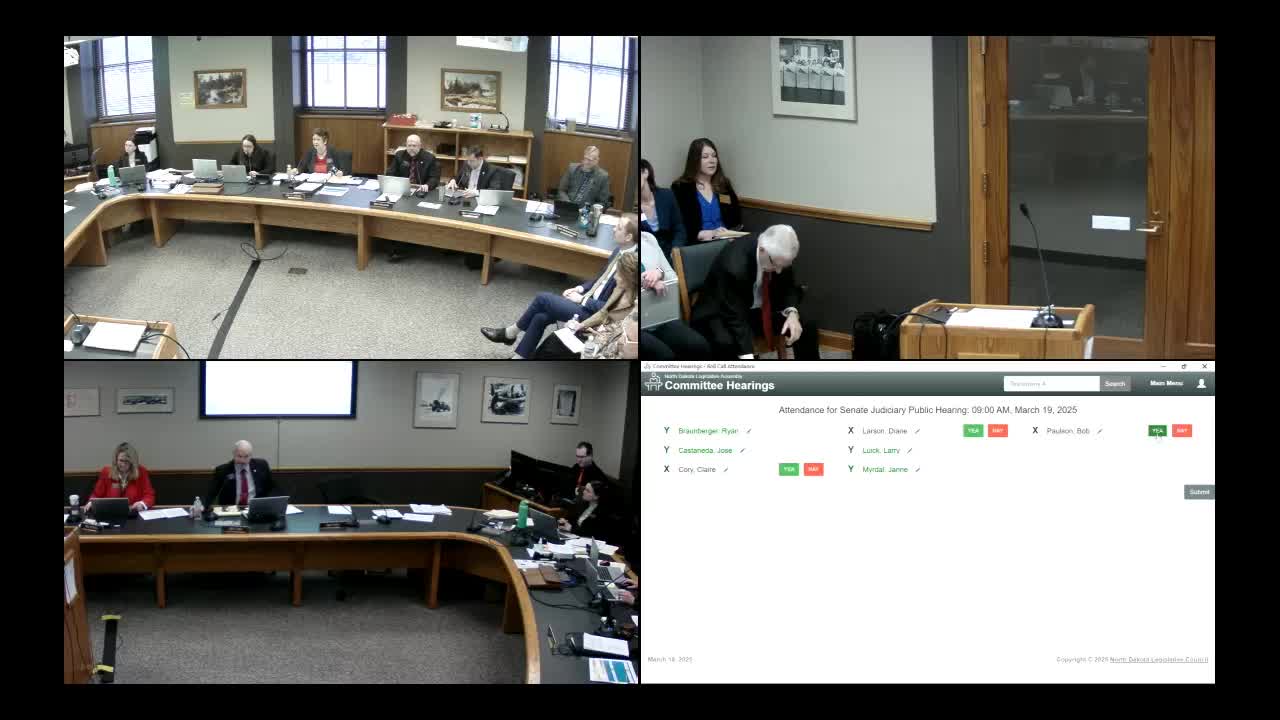
The Senate Judiciary Committee opened a hearing on House Bill 1425, a package of statutory changes to expand prosecution‑led diversion, authorize local deflection processes for first responders and create a three‑county pilot for supervision of pre‑sentence diversion, supporters said.
The Senate Judiciary Committee opened a hearing on House Bill 1425, a package of statutory changes to expand prosecution‑led diversion, authorize local deflection processes for first responders and create a three‑county pilot for supervision of pre‑sentence diversion, supporters said.
Lieutenant Governor Michelle Strinden, appearing for the Armstrong administration, told the panel, “For the record, my name is Michelle Strinden, Lieutenant Governor of the State of North Dakota. I'm here on behalf of the Armstrong Administration to speak in support of House Bill 14 25.” She said the bills grew from an interim reentry study and aim to “interrupt misconduct early and intervene with treatment resources in cases where addiction and mental illness are the root cause.”
Representative Lawrence Clamine, sponsor for the House, told the committee “House bill 14 25 targets the front end of reentry,” and summarized three major components: (1) clarifying and codifying prosecution‑led diversion authority, (2) authorizing local deflection processes that let law enforcement and first responders direct people to treatment and services rather than arrest, and (3) funding a pilot and a study of pretrial services. He said section 1 would “codif[y] court rule 32.2 of the North Dakota Rules of Criminal Procedure” to authorize county prosecutors to offer diversion and require written local guidelines; sections 3 and 4 would permit the Department of Corrections and Rehabilitation (DOCR) to supervise diversion participants and set up a three‑county supervision pilot.
The bill request includes appropriations described in testimony: $1,000,000 to DOCR for one FTE to staff and oversee the pilot (with $270,000 of that allocation noted for an initial component), roughly $679,000 to contract with local third‑party providers to monitor participants and connect them to behavioral health and treatment services, an estimated $50,000 for software, and $750,000 to the Department of Health and Human Services (DHHS) for services in the pilot; section 7 would appropriate $55,000 to contract a third party to study pretrial services.
Support witnesses described operational and public‑safety rationales. Robin Schmalenberger, reentry program manager for DOCR, said the pilot will “allow that to happen” in counties that opt in, and that DOCR would help develop operational guidelines, collect data and report outcomes. Jonathan Holt, the state’s Commissioner of Recovery and Reentry, emphasized that first responders often are “the first wave of care” and that defining a deflection process could help prevent people from “slipping through the cracks” after an initial contact.
Speakers representing emergency medical services underscored practical and liability concerns. Todd Porter, who owns ambulance services in Bismarck and Mandan, said the proposals would ask EMS to do work outside ordinary practice — for example transporting a patient to a treatment or counseling site rather than an emergency department — and explained the clinical risk tied to those choices. “We don't normally leave patients in the care of someone else,” Porter said, adding that specific program definitions and safe operational protocols are necessary for EMS to participate.
Not all testimony supported the bill’s liability language. Jackie Hall, executive director of the North Dakota Association for Justice, said she supports diversion but opposed a blanket civil‑liability exemption in the bill and in Representative Porter’s amendment that would expand the list of first responders covered. “They do not require immunity for these programs to be successful,” Hall said, arguing immunity could remove accountability and was not recommended in the reentry study report. Several senators pressed sponsors about who would pick the three pilot counties, which offenses would be eligible, and whether local prosecutors and counties would bear new workloads and costs.
Cass County State's Attorney Kim Hegvick testified by video that prosecutors already have discretion to use diversion but lack funding and a mechanism to monitor participants; “The problem is we don't have funding or a mechanism to hold people accountable,” she said, urging that funding for monitoring is the primary barrier to broader use of diversion.
Committee members questioned how eligibility and safeguards will be defined. Sponsors repeatedly said eligibility and minimum standards would be developed in local guidelines and DOCR‑facilitated pilot plans, and that the pilot is intended to produce data and best practices to guide wider implementation. The proposed statute also includes an exemption from civil liability for participating law enforcement, first responders and behavioral‑health providers; proponents framed that language as an encouragement for participation, while opponents called for removing or narrowing it.
The committee did not take a vote on the bill during the hearing. Testimony was a mix of state agency and local provider support, operational questions from EMS and defense/civil‑liability concerns from advocacy groups and a trial‑bar organization.
The committee moved next to House Bill 1417; no committee action or vote on HB 1425 was recorded during the hearing.