Get Full Government Meeting Transcripts, Videos, & Alerts Forever!
Get email alerts on the Education.financial Literacy topic
No spam. Unsubscribe anytime.
Committee debates requiring financial‑literacy instruction; sponsors propose half‑unit or standalone course
Summary
House Bill 15‑33 would require financial‑literacy concepts in high school. The sponsor proposes an amendment to make a half‑unit (or an approved standalone course) mandatory; supporters cited research favoring standalone courses while some districts warned an added graduation requirement could be an unfunded mandate.
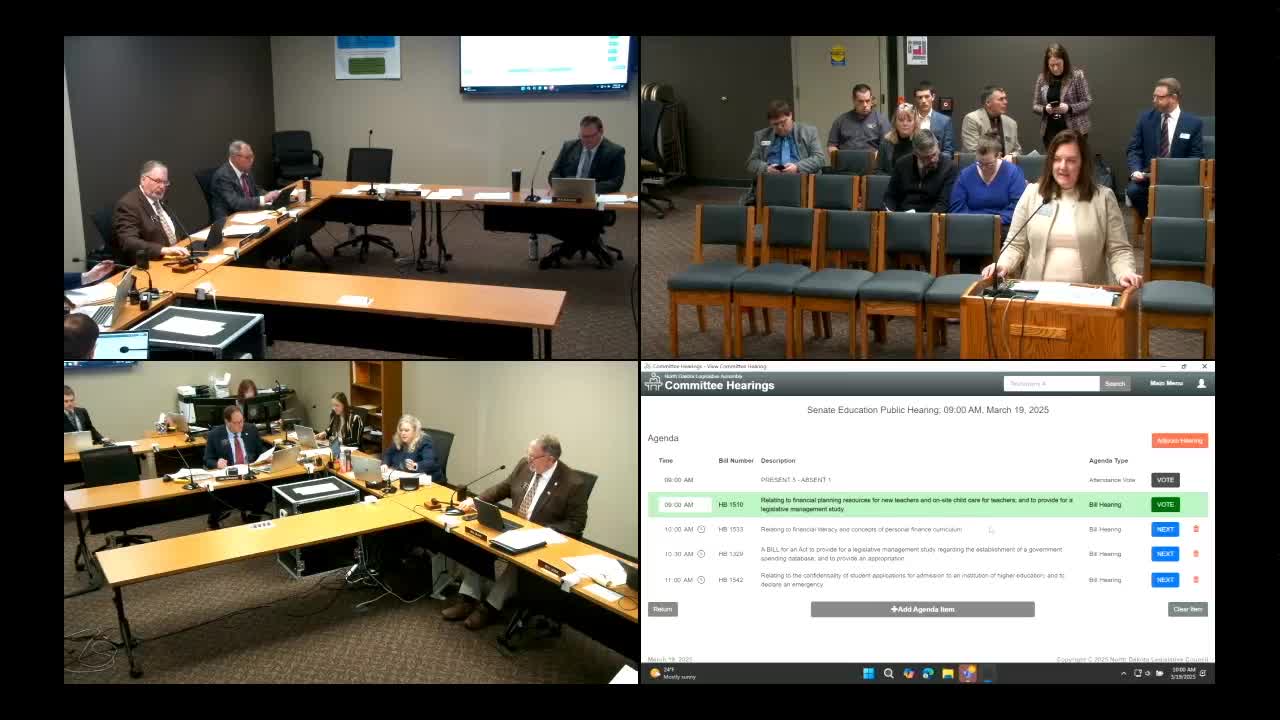
The Senate Education Committee heard House Bill 15‑33, which would require North Dakota high schools to teach financial‑literacy concepts and would direct the Department of Public Instruction (DPI) to use updated K‑12 financial literacy content standards. Representative Brandy Pyle (District 22) presented an amendment to require each student to complete one half‑unit of financial literacy or, with DPI approval, an equivalent course.
Pyle said financial literacy belongs in a modern ‘‘portrait of a graduate’’ and described the proposal as a way to ensure students leave high school able to manage college costs, credit, and everyday finance. She asked the committee to adopt the amendment that would make the course a graduation requirement unless embedded as an approved equivalent.
Supporters included State Treasurer Thomas Beadle, who co‑chairs the state Financial Literacy Commission, and Lance Hill of Bank of North Dakota. Beadle and Hill described state and national efforts to expand personal finance instruction and pointed to resources available to schools, including the free SmartWithMyMoney.nd.gov modules launched by Bank of North Dakota. Treasurer Beadle cited national research presented to state treasurers showing stronger student outcomes when personal finance is taught as a standalone semester course rather than embedded across other subjects.
A student from Legacy High School, Kale Schultz, testified in favor and described a semester‑long economics course at his school that includes a large financial‑literacy project. “This class really helped me decide where I wanted to go, how I'm going to pay for it,” Schultz said, describing budgeting, loan choices and a final project that modeled post‑graduation expenses.
National non‑profit Next Gen Personal Finance (NGPF) submitted online testimony urging a standalone personal‑finance semester; NGPF cited research that embedded instruction is taught less than half the time and argued a dedicated course leads to better outcomes. NGPF said a national study estimates a large lifetime economic benefit per student when states guarantee a dedicated personal‑finance course.
DPI representatives described a concurrent process: a team of North Dakota educators has drafted K‑12 financial‑literacy content standards and will publish a second draft for public comment; DPI staff said the new standards extend into elementary and middle school to reflect that students make financial decisions before high school. DPI’s assistant director noted the standards are being developed in collaboration with Bank of North Dakota, the insurance commissioner and other stakeholders so districts can select materials and align curriculum.
Concerns from school representatives focused on implementation and funding. The North Dakota School Boards Association objected to converting the bill into an unfunded graduation requirement, saying rural and small districts may struggle to staff a new standalone course and warning that mandating a half‑unit could displace other electives. Several witnesses said many districts already embed financial concepts in economics, problems of democracy (POD) or approved CTE courses; DPI noted allowable substitutions are tracked in alignment charts but the department does not currently collect statewide counts of who uses which course to satisfy the requirement.
No committee vote was recorded in the transcript. Sponsors and supporters asked the committee to consider the proposed amendment and noted the DPI standards development process and public comment schedule would continue in parallel with any statutory decision.
Clarifying details recorded in testimony: DPI’s K‑12 financial literacy standards second draft was scheduled for public comment and expected to be provided to the state superintendent for review in May 2025; Bank of North Dakota and the treasurer’s office offer a free online SmartWithMyMoney.nd.gov learning platform; national organizations and research proponents recommended a standalone semester deliver greater efficacy than embedded instruction. Funding for a new statewide mandated half‑unit was not specified in the bill testimony; opponents described the amendment as an unfunded mandate for some districts.