Get Full Government Meeting Transcripts, Videos, & Alerts Forever!
Get email alerts on the Education.teacher Retention topic
No spam. Unsubscribe anytime.
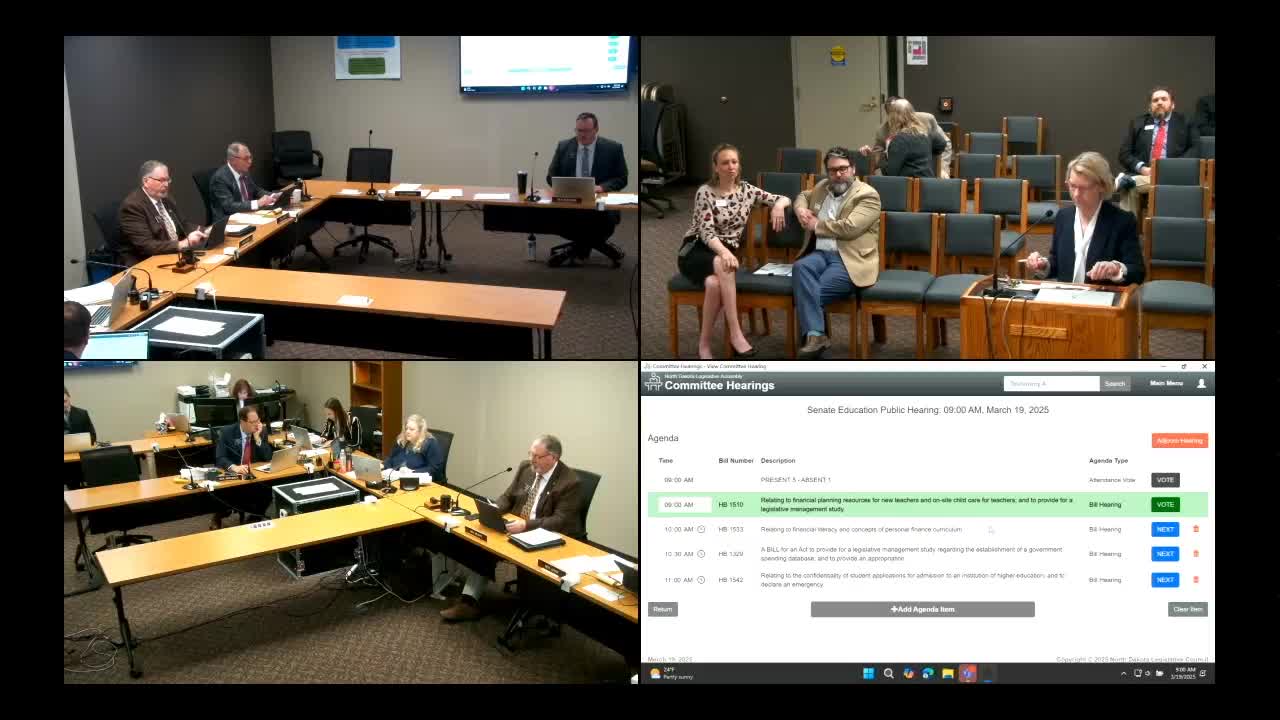
Senate Education Committee hears bill to expand teacher supports, childcare and mentorship funding
Summary
Senate Education Committee considered amended House Bill 15‑10 to provide financial planning resources for new teachers, encourage on‑site childcare at schools, and study interstate teacher licensure mobility; sponsors said some funding is proposed in the governor’s budget while the bill itself mainly adds policy and study language.
The North Dakota Senate Education Committee on an amended House Bill 15‑10 heard testimony proposing statewide financial‑planning resources for teachers, encouragement for school‑based child care, and a legislative study of interstate teacher licensure mobility to support recruitment and retention.
Representative Cynthia Schreiberbeck, District 25, introduced the engrossed and amended version of House Bill 15‑10 and said the measure grew out of the teacher retention and recruitment task force created by Executive Order 202038 and that the bill reflects several of that task force’s recommendations. “The proposed study in section 4 was not a recommendation of the task force,” Schreiberbeck said, describing why a study of interstate teacher mobility compact options was added.
The bill is divided into sections. Maria Nesit, chief of staff to Lieutenant Governor Strinden and senior advisor to Governor Armstrong, explained that section 1 would produce financial‑planning and benefits‑education resources (handouts, webinars, in‑person trainings) to help new teachers understand total compensation and district investments. Section 2 would clarify state support and partnership for school‑based child care and emphasize health, safety and early‑childhood quality if districts elect to provide space. Section 3 would support a study to identify opportunities to maximize dollars related to health care and long‑term earnings for teachers. Section 4, as presented to the Senate, would require a legislative management study on interstate teacher licensure mobility if selected by legislative management and would seek Workforce Development Council input.
Nesit and others emphasized the bill is intended to support retention rather than mandate programs. “This section demonstrates a commitment to be a partner in supporting school districts to provide on‑site child care,” Nesit said, adding that school districts already provide a variety of early‑childhood services but face state and federal regulatory ‘‘red tape’’ that can make implementation difficult.
Committee members pressed for funding and scope details. Nesit and Luke Schaefer, CEO of Central Regional Education Association and chair of the task force, said two key investments are included in separate budget legislation: a $2,000,000 item in the governor’s budget for a statewide teacher retention program administered by the Department of Public Instruction (DPI), and a proposed $2,000,000 appropriation above DBI’s base allocation (noted in testimony as a pass‑through to support ND RISE, the state mentorship program). Chad Roberts, deputy executive director of the Retirement and Investment Office, testified that retirement education enhancements were included in related budget language (House bill 10/22), noting the House requested $35,000 and the Senate amended it to $25,000; Roberts said the office can provide retirement‑planning information to DPI without additional funding.
On child care, committee members asked whether the bill would require districts to operate child care or provide new state funding. Nesit and DPI staff said the bill is optional for districts and would encourage partnership and problem‑solving; funding is expected to be braided from existing early childhood funding streams, local district investment for startup costs, and parent contributions or employer matches. DPI testimony noted there is no statutory prohibition on schools hosting child care but that licensing and facility rules involve multiple agencies (DPI, Department of Human Services) and can be complex in practice.
Task force chair Luke Schaefer emphasized the non‑financial reasons teachers leave: work environment, student behavior and school culture. He said mentorship programs such as ND RISE show measurable retention results and that improved communication about total compensation (including retirement benefits administered by TFFR) can help recruitment and retention.
No formal committee vote or final action on the bill was recorded during the hearing. Sponsors asked the committee to give a favorable recommendation to the amended version and to support the budgeted investments included in the governor’s budget bills.
Clarifying details from testimony include a $2,000,000 proposed appropriation for a statewide teacher‑retention program in DPI’s budget and a proposed $2,000,000 pass‑through to ND RISE above a base DBI allocation of $2,500,000; retirement‑education enhancement funding was described in related budget bill language at $25,000–$35,000 depending on chamber changes. The bill as presented to the committee did not contain new, dedicated statewide funding for on‑site child care; testimony explained local districts would decide whether to prioritize slots for teachers and how to braid state, local and parent/employer funding.
Representative Schreiberbeck and administration witnesses said the bill is intended to move recommendations from the task force toward implementable steps, not to solve the shortage in a single year.
The committee closed testimony on House Bill 15‑10 after proponents and affiliated agency representatives took questions; no formal committee action on the bill was recorded in the transcript.