Get Full Government Meeting Transcripts, Videos, & Alerts Forever!
Get email alerts on the Social Services topic
No spam. Unsubscribe anytime.
Senate committee advances bill to expand SNAP employment-and-training requirements amid debate over exemptions and capacity
Summary
The Senate Finance Committee voted to report Senate Bill 249 to the full Senate, which would expand SNAP employment-and-training requirements and extend the age range subject to mandatory participation to 18–59.
The Senate Finance Committee voted to report Senate Bill 249 to the full Senate with the recommendation that it pass after extensive questioning and outside testimony about program capacity and exemptions.
Committee Counsel described the bill as modifying SNAP (Supplemental Nutrition Assistance Program) employment-and-training (E&T) requirements so that all able-bodied adults without dependents would be subject to E&T unless they met listed exemptions. Counsel said the bill would substitute SNAP E&T participation for certain work requirements currently tied to Temporary Assistance for Needy Families, expand the age bracket for mandatory E&T from 18–54 to 18–59 and require the Department of Human Services (DHS) to provide each registrant a comprehensive list of available E&T services. Counsel also described reporting requirements: DHS must submit annual reports to the Legislative Oversight Commission on Health and Human Resources Accountability (LACRA) for three years beginning October 2025 (transcript stated a three-year series beginning October 2025 and ending October 2028); the reports would include specified data on referrals, participant outcomes and the number removed from SNAP due to increased household income.
Testimony: Caitlin Cook, director of advocacy and public policy at Mountaineer Food Bank, opposed a mandatory E&T expansion without investments to support programming and said mandatory programs in other states had strained charitable food networks. She testified that transportation and internet access barriers in parts of the state make mandatory participation difficult and cited examples from other states where mandatory programs were later scaled back.
Jeremiah Samples, representing the Foundation for Government Accountability (FGA), described SNAP E&T as supports facilitating entrance into the workforce — including education and training and transportation when provided — and said that the bill contains language allowing DHS to exempt individuals if local resources are unavailable. He also explained that SNAP benefits are federally funded transfers to an EBT card and that the state administers eligibility and related program activity. Samples testified that reported counts of people affected varied in prior briefings (different figures cited included roughly 2,269, about 8,000 and broader counts up to 50,000); counsel and witnesses agreed that the department's estimates have varied and that final counts remain uncertain.
Committee members pressed counsel and witnesses on exemptions in the bill: listed exemptions include caring for a child under age 6, caring for an incapacitated person, enrolled students, participants in drug- or alcohol-treatment programs, those employed at least 30 hours per week, people 60 and older, disabled individuals, and others described in the bill. Counsel explained the bill permits DHS to develop additional discretionary exemptions and provides that after enumerated exemptions are applied, DHS may exempt up to 20% of remaining registrants at its discretion. Counsel further explained that if DHS determines it lacks resources to provide required supports in a county or statewide, DHS must report to the legislature within 14 days and, in that circumstance, mandatory requirements would not apply to those registrants.
Committee members also questioned potential federal compliance risks; one senator cited an excerpt of the Code of Federal Regulations saying a lack of state funding for reimbursement could expose the state to a federal error or clawback, and counsel said he was unaware of a regulation that would categorically preclude state exemptions and noted a potential risk of federal clawback if state action conflicted with federal rules.
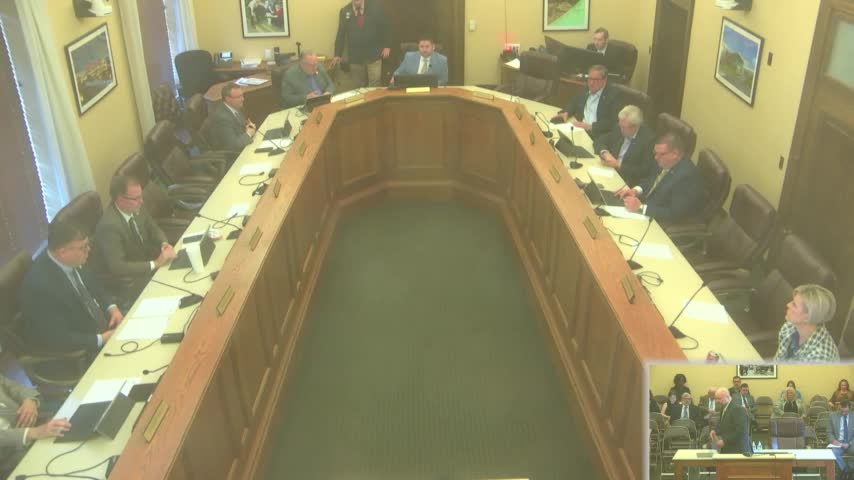
After extended discussion and questions of witnesses and counsel about counts, exemptions, transportation and administration, the vice chairman moved Senate Bill 249 be reported to the full Senate with the recommendation it pass. The chair called a voice vote and declared the ayes had it. Senate Bill 249 will be reported to the full Senate.
Votes at a glance: Senate Bill 249 — motion to report to full Senate with recommendation that it do pass; voice vote; chair declared motion adopted (counts not specified).