Get Full Government Meeting Transcripts, Videos, & Alerts Forever!
Get email alerts on the Hb 5024 Business Oregon Budget topic
No spam. Unsubscribe anytime.
Stakeholders urge lawmakers to fund Business Oregon programs during HB 5024 public hearing
Summary
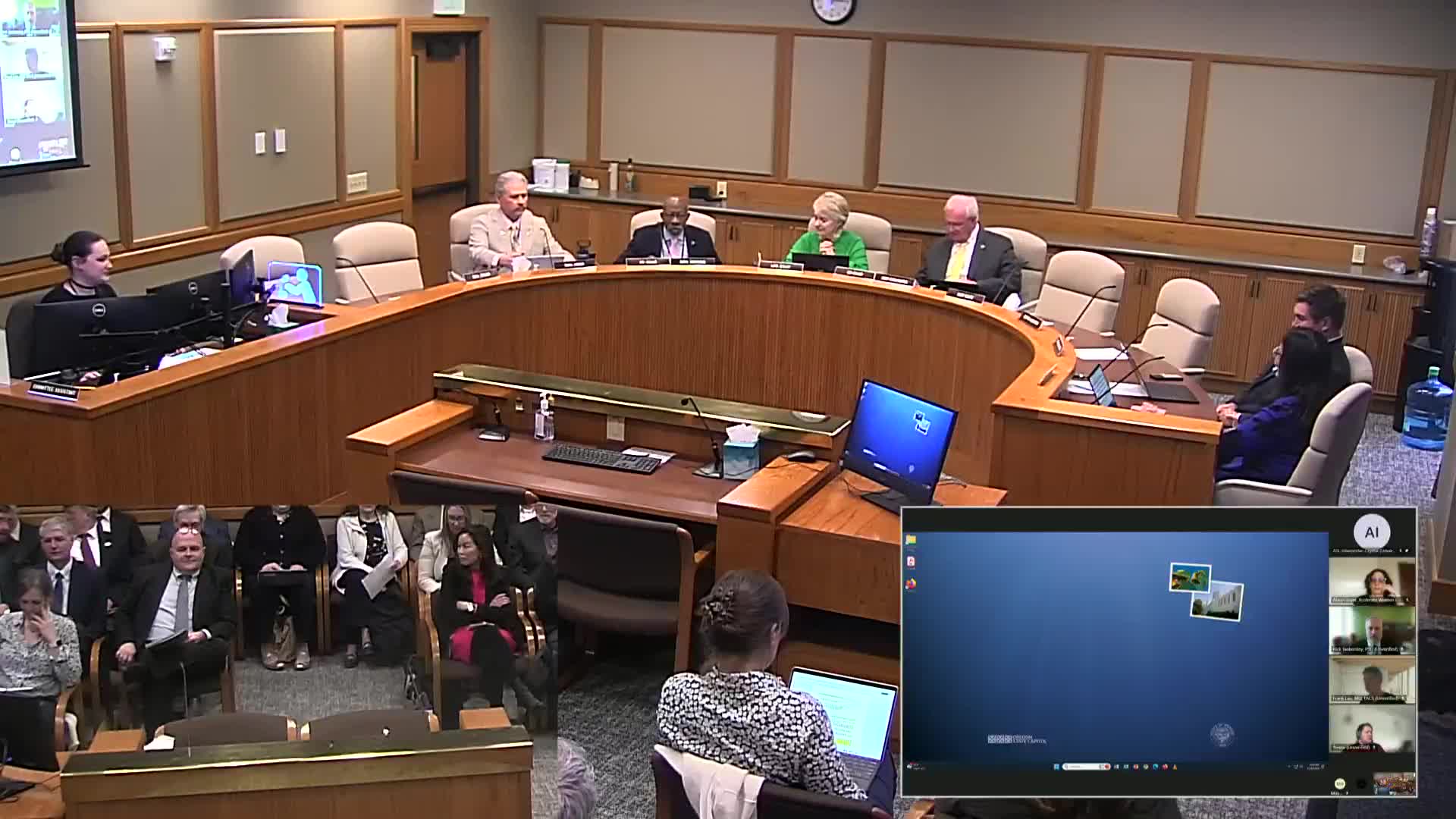
Co-chairs Senator Woods and Representative Gomberg opened a public hearing March 4 on House Bill 5024, hearing roughly 36 witnesses who asked lawmakers to preserve or increase funding for Business Oregon programs that support rural economic development, workforce pipelines, manufacturing, bioscience startups, port infrastructure and child care.
Co-chairs Senator Woods and Representative Gomberg opened a public hearing March 4 on House Bill 5024, hearing roughly 36 witnesses who asked lawmakers to preserve or increase funding for Business Oregon programs that support rural economic development, workforce pipelines, manufacturing, bioscience startups, port infrastructure and child care.
The testimony focused on several specific programs and policy option packages within HB 5024. Witnesses representing economic development districts, ports, incubators, universities, trade groups and local governments described how Business Oregon grants and technical assistance operate “boots on the ground” to help businesses access capital, rebuild after disasters, commercialize university research and create local jobs.
Jessica Mehta, executive director of Mid Columbia Economic Development District, said the agency and her region “have benefited from many of [Business Oregon’s] funding programs, including the Rural Opportunity Initiative and Regional Innovation Hub,” and added, “I strongly support the passage of House Bill 5024 to continue that work in my region.”
Brandy Ferguson, executive director of the McKenzie Community Land Trust, described the Holiday Farm Fire recovery in the McKenzie River Valley and credited a Business Oregon ROI grant with allowing local leaders to focus on rebuilding businesses alongside housing. “There is no funding to rebuild a business like there is for a home,” Ferguson said, noting higher rebuild costs and the role of ROI grants in enabling community-led planning and decision-maker site tours.
Several witnesses detailed workforce and commercialization programs. Joseph Ueno, executive director of the Oregon UAS Accelerator in Pendleton, told the committee that cuts to grant funding would “threaten not just our momentum, but Oregon’s competitive edge.” Ian Ananese, founder of Xyng Drone Solutions, and other founders credited the accelerator and incubator supports with helping move products to market and create local jobs.
Speakers from the bioscience and university sectors urged support for the University Innovation Research Fund (UIRF). Rick Tankersley of Portland State and Gabby Cruz Thompson of Intel emphasized the fund’s role in leveraging federal research dollars; Cruz Thompson said Intel had committed in-kind support to a regional NSF-backed tech hub and asked the committee to back state matching dollars. Several university and company witnesses described past matches that unlocked federal grants and regional tech hub awards.
Local governments and economic development groups asked lawmakers to fund infrastructure-focused policy option packages in HB 5024. Mayor Lacey Beatty of Beaverton and Mayor Tim Rosner of Sherwood, speaking for the Metropolitan Mayors Consortium, urged support for the governor’s proposed housing infrastructure funds and additional funding for industrial-site readiness. Elizabeth Remley of the Oregon Business Council described a backlog of roughly $1 billion in work to make designated industrial sites shovel-ready and supported a revolving loan fund to provide upfront capital.
Infrastructure and port investments were highlighted by Kimberly Branham, Port of Portland chief trade and economic development officer, who identified line items included in requests: $15,160,000 for Lower Columbia navigation-channel maintenance and $20,200,000 for container service at Terminal 6. Branham said Terminal 6 supports more than 1,500 jobs and that losing container service would raise trucking costs for Oregon shippers by an estimated $19.2 million annually.
Child care and brownfields funding also drew testimony. Dana Hepper of the Children’s Institute reviewed results from the Child Care Infrastructure Fund created by House Bill 3005 (2023), saying the first $10 million awarded funded 64 providers across 29 counties and expanded roughly 2,592 slots (1,326 improved and 1,266 new, including 643 infant/toddler slots). Metro and other witnesses urged continued support for Business Oregon’s brownfield remediation programs and asked the subcommittee to retain $15 million in the governor’s request for brownfields grants and loans.
Manufacturing and small-business supports were represented by the Oregon Manufacturing Innovation Center, OMEP (Oregon Manufacturing Extension Partnership), the Oregon Metals Initiative and the Small Business Development Center network. Don Hendrickson of OMIC R&D, Mike Vanier of OMEP, JL Wilson for the Oregon Metals Initiative and Mark Gregory of the SBDC Network described measurable client outcomes, contract awards, partnerships with universities and federal leverage that they say justify continued funding.
Multiple witnesses from underrepresented-business technical assistance providers—Accelerate Women, community chamber coalitions and the Northwest Native Chamber—urged full funding of the TA program (the transcript and testimony referenced $4,800,000 as an amount directed to the TA program in the governor’s recommended budget) because the providers deliver culturally and geographically aligned services.
The subcommittee did not take a vote during the hearing. Staff noted that written testimony has been filed on OLIS under the bill number, and co-chairs announced two work sessions scheduled for the next day: one on a Business Oregon Brownfields revolving loan fund request and one on a Housing and Community Services report on expenditures and outcomes.
The hearing record contains numerous specific budget requests and program outcomes cited by witnesses; the committee will consider those requests in upcoming work sessions and deliberations.