Get Full Government Meeting Transcripts, Videos, & Alerts Forever!
Get email alerts on the Elections Administration topic
No spam. Unsubscribe anytime.
Wichita County elections administrator outlines registration gains, mail‑ballot costs and website upgrades
Summary
Elections Administrator Robin Pinkanon told the Wichita County Commissioners Court on March 18 that voter rolls changed after 2024, mail‑ballot processing is costly, and the elections office is expanding online results and ballot-image access while facing file‑size and redaction challenges.
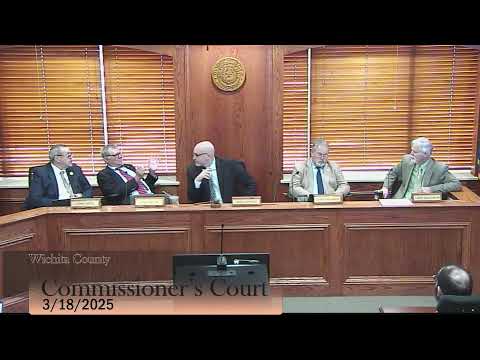
Robin Pinkanon, Wichita County elections administrator, told the commissioners on March 18 that the office processed a surge of voter-registration activity during the 2024 presidential cycle and is focusing on cleaning the voter roll, improving online access to results and ballot images, and recruiting poll workers.
"Maintaining an accurate voter registration file is the first step in ensuring an accurate election," Pinkanon said, arguing that registration work drives everything the office does. She told the court that total registered voters rose from roughly 77,600 in January 2024 to about 79,805 in November 2024, then fell to about 76,400 by January 2025 after a state mass cancellation of suspended registrations.
Why it matters: the office said returned mail and suspended status remain a major driver of inaccuracies in the roll and of extra work before every election. The county also pays material costs to support mail voting; Pinkanon briefed the court on per‑ballot kit, paper and postage expenses and on the staff time required to process incoming ballots.
Pinkanon gave commissioners a detailed breakdown of recent activity: the elections office processed more than 12,500 new or updated registration applications in 2024 (compared with about 9,000 in 2023), completed regular cancellations and a mass cancellation, and continues monthly death‑record and registration cleanup. She said lower turnout for local or runoff contests in a presidential year explains a high rate of mailed but unreturned ballots for those local contests.
On mail‑ballot costs, Pinkanon provided itemized estimates: "You're looking at roughly $2.20 for the actual kit,... about 25¢ a paper, and then to mail 1 is 97¢," she said, adding that those figures exclude labor, printing and processing time. She emphasized that every mailed packet also requires processing of an application and, in many cases, follow up when forms are incomplete.
Pinkanon described recent upgrades to the office warehouse and to the elections website. The office has reorganized mail‑ballot kits and storage, built stands to keep equipment off the floor, and posted cumulative election results, precinct results (with redactions where needed to preserve voter anonymity), polling‑place reports, reconciliation documents and cast‑vote records (CVRs). She said ballot images are being prepared for publication but that the large file sizes of redacted images have strained available web storage; she said county IT is reviewing options.
"We are putting the ballot images out there as well," Pinkanon said, and noted redaction is time‑consuming because images arrive from the voting system as PNG files that must be converted, redacted individually and then posted. She said the office is working with internal IT and an outside vendor, Crane West, on alternatives to reduce file size and make rapid posting feasible.
The administrator also reviewed near‑term election workloads and equipment needs: May municipal and school elections (including districts that cross into Archer and Clay counties), the potential November constitutional amendment and local contests, and ongoing preparation for 2026. She said the office currently has fewer controllers and scanners than would be optimal for a model with more localized precinct voting — "I only have 38 controllers, and I have 42 scanners," she said — and that equipment and poll‑worker recruitment remain priorities.
On staffing and training, Pinkanon said the county will resume in‑person volunteer deputy registrar training twice monthly (the county requires in‑person instruction rather than purely the state's online option) and is using the county calendar for RSVPs and poll‑worker signups. She also described plans to digitize historical voter‑registration records and improve street/house‑range consolidation in the registration database to reduce duplicate address entries.
Commissioners asked about polling‑place availability and legislative proposals that could affect elections administration — for example, proposals to require campus locations for large colleges or to change ballot retention and posting deadlines. Pinkanon said some pending proposals would require significant operational changes and urged continued attention to equipment, staff training and IT support for posting ballot images.
Pinkanon closed by asking for IT assistance to make ballot images publicly available while protecting voter anonymity and complying with legal guidance. The presentation drew no immediate action; commissioners thanked her for the briefing and discussed follow‑up needs.
The elections briefing is intended to inform upcoming budget, equipment and staffing decisions and to give the public more transparent access to election records and results.