Get Full Government Meeting Transcripts, Videos, & Alerts Forever!
Get email alerts on the Economic Development topic
No spam. Unsubscribe anytime.
Economic development subcommittee opens budget review, spotlights UI debt and small-business concerns
Summary
Co-chairs of the New York State Legislature's Economic Development Joint Conference Committee opened a budget review emphasizing the state's unemployment-insurance debt, support for semiconductors and biosciences, and small-business challenges including retail theft and regulatory burdens.
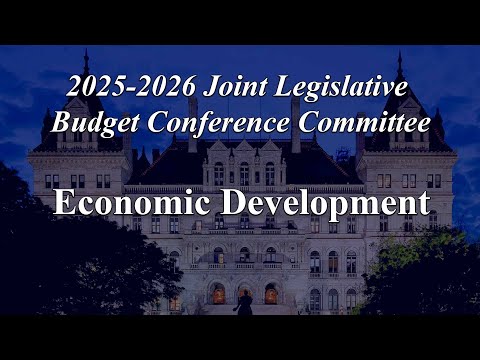
Sen. Sean Ryan, co-chair of the Economic Development Subcommittee, and Assemblymember Al Sturpi, the Assembly co-chair, opened the joint conference meeting and outlined priorities for the upcoming budget negotiations, including addressing the state’s unemployment-insurance debt and supporting business growth in semiconductors, unmanned aerial systems and biosciences.
“My hope is we'll all work together to achieve a number of wins for business this year in the budget,” Assemblymember Al Sturpi said, listing efforts to clarify pay-frequency law, address unemployment-insurance trust fund debt and remain “focused in economic development areas like semiconductor manufacturing, unmanned aerial systems, and biosciences.”
The meeting featured extended remarks from Sen. George Borrello, who framed the unemployment-insurance debt as an urgent fiscal burden on employers. “The unemployment insurance debt, which has been crushing for our businesses,” Borrello said, later urging the Legislature to “just pay it off” rather than use targeted grant programs. He described the remaining balance as “about 6 and a half billion dollars left.”
Other committee members emphasized both opportunity and risk in the draft budget. Sen. Michelle Hinchey highlighted agricultural provisions, saying the budget closes “some of the loopholes, including fixing the overtime tax credit that we passed for our dairy farmers,” and praised extensions to workforce-retention tax credits. Assemblymember Carrie Warner and Assemblymember Steve Otis cited investments aimed at attracting innovation employers, with Otis noting that New York’s educated workforce helps draw semiconductor and biotech firms.
Committee members from both parties raised small-business concerns. A newly seated senator representing South Brooklyn described steep local costs and retail theft affecting neighborhood merchants, and an Assemblymember from the minority conference provided anecdotal accounts of business owners who must operate alone or face repeated theft. “They can't even afford to turn on the heat or the air conditioning,” the minority assemblymember said, describing slim profit margins and storefront closures.
The co-chairs reviewed procedural rules for the subcommittee, including that co-chairs “shall determine all matters of parliamentary procedure” and that no alternate may vote unless designated to fill an excused vacancy. The Senate designated Sean O'Brien as recorder and the Assembly designated Deborah Jenkins as recorder. The co-chairs said the agencies slated for discussion include the Alcohol Beverage Control Board, Empire State Development, the Urban Development Corporation and the New York State Gaming Commission.
Several members noted priorities beyond a single budget cycle. Sen. James Sanders emphasized the human dimension of budget choices, saying, “At the end of everything, it's a question of people.” Sen. Borrello urged a broader change in Albany’s approach to business to prevent continued job and business loss from state competitiveness issues.
No formal votes or final actions were recorded at the opening session. The committee indicated it will continue negotiations and hearings over the next two weeks to resolve outstanding items and produce recommendations for the final budget.
The meeting included a mix of policy remarks, sector-focused proposals for economic development, and repeated appeals from members to address unemployment-insurance debt and small-business operating conditions; procedural rules and staff designees were also recorded.