Get Full Government Meeting Transcripts, Videos, & Alerts Forever!
ODE outlines Student Success Act spending, warns of future cuts as subcommittee questions data and outcomes
Summary
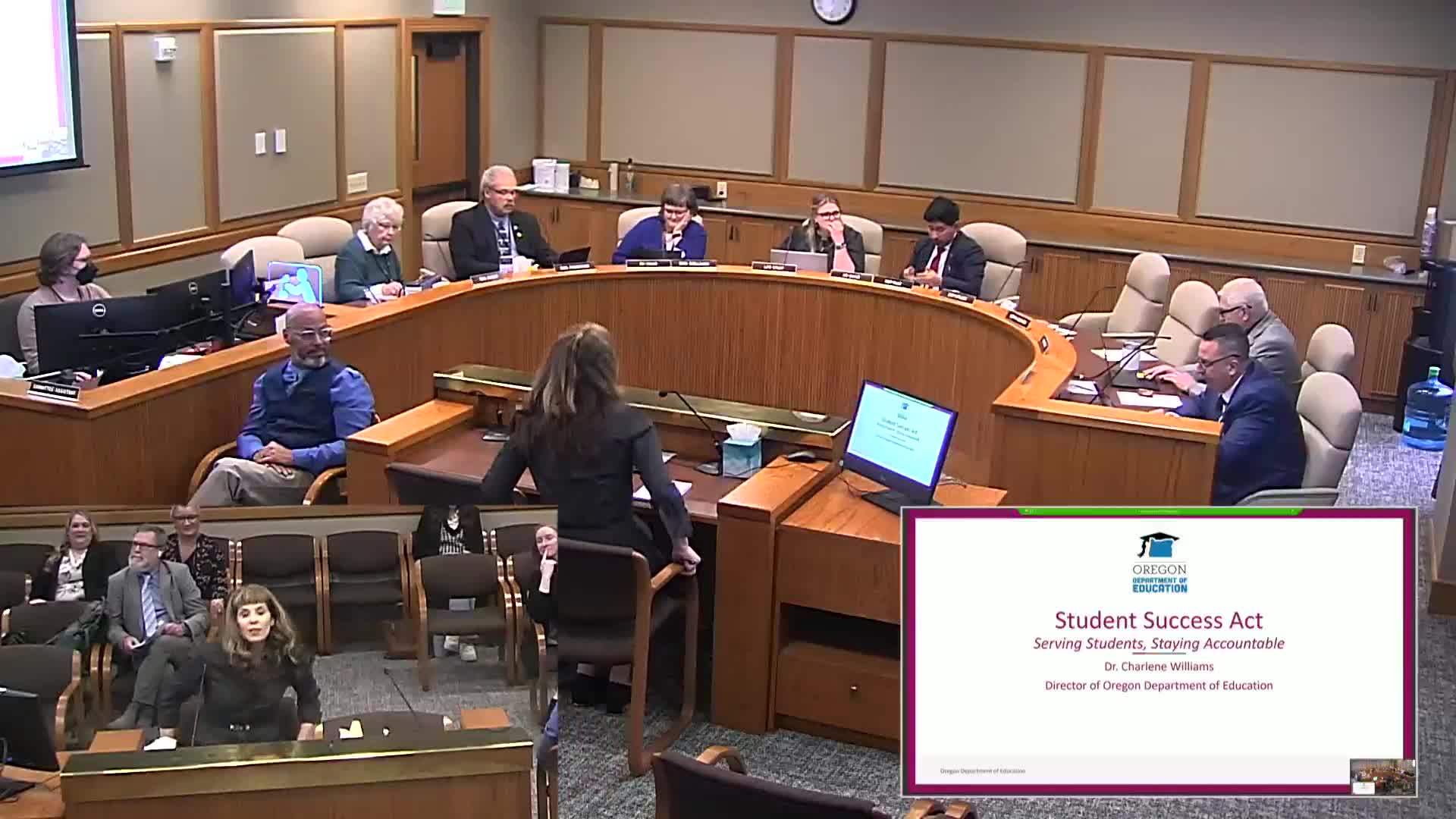
Oregon Department of Education officials briefed the Ways and Means education subcommittee on March 18 on how Student Success Act funds flow through three accounts and support 36 grant programs, highlighted local results, and flagged possible gaps if corporate activity tax revenue falls short; no votes were taken.
Salem, Ore. — Officials from the Oregon Department of Education told the joint Ways and Means subcommittee on education on March 18 that the Student Success Act (SSA) has created a multi-account funding structure that supports 36 grant programs statewide but that revenue uncertainty and a governor-recommended budget would reduce some program budgets if enacted.
"We're excited to be here with you today to share the great work that is happening across Oregon as we implement the Student Success Act," Cassie Medina, assistant superintendent for the Office of Education Innovation and Improvement at the Oregon Department of Education, said at the hearing. "The Student Success Act represents an over $2,000,000,000 investment in Oregon's children and youth."
The presentation, delivered by Medina with other ODE officials including Amber Forster (chief financial officer) and Taniel Weatherall (chief of staff), summarized how revenue from the corporate activity tax (CAT) flows into the Fund for Student Success and then into three statutorily defined accounts: the Student Investment Account (SIA), the Statewide Education Initiatives Account (SEIA), and the Early Learning Account (ELA). The SIA receives at least 50% of remaining funds and is intended to meet students' mental and behavioral health needs and raise academic achievement; SEIA receives up to 30% for 26 statewide programs; ELA receives at least 20% for early learning investments.
Why it matters: The SSA redirected a new revenue source, the CAT, to K‑12 and early learning programs. Committee members pressed ODE on how those dollars translate to measurable student outcomes, how districts report progress, and what would happen if CAT revenue underperforms.
Key funding and program details
- ODE said the CAT was originally estimated to generate about $2.7 billion for…
Already have an account? Log in
Subscribe to keep reading
Unlock the rest of this article — and every article on Citizen Portal.
- Unlimited articles
- AI-powered breakdowns of topics, speakers, decisions, and budgets
- Instant alerts when your location has a new meeting
- Follow topics and more locations
- 1,000 AI Insights / month, plus AI Chat