Get Full Government Meeting Transcripts, Videos, & Alerts Forever!
Get email alerts on the Education Student Success Act topic
No spam. Unsubscribe anytime.
ODE outlines Student Success Act spending, warns of future cuts as subcommittee questions data and outcomes
Summary
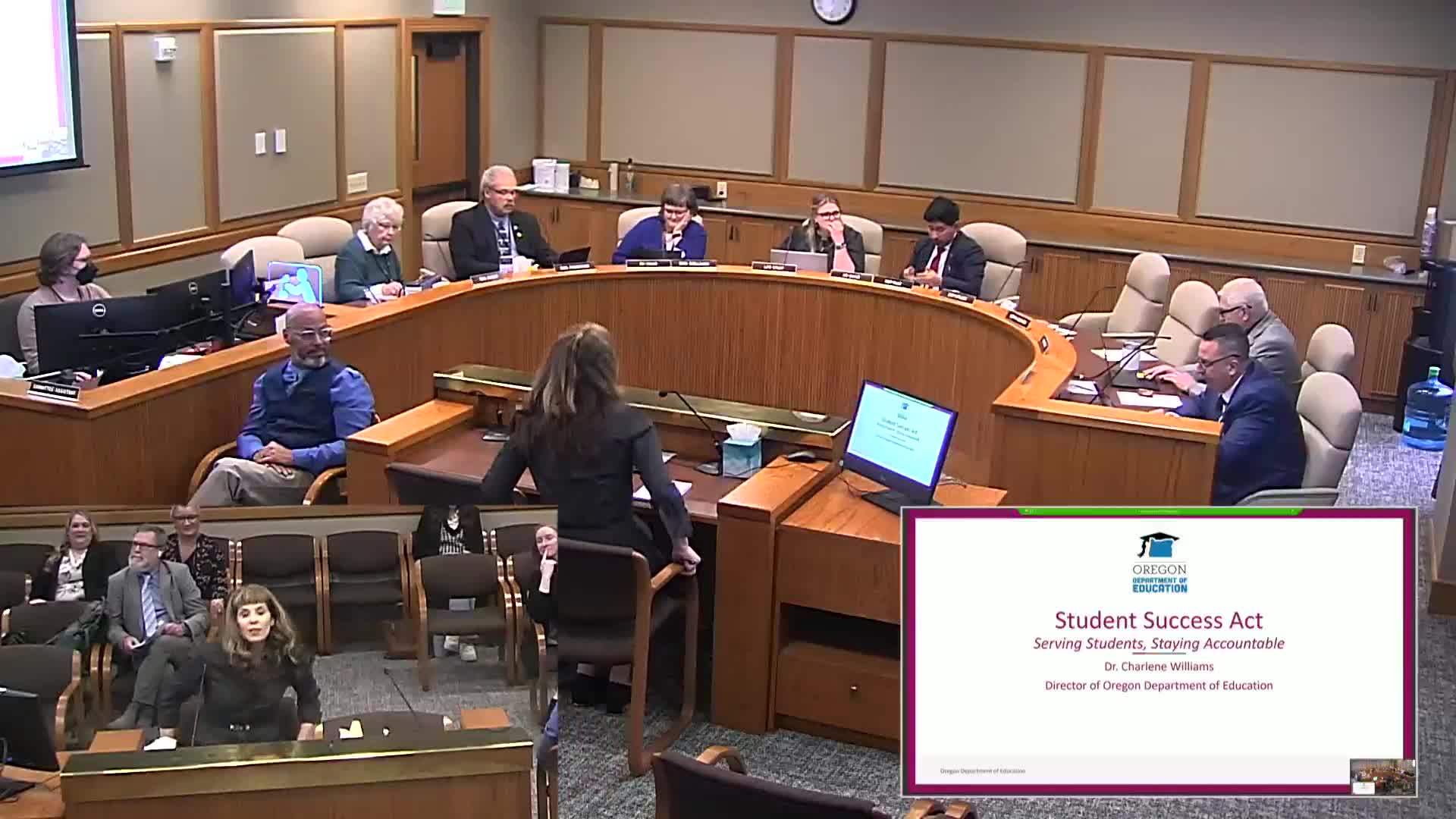
Oregon Department of Education officials briefed the Ways and Means education subcommittee on March 18 on how Student Success Act funds flow through three accounts and support 36 grant programs, highlighted local results, and flagged possible gaps if corporate activity tax revenue falls short; no votes were taken.
Salem, Ore. — Officials from the Oregon Department of Education told the joint Ways and Means subcommittee on education on March 18 that the Student Success Act (SSA) has created a multi-account funding structure that supports 36 grant programs statewide but that revenue uncertainty and a governor-recommended budget would reduce some program budgets if enacted.
"We're excited to be here with you today to share the great work that is happening across Oregon as we implement the Student Success Act," Cassie Medina, assistant superintendent for the Office of Education Innovation and Improvement at the Oregon Department of Education, said at the hearing. "The Student Success Act represents an over $2,000,000,000 investment in Oregon's children and youth."
The presentation, delivered by Medina with other ODE officials including Amber Forster (chief financial officer) and Taniel Weatherall (chief of staff), summarized how revenue from the corporate activity tax (CAT) flows into the Fund for Student Success and then into three statutorily defined accounts: the Student Investment Account (SIA), the Statewide Education Initiatives Account (SEIA), and the Early Learning Account (ELA). The SIA receives at least 50% of remaining funds and is intended to meet students' mental and behavioral health needs and raise academic achievement; SEIA receives up to 30% for 26 statewide programs; ELA receives at least 20% for early learning investments.
Why it matters: The SSA redirected a new revenue source, the CAT, to K‑12 and early learning programs. Committee members pressed ODE on how those dollars translate to measurable student outcomes, how districts report progress, and what would happen if CAT revenue underperforms.
Key funding and program details
- ODE said the CAT was originally estimated to generate about $2.7 billion for the 2023–25 biennium. The Department of Revenue retained $21.3 million for collection costs and transferred the remainder to the Fund for Student Success; the fund had an opening balance ODE described as $315 million. ODE also identified a $40 million allocation for a high‑cost disability account. (Exact statutory references were provided in the hearing materials.)
- The Fund for Student Success supports 36 grant programs: 28 K‑12 programs and 8 early‑learning programs administered across ODE and the Department of Early Learning and Care. ODE said the SIA alone represents "just over $1.1 billion" in the current biennium.
- ODE's Office of Education Innovation and Improvement (EII) manages approximately $1.6 billion in grants and aid each biennium and is staffed with 73 permanent positions, Medina said.
How grants are used and reported
- SIA grantees must engage students, families, licensed and classified staff, and community members when developing plans. Allowable uses include reducing class sizes, increasing instructional time, well‑rounded education, and mental and behavioral health supports; up to 5% of total SIA expenditures may be used for administrative costs.
- ODE described quarterly reporting by grantees, the use of longitudinal performance growth targets (LPGTs) tied to five common metrics (third‑grade ELA proficiency, regular attender, ninth‑grade on‑track, four‑year graduation, and five‑year completer), and a range of monitoring tools including corrective action when requirements are not met.
Examples and program highlights
- ODE staff cited district examples reported to the agency: Adele School District used SIA funds for summer tutoring and a STEM lab; Medford credited family engagement and staff for meeting attendance LPGTs; Forest Grove reported a ninth‑grade on‑track rate of 85%, "7.5% higher than our target for 23–24," according to the presentation slides.
- Targeted programs include Everyday Matters (a chronic‑absenteeism initiative funded at $7.3 million), the Early Indicator and Intervention System (EIIS, funded via a per‑student allocation ODE described as $3 per average daily membership with an additional $1.98 million for technical assistance), High School Success (about $361.7 million), and a mix of state and federal funding for Career and Technical Education (CTE) totaling approximately $55.3 million (about $17.7 million state, $37.6 million federal).
- Competitive and formula grants for CTE include $7 million in CTE revitalization grants and a $7.8 million career pathways fund. ODE reported increases in credentials earned by students and expansion of programs into schools statewide.
Participation and oversight
- ODE said 230 entities were eligible for SIA grants in 2023–25 and that 209 grant agreements had been executed; 78% of SIA funds had been claimed at the time of the presentation. ODE noted that 437 schools across 16 districts receive federal school improvement support under federal identification processes.
- Education Service Districts (ESDs) receive technical assistance grants (ODE cited $44.6 million distributed to 19 ESDs) and serve as regional points of contact and coaching partners.
Questions from the subcommittee and requests for follow up
Committee members repeatedly asked how ODE ties dollars to measurable outcomes and how the agency shares accessible, district‑level data. Medina and other ODE presenters said grantees submit quarterly reports and LPGTs, and that ODE has contracted with external evaluators (the Center for Research Evaluation) and Education Northwest for technical assistance cohorts. Committee members requested concrete local examples of what changes look like for students — for example, specific CTE partnerships or programs (an aviation program at Hillsboro and other work were discussed as illustrative examples) — and ODE agreed to return with district‑level specifics.
Budget pressure and potential reductions
- ODE staff flagged revenue and budget pressure: the agency said the CAT has not been reliably growing enough to fully sustain all current programs and that the governor's recommended budget proposes reductions across several accounts and programs. Specific reduction figures, presented by ODE as part of the briefing, include reductions of about $18 million each to High School Success and the Intensive Program, roughly $7.5 million to ESD technical assistance, about $7.5 million to operations, and smaller reductions to CTE revitalization (~$800,000), CTE career pathways (~$1 million), student leadership centers (~$93,000), and Future Farmers of America programming (~$184,000). ODE characterized the revenue situation as likely to create challenges if current structures remain unchanged.
No formal action taken
The hearing was informational; the subcommittee opened the hearing on Senate Bill 5515 and Senate Bill 5516 but recorded no motions or votes. Members asked ODE to provide further documentation on outcomes, revenue projections, and concrete examples of student‑level program changes.
Looking ahead
ODE presenters said they will return with additional data and specific district examples requested by members, and ODE staff noted one planned follow‑up presentation that was postponed (a presenter identified as Dan). The subcommittee did not adopt policy or budget actions during the session.
Ending
The hearing closed with the chairs adjourning the informational session; ODE committed to returning with follow‑up materials on data, district examples, and revenue projections.