Get Full Government Meeting Transcripts, Videos, & Alerts Forever!
Get email alerts on the Consumer Privacy Ocpa Amendments topic
No spam. Unsubscribe anytime.
Committee hears wide-ranging proposals to tighten Oregon Consumer Privacy Act; debate centers on geolocation bans, youth protections and implementation timeline
Summary
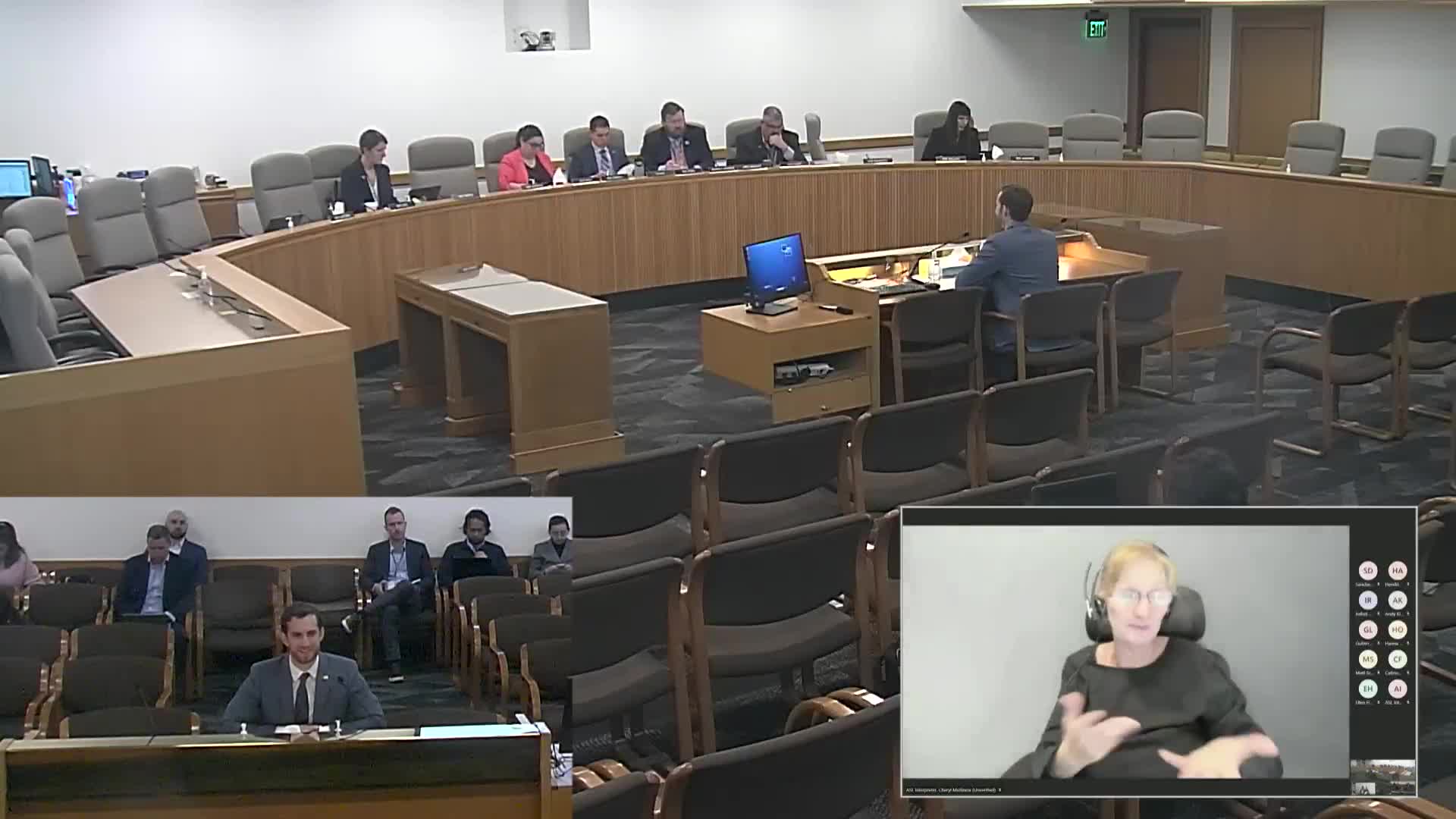
The House Committee on Commerce and Consumer Protection held a public hearing March 18 on House Bill 3,899, which would lower applicability thresholds for the Oregon Consumer Privacy Act, ban private sale of precise geolocation data, and strengthen data-minimization and youth-data protections.
The House Committee on Commerce and Consumer Protection held a public hearing March 18 on House Bill 3,899, a bill that would amend the Oregon Consumer Privacy Act (OCPA) to reduce thresholds that trigger regulation, prohibit sale of sensitive data including precise geolocation, and strengthen data-minimization requirements.
Representative Willie Choetzen, a sponsor of HB 3,899, told the committee the measure has three main goals: ban the private sale of precise geolocation data, prohibit the private sale of personal data for children 15 and younger, and tighten data-minimization rules so companies only retain data necessary to provide requested services. Choetzen said the bill’s forthcoming dash-1 amendment language has been shared with advocates and opponents and that the measure aims to close known gaps in the 2023 law.
Supporters, including Oregon Consumer Justice, Consumer Reports, the Electronic Privacy Information Center (EPIC), and PIRG, argued the marketplace for sensitive consumer information is causing tangible harms. Chris Coughlin and Hannah Osman of Oregon Consumer Justice testified that vehicles and apps collect and sometimes sell highly personal data with limited consumer transparency. Matt Schwartz of Consumer Reports cited a General Motors case reported in the press in which precise driving data was shared and used by insurers. Katrina Fitzgerald of EPIC and Ellen Hengensbach of PIRG emphasized that precise geolocation can be re-identified and that preventing its sale would limit risks such as stalking, price discrimination and post-sale abuse.
Choetzen said the bill lowers the state-coverage threshold (the measure discussed reducing the threshold from 100,000 to 35,000 consumers in Oregon when certain provisions apply) to capture more businesses and that it would prohibit controllers from selling sensitive data or processing it for targeting or profiling that produces significant legal effects. He framed the change as urgent, saying inaction would let the status quo—companies selling location and youth data—continue and argued other states have moved to strengthen protections.
Opponents including the Oregon Business and Industry association, the Technology Association of Oregon (TAO), TechNet and the State Privacy and Security Coalition raised process and technical concerns. Witnesses said Senate Bill 619 (the 2023 OCPA) resulted from a multi-year, multi-stakeholder process and only recently took effect in July 2024; they urged more stakeholder negotiation before reopening foundational elements. Industry witnesses warned the dash-1 amendment’s proposed definitions (including a broad “transfer” concept and a novel data-minimization standard) could be legally and technically unclear, impose heavy compliance costs—particularly on small businesses—and conflict with parts of OCPA that have not yet come online (such as the universal opt-out mechanism).
Representatives of Daimler Truck and other trade associations also emphasized implementation burdens and urged carve-outs for commercial vehicle telematics and for services that rely on location data for public-health, emergency-notification or other legitimate public-interest uses. Industry witnesses said they are willing to participate in work groups but asked for more time for outreach and technical design.
Committee members asked about stakeholder outreach and whether a ban on the private sale of geolocation data would block legitimate public-interest uses. Supporters said the bill bans private sale but would not bar collection or lawful uses such as emergency alerts; opponents said definitions and carve-outs matter and urged a deliberative process to avoid unintended consequences.
The hearing included testimony from out-of-state legislators: Montana State Senator Daniel Zolnicoff described Montana’s recent consumer data law and urged Oregon to consider stronger protections. After several panels of proponents and opponents, the committee closed public testimony without a vote. The sponsor and multiple witnesses signaled willingness to continue negotiations on dash-1 amendment language; no committee action was taken at the hearing.