Palm Coast council approves revised utility-rate plan amid debate over moratorium and infrastructure funding
Loading...
Summary
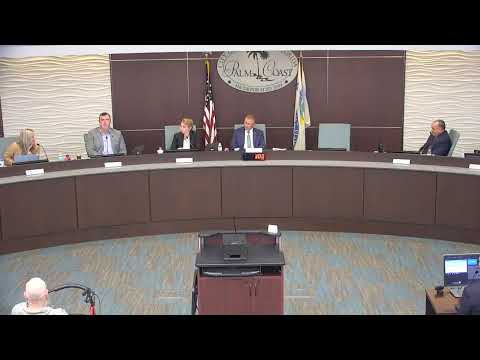
The Palm Coast City Council voted 3-1 on March 18 to adopt a modified utility-rate and charges plan that phases in rate increases and delays some capital projects to avoid a second bond. The council considered, but did not advance, a mayor’s motion for a residential growth moratorium.
The Palm Coast City Council voted 3-1 on March 18 to approve a modified utility-rates and charges plan meant to fund water and wastewater repairs and capacity work while avoiding a second bond issue in the near term.
The ordinance at its second reading — described to the council by Carl Cody, director of stormwater and engineering, and Murray Hamilton, a consultant with Raftelis — will update charges for services effective April 1, 2025 and implement a multi-step rate increase schedule the council adopted as modified plan option A.
The vote followed hours of public comment about flooding, stormwater swales, utility hookups and the pace of residential approvals. Mayor Norris moved a separate measure to place a citywide moratorium on new residential construction but that motion received no second and died on the floor.
Why it matters: City officials say the utility system must be funded now to meet regulatory requirements, maintain service and support future economic development. Opponents said earlier, higher rates or an immediate moratorium would harm residents and local contractors. Supporters urged action to avoid larger costs and regulatory violations in the future.
City presentation and council options Carl Cody summarized staff recommendations and a modified capital-improvement plan (CIP) developed after council direction to search for ways to eliminate a proposed second bond. Cody said the city already increased utility impact fees effective May 1, 2024 and, citing state law, noted those impact fees cannot be raised again until May 1, 2028. He described charges for services (turn-ons, taps, meter installation, inspection fees) that staff proposes become effective April 1, 2025.
Cody and consultant Murray Hamilton presented two rate paths that would fund a modified five-year CIP while deferring or removing selected projects. Option A — the plan council adopted — calls for an 8% increase on April 1, 2025 and again on Oct. 1, 2025, with future annual adjustments beginning Oct. 1, 2026 tied to the U.S. CPI for water and sewer maintenance services or 4%, whichever is greater. Option B proposed smaller near-term increases followed by higher increases in later years.
The modified CIP reduces near-term expenditures by delaying or removing several major water and wastewater projects, including pushing back a 1,500,000-gallon-per-day brackish expansion tied to Water Treatment Plant 3 and removing a wet-weather reclaimed discharge design project tied to I&I (inflow and infiltration) reductions. Cody warned the council of potential consequences: higher future construction costs, possible exceedance of FDEP daily peak-flow limits during drought or high use, lower water pressure during peak times that could affect fire service, and increased I&I-driven flows that could cause sanitary overflows if pipe lining and manhole rehabilitation are reduced.
Council debate and rationale Vice Mayor Pontieri said staff returned with alternative plans aimed at limiting the financial burden on longtime residents while addressing critical infrastructure needs. "This is what we have to do," she said, urging adoption of the modified plan that reduced near-term impacts on ratepayers. Councilmember Gambaro and Councilmember Miller both said they were prepared to approve a revised plan; Gambaro noted doing nothing was not an option.
Opposing the motion, Mayor Norris voted no on the adopted plan. Earlier in the meeting he moved to adopt a residential growth moratorium, arguing infrastructure is not yet in place; that motion died for lack of a second.
Public comments Dozens of residents, builders and local association representatives addressed the council before the vote. Several residents described recurring sewer backups, flooded swales and potholes they said persist because needed repairs and maintenance have been deferred. Leslie Johnson cited the city charter’s directive that enterprise revenues be used for water and wastewater systems and asked that utility receipts be strictly dedicated to those systems.
Builders and business representatives warned against a moratorium. Jared Hallick, a local construction manager, called a moratorium "a knee-jerk reaction" that would choke the local economy and strip paychecks from skilled trades. Anna Maria Long, executive officer of the Flagler Home Builders Association, provided a breakdown of the widely-cited "19,000" lots figure, telling the council that many lots are in large developments that would not be built for years and that the number alone does not indicate an immediate surge in permits.
Key numbers and clarifications - Charges-for-service updates are proposed to be effective April 1, 2025. - Impact fees were raised May 1, 2024 and, per state statute cited by staff, cannot be increased again until May 1, 2028. - Option A adopted by council: 8% increase April 1, 2025 and Oct. 1, 2025; future annual adjustments begin Oct. 1, 2026 using CPI or 4%, whichever is greater. - Staff said impact fees and grants would cover a substantial share of CIP costs but that some projects still require bond financing; the modified plan reduces near-term bond needs but does not eliminate the possibility of future bond(s).
Votes and next steps The council voted to adopt modified plan option A on an ordinance at second reading (utility rate amendment). Vice Mayor Pontieri and Councilmembers Gambaro and Miller voted yes; Mayor Norris voted no. The motion passed 3-1. Council directed staff to proceed with financing-team work and timeline steps presented by staff, which included seeking bonds in mid-2025 if needed and revisiting rates and impact fees in 2027–2028.
Ending note Councilmembers and staff repeatedly urged residents and stakeholders to continue providing information about local flooding, swale conditions and specific maintenance needs; staff said it would pursue grants, SRF loans and other funding while the council moved forward with the adopted rate plan.