Get Full Government Meeting Transcripts, Videos, & Alerts Forever!
Get email alerts on the Economic Development topic
No spam. Unsubscribe anytime.
Burke County leaders hear economic development briefing as county eyes product, housing and workforce strategies
Summary
County manager and consultant Crystal Morphis outlined economic indicators, gaps in developable industrial buildings and workforce challenges; speakers urged focus on product development (spec buildings, pad-ready sites), workforce “on-ramps” and marketing the county to recruiters.
Burke County commissioners on Tuesday heard a lengthy economic development briefing that outlined weak recent tax-base growth, the county’s manufacturing workforce strengths and the need for more “product” — ready-to-occupy industrial buildings and pad-ready sites — to attract corporate investment.
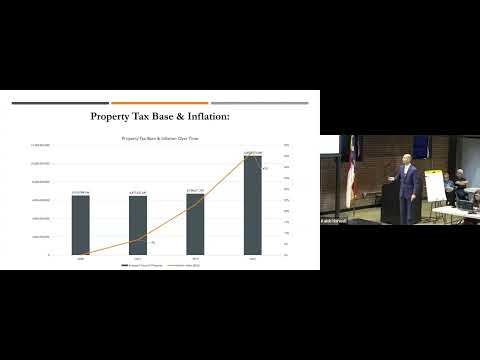
The county manager opened the session by saying the agenda item was an economic development forecast and stressed the connection between creating jobs, expanding the tax base and improving residents’ economic mobility. He and consultant Crystal Morphis presented data showing that Burke’s total property tax base has largely tracked inflation in recent years and that the county has lagged regional peers in post‑COVID economic growth and in new corporate investment.
Why it matters: Commissioners were urged to treat product development (buildings and sites), workforce training and regulatory streamlining as linked priorities. Presenters said one large corporate investment generates tax revenue equivalent to hundreds of new single-family homes without creating the same service demand, making such investments a strategic way to grow the tax base without proportionally raising service costs.
County manager (identified in the meeting as Brian) told the board Burke County’s current total tax base is “about 10,800,000,000.0” and that long‑term growth has been modest; he said most of the county’s recent corporate investment reported by the state’s Economic Development Partnership of North Carolina (EDPNC) — roughly $29 million over three years — came from one large project (the UNIX project). He compared Burke to nearby counties and showed those peers attracted substantially more reported investment in the latest three‑year period.
Crystal Morphis, CEO and founder of Creative Economic Development Consulting, told commissioners that the primary factors companies use to decide where to locate are labor availability and ready real estate. She recommended the county invest in workforce “on‑ramps” and short‑term credential programs (examples cited: Fast Forward, 12-in-6-style certificate programs) and called for a multi‑level approach that coordinates local infrastructure, education and regional/state partners. Morphis said 38% of recent site prospect requests wanted a building and an additional 25% preferred a building, meaning the largest single market opportunity is having usable buildings available for immediate occupancy.
Board discussion focused on the county’s limited inventory of modern industrial buildings (class A stock with 30‑foot clear heights and 100,000+ square feet) and the effect that shortage has had on missed opportunities. Commissioners asked about barriers; presenters pointed to a combination of insufficient pad-ready sites, utility capacity, permitting timelines and access/road limits. Commissioners and staff noted a Drexel site — rail served and utility-ready — is shortlisted as one of two potential locations for a very large project, and that a shell building proposal for the Burke Business Park is advancing through procurement steps.
A consistent theme was workforce: Morphis said manufacturing remains Burke’s largest employment sector (about 26% of local employment) and stressed aligning educational and training outputs with employer demand — including trades, electromechanical and advanced manufacturing skills. She and staff discussed childcare and affordable housing as practical workforce constraints: child care shortages were identified as a major cause of labor force disengagement and one factor that employers consider when assessing a location.
Commissioners also heard that business retention and expansion (BRE) should remain the county’s top priority because about two‑thirds of new jobs and investment nationally come from existing local businesses. Morphis advised that incentive policies should be structured to support expansions of local employers as well as new prospects. The county manager and staff emphasized BDI (Burke Development, Inc.) and other local partners should continue to track incoming requests for information (RFIs); staff said there were roughly 40 RFIs in 2024 the county could not respond to because of lack of product.
Ending: Commissioners signaled interest in continuing the shell-building project and product-development work the county has already started; they pressed staff for follow‑up on site readiness, utility capacity and timelines for the proposed spec building at the Burke Business Park. No formal action was taken on policy changes during the presentation; staff said more detailed implementation recommendations would be brought back as part of the county’s budget and capital planning process.