Get Full Government Meeting Transcripts, Videos, & Alerts Forever!
Get email alerts on the City Finance Audit topic
No spam. Unsubscribe anytime.
Council accepts audit showing "clean" opinion; public calls for deeper review of utility finances
Summary
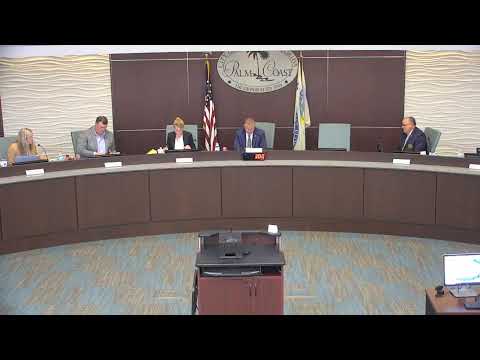
Palm Coast City Council unanimously approved the city's annual comprehensive financial report after auditors reported an unmodified ("clean") opinion and told the council there were no findings in the internal control and single-audit reports.
Palm Coast City Council unanimously approved Resolution 2025 accepting the city's annual comprehensive financial report for the year ended Sept. 30, 2024, after auditors presented the audit and confirmed they issued an unmodified (clean) opinion.
The report and a subsequent council discussion focused on the reliability of the city's financial statements, the city's fund balance, and questions raised in public comment about developer reimbursements and utility finances. "We do have what's called an unmodified opinion or a clean opinion. It's really the best opinion we can provide over a set of financial statements," the auditor told the council during the presentation.
Why this matters: the audit is the independent annual check on the city's finances and internal controls. A clean audit opinion signals that the auditor did not find material misstatements in the financial statements. Still, several residents pressed the council for additional, narrower reviews of specific areas such as utility billing and developer reimbursements, and council members discussed the difference between a routine financial audit, a targeted forensic audit, and a broader state-initiated operational audit.
What the auditors reported
The auditor said there were no findings in the report on internal control and compliance and no comments in the single-audit testing of federal/state grants. The auditor also noted the city had an unmodified opinion on the financial statements and that the financial condition assessment performed as part of the audit yielded an "inconclusive" rating, which the auditor described as effectively "middle of the pack, average." The auditor explained the financial condition assessment compares 20 to 30 metrics to similar entities and to historical trends.
Key numbers and items discussed
- Unassigned general fund dollars: $22,309,000 (unassigned portion) - Total general fund balance: $29,000,000 (as of Sept. 30, 2024) - Unassigned fund balance as a percentage of expenditures (FY 2024): 39% (city policy and GFOA guidance set a minimum reference at 16.67%) - Total assets (balance sheet figure cited in the meeting): about $974,000,877 - Net position reported in the audit: about $771,112,783 - Long-term borrowing referenced: drawdowns on State Revolving Fund (SRF) loans and a subsequent stormwater loan of about $18,300,000 noted as a subsequent event; SRF drawdowns during the year were cited at about $12.5 million
Council and staff comments
Mayor Norris and several council members thanked staff for producing the audited financial statements early. Council members asked auditors to clarify sampling methods and what a forensic or operational audit would entail. The auditor described operational audits (such as those performed at the request of JLAC or the state) as broader in scope than a forensic audit and said a forensic audit is usually more pointed and labor-intensive and requires scoping; an example cited was that an in-depth forensic review of a utility fund could cost "at least hundreds of thousands of dollars." The auditor confirmed the firm has peer reviews and internal oversight over its own audit work.
Public comment and requests for deeper review
During public comment multiple residents pressed the council to pursue deeper reviews. One resident asked who was pursuing $120 million plus interest alleged to be owed by a developer for infrastructure tied to a West End expansion; the city manager responded that DRI activations and developer obligations depend on activation of the DRI and are not yet triggered. Several speakers asked why a forensic or state operational audit had not found specific missing money and urged the council to request a state operational audit or a forensic review of utility transactions. Others raised concerns about potential misallocation of utility funds into other uses and suggested separating utility charges to improve transparency.
Formal action
The council voted 4-0 to accept the annual comprehensive financial report (Vice Mayor Pontieri: yes; Council Member Gambaro: yes; Council Member Miller: yes; Mayor Norris: yes). The motion passed unanimously.
What the vote does and does not do
Accepting the audited financial report files the city's audited financial statements for FY 2024 and makes the audit and related reports part of the public record. It is not, by itself, an instruction to initiate an operational or forensic audit. Council discussion acknowledged that a forensic or operational review would require separate scoping, a funding decision, and (if state-led) a separate process through the state.
Next steps mentioned
Council members and staff discussed how to escalate requests for deeper review: the mayor had earlier contact with JLAC/the state auditor about an operational review, and council members noted that if the city asks the state to initiate an operational audit there are different funding and process implications. Several council members invited residents to send specific line-item questions to staff so staff could research particular alleged missing funds and provide follow-up.
Ending
Council members praised staff for early issuance and presentation of audited financial statements and acknowledged that the audit found no material internal-control findings. Multiple residents said they would continue to press for more-targeted investigations of developer reimbursements and utility accounting in subsequent meetings or via formal requests to staff.