Get Full Government Meeting Transcripts, Videos, & Alerts Forever!
Get email alerts on the Workplace Harassment Training topic
No spam. Unsubscribe anytime.
Tooele County employees receive refresher on harassment, protected classes and reporting
Summary
A trainer led a roughly hour-long harassment and discrimination training for Tooele County employees covering protected classes, definitions of harassment (including hostile work environment and quid pro quo), recent statutory additions and reporting channels; trainer urged employees to report incidents and cited anti-retaliation protections.
A trainer led a harassment and discrimination training for Tooele County employees, reviewing federal and state protections, definitions of harassment and recommended reporting steps.
The trainer opened by saying the county does not see many harassment lawsuits but warned that those that occur are “very, very visible” and costly; the trainer urged staff to prevent incidents that could become front‑page news. The session covered the original five protected classes under Title VII of the Civil Rights Act of 1964 and later additions, including age under the Age Discrimination in Employment Act (ADEA), disability protections from the Rehabilitation Act and the Americans with Disabilities Act (ADA), pregnancy protections added in 1978, and the Genetic Information Nondiscrimination Act (GINA) of 2008. The trainer noted that Utah’s legislature added vaccine status to the list of protected categories in 2022 and discussed a state law protecting religious expression at work when it is “reasonable, nondisruptive, and non harassing.”
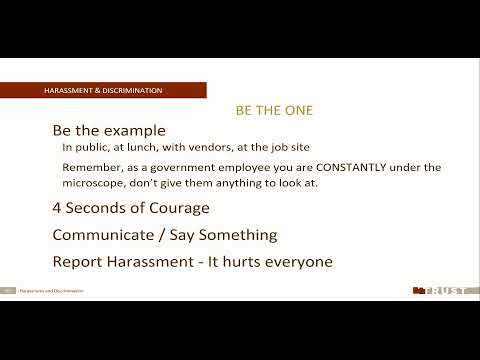
Why it matters: the trainer repeatedly framed harassment claims as expensive and highly public, and emphasized that county employees who wear Tooele County insignia are “always under a microscope” when interacting with the public. The trainer urged staff to “keep your hands to yourself, keep your words to yourself, keep your thoughts to yourself,” and to use “4 seconds of courage” to call out inappropriate conduct in the moment or to report it afterward.
The session defined key terms and examples. The trainer described harassment as conduct based on a protected characteristic that is pervasive, unwelcome and sufficiently severe to create a hostile work environment; he contrasted isolated incidents (which may be inappropriate but not necessarily illegal) with pervasive or severe conduct that may be unlawful. Sexual harassment was discussed in two forms: quid pro quo (an exchange such as ‘‘do this for me, I’ll do that for you’’) and hostile work environment (repeated or severe conduct that interferes with an employee’s ability to do their job).
The trainer used hypotheticals and role‑play to illustrate points: he asked whether a supervisor repeatedly telling an employee to “do your job better or you’re going to be fired” is harassment, and explained that harassment becomes illegal when it targets someone because of a protected class. The trainer described how stereotyping or insulting references to a person’s family, body, gender, disability, age, pregnancy or other protected traits can cross the line into demeaning conduct. He also highlighted nonphysical concerns such as offensive jokes, derogatory names and repeated teasing that becomes pervasive.
On genetic and biometric information, the trainer summarized GINA’s core protection: employers who obtain genetic information (for example, from cheek swabs) generally cannot use that information in hiring, promotion or disciplinary decisions. He said biometric screening or retinal scans, if implemented, implicate similar concerns about how information is used.
Reporting and remedies: the trainer advised staff to know internal policies and reporting channels (supervisor, human resources or other designated officials), and to “work with your organization to resolve the problem.” He reminded employees they have protections against retaliation for reporting harassment and discrimination, and urged staff who do not feel safe intervening in the moment to report the incident afterward. The trainer repeatedly encouraged employees to report so problems can be addressed and not allowed to become pervasive.
Examples and public context: the trainer referenced recent newsworthy harassment incidents and used the University of Utah women’s basketball team at an NCAA tournament as an example of severe public harassment; he cautioned staff that public visibility can magnify the consequences for the county. He also used workplace anecdotes to show how seemingly benign touches or comments may retraumatize people with prior abuse histories and therefore should be avoided.
The trainer closed by reminding employees that supervisors who do not correct inappropriate behavior can inadvertently normalize it and that a single employee’s intervention or report can prevent broader problems. No formal actions, votes or policy adoptions were recorded during the session.