Get Full Government Meeting Transcripts, Videos, & Alerts Forever!
Get email alerts on the Workplace Harassment Training topic
No spam. Unsubscribe anytime.
Utah Local Governments Trust gives harassment, discrimination training to Tooele County staff
Summary
A risk manager from Utah Local Governments Trust led a roughly hour-long training for Tooele County employees on workplace harassment, definitions of protected classes, reporting steps and examples of prohibited conduct.
A risk manager from Utah Local Governments Trust led a workplace harassment and discrimination training for Tooele County employees during a county meeting session, emphasizing legal definitions of harassment, protected classes and how staff should report incidents.
The presenter said insurers often handle lawsuits that follow harassment or discrimination claims and urged staff to prevent misconduct before it becomes a legal or public-relations problem. “Keep your hands to yourself, keep your thoughts to yourself, keep your words to yourself,” the presenter said, summarizing a central rule he urged employees to follow.
The training reviewed core federal protections and state developments relevant to county employees. The presenter identified Title VII of the Civil Rights Act of 1964 and the Equal Pay Act of 1963 as foundational federal employment laws, said the Age Discrimination in Employment Act of 1967 protects workers 40 and older, described the Rehabilitation Act of 1973 and the Americans with Disabilities Act (1990) with amendments in 2008, and named the Genetic Information Nondiscrimination Act (GINA) of 2008 as a newer protection against discrimination based on genetic or biometric data. He also referenced recent Utah state-level religious‑liberty provisions that allow employees to express religious or moral beliefs in the workplace so long as the expression is “reasonable, nondisruptive, and non‑harassing,” unless it conflicts with an employer’s essential business interests.
Practical examples were used to distinguish between inappropriate conduct and unlawful harassment. The presenter explained that ordinary workplace criticism by a supervisor is not illegal harassment unless the conduct is targeted because of a person’s membership in a protected class. He described two legal theories employers commonly face in harassment claims: quid pro quo (a "this for that" exchange, such as offers of promotion in return for sexual favors) and hostile work environment (conduct that is pervasive or severe enough to make an employee feel unsafe at work).
The session listed common ways harassment can appear: stereotyping, name‑calling, unwelcome touching, threats, and repeated teasing that becomes pervasive. The presenter used video clips and role examples to show how banter can shift into harassment if it targets protected characteristics such as race, religion, gender identity, disability, age, pregnancy, familial status, genetics or (in Utah) vaccine status, which the presenter said was added to Utah’s protected‑class list in 2022.
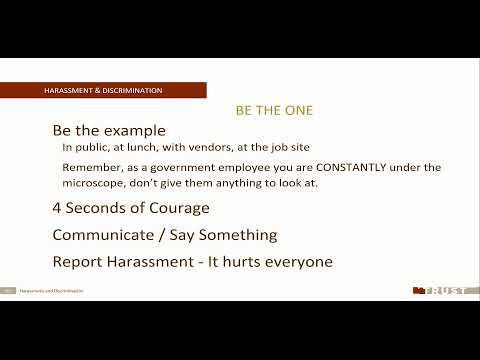
On reporting and response, the presenter advised employees to learn their internal policies and report incidents to supervisors, human resources or county leadership, and to cooperate with investigations. He encouraged bystanders to use “four seconds of courage” to intervene when they hear inappropriate comments, and said county employees are protected from retaliation for reporting harassment.
The presentation stressed the public visibility of county employees — the presenter noted staff often work in uniforms or county vehicles — and warned that harassment allegations can become public and lead to insurer and legal involvement. No formal actions, votes, or new county policies were proposed or recorded during the training segment.