Get Full Government Meeting Transcripts, Videos, & Alerts Forever!
Get email alerts on the Permanent Supportive Housing topic
No spam. Unsubscribe anytime.
Austin officials describe funding, services and outcomes for permanent supportive housing to Nashville council committee
Summary
City of Austin staff and local partners told Nashville committee members how Austin funds and operates site-based permanent supportive housing, detailing capital, services and rental-assistance components and reporting high retention rates for program participants.
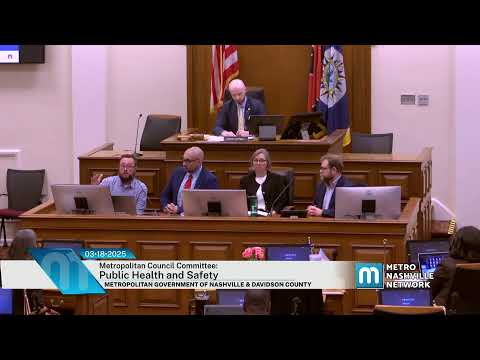
City of Austin officials and nonprofit partners described Austin’s investments in site-based permanent supportive housing and the wraparound services that support it during a Nashville Metropolitan Council committee meeting.
Andrew Willard, senior planner in Austin’s Homeless Strategy Office, told the committee that site-based permanent supportive housing (PSH) requires three funding pieces: capital to build or convert buildings, ongoing wraparound services and rental assistance. “Site based PSH kind of requires three funding sources to work,” Willard said.
The visitors said Austin has expanded PSH in recent years with a mix of hotel conversions and new construction financed through local gap financing, voter-approved bonds and other tools. Willard said the city provided about $122,500,000 in gap financing for a portfolio of projects that together represent 1,345 PSH units in Austin’s pipeline, and that the city uses a combination of bonds, local housing vouchers and other revenue to support development and operations.
Nicole Jocelyn, with Austin’s housing department, described several local tools: a downtown density-bonus program that yields fees for the housing trust fund, a smart-housing program that waives permit fees for qualifying projects, an expedited permit-review team for public projects and a local housing voucher pool. Jocelyn said the city provides $4,000,000 a year for local housing vouchers and currently has 374 vouchers fully committed across seven projects.
Dr. Aaron Alarcon, CEO of Family Elder Care, described Pecan Gardens, a hotel the city purchased and converted into 78 PSH units for people age 55 and older exiting homelessness. He summarized the service model — intensive case management (about 13 residents per PSH caseworker), service coordination, peer support, SOAR specialists to assist with disability benefits, and partnerships for basic health care — and said Family Elder Care also manages the asset and supervises the contracted property manager, Volunteers of America.
Jason Phillips, director of systems advancement for Ending Community Homelessness Coalition (ECHO) in Austin and Travis County, highlighted outcomes data. “What we see with our PSH is typically we’re seeing a 95% or higher permanent housing retention rate,” Phillips said, and he offered the coalition’s public reports for more detail (austinecho.org).
Council members asked about legal preemption and voluntary participation. Councilmember Preptique asked how Austin navigates state preemption; Willard said the city has sought creative use of local housing levers and, in some cases, obtained additional state dollars through a cooperative relationship with the mayor and the legislature. Councilmember Weiner asked how the city engages people who initially refuse services; panelists said Austin follows Housing First principles, prioritizes low-barrier access and relies on proactive outreach, case management and harm-reduction practices rather than excluding people for past substance use or criminal history.
Speakers and visitors from Austin said the high per-unit service cost (about $20,000 per unit per year, per the presentation) reflects the intensity of supports PSH residents typically need and the program’s strong outcomes relative to alternatives such as rapid rehousing or shelter.
The Nashville committee members thanked the Austin delegation and said they would continue the exchange of ideas; no formal action was taken on the presentation itself during the meeting.