Get Full Government Meeting Transcripts, Videos, & Alerts Forever!
Get email alerts on the Downtown Economic Development topic
No spam. Unsubscribe anytime.
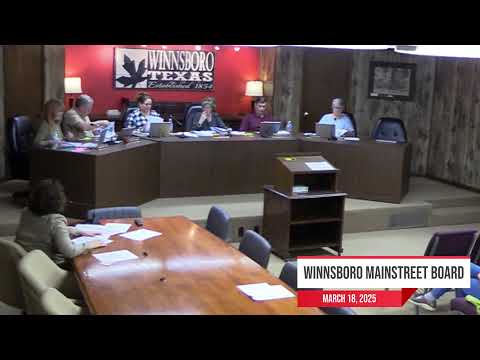
Winnsboro Main Street board outlines 2025 work plan focusing on marketing, wayfinding and workforce
Summary
At a March 11 work session, the Winnsboro Main Street Board reviewed a condensed 2025 transformation strategy that centers on increasing customer traffic, strengthening marketing, improving wayfinding and building a local workforce pipeline. The board discussed budgets, partners and committee roles and approved the January minutes by voice vote.
The Winnsboro Main Street Board met in a work session March 11 to review a condensed 2025 transformation strategy that focuses on increasing downtown foot traffic through marketing and wayfinding, strengthening business-to-business awareness, supporting workforce training and expanding historic-identity efforts.
The board discussed two core strategies: (1) business growth and economic development, with a near-term target to increase customer traffic and business visibility; and (2) community engagement and destination marketing, including events, a shared citywide calendar and a push to better document and promote historic assets. The meeting included budget reviews, partner lists and a plan to form committees and assign chairs to develop measures and tasks.
Why it matters: The Main Street program requires quarterly reporting to Main Street America and asks local boards to nominate one to three transformation strategies. Winnsboro’s board has a shortened timeline for 2025 (roughly seven months) and must match limited program funds to prioritized tasks while coordinating city staff, the Chamber, the Wood County EDC and local merchants.
Board members and staff highlighted specific measures and budget constraints. The draft plan proposes a 15% target increase in customer traffic for downtown (board members debated whether that figure should be higher) and referenced a recent local metric: a 40% year-over-year visitor increase at the WCA gallery during a prior period. Jody Jones said those are starting points and the board can revise goals if early results exceed expectations.
The group reviewed the Main Street budget line items that will support the plan: an advertising allocation of $13,000 and an events budget of $8,000, of which about $4,000 remained at the time of the meeting. Jody Jones summarized: “That only leaves us $3,000 to do anything else,” underscoring limits on what can be accomplished without additional funding or reallocations.
Tasks discussed for Strategy 1 (business growth and visibility) included improved signage and wayfinding (acknowledging the need for a brand identity before final sign designs), shared marketing campaigns (digital and print), development of co-marketing packages for overnight visitors, and use of standardized data collection (sales tax and venue headcounts) to build baselines and track the proposed percentage increases. Board members flagged measurement questions—how to count visits downtown versus citywide—and suggested using multiple baselines (sales tax, WCA headcount and business self-reporting).
For Strategy 2 (community engagement and destination marketing), members proposed a citywide calendar of events, stronger social-media coordination (Instagram, Facebook/Meta Business Suite), promotional videos, a shared photo library for businesses, and collaboration with the Texas Downtown Association for event best practices. Several members recommended ‘‘slow rolling’’ calendar releases (30–90 days) targeted to different audiences: immediate weekend visitors versus seasonal tourism.
Workforce and business development was the other substantive goal. The board discussed quarterly training sessions (goal: two per year with 60% engagement) and creating a stronger pipeline between local schools, Workforce Solutions of Northeast Texas and area employers. The group noted existing local efforts—school internships and a new Youth Leadership Council at the library—and discussed coordinating those with business recruitment and retention work being developed by the city’s economic development staff.
Historic identity and preservation emerged as a cross-cutting topic. Several board members asked the Main Street board to raise awareness about the absence of a historic overlay that would prevent demolition of historic Main Street buildings. Participants recommended an education campaign and staff-led discussions before asking city council to consider ordinance changes, to avoid public misunderstanding.
Budget and funding options discussed included: earmarking retained EDC revenues in future budgets, pursuing hotel/occupancy-tax (HOT) grants for events and marketing, storefront improvement grants (for façade/appearance work), and outside grants or sponsorships for larger items (wayfinding kiosks, professional video). Mackenzie, identified in the meeting as a finance officer, was asked to clarify current HOT allocation levels for the city.
Next steps: board members will identify which committees they will join or chair; committees will develop concrete, measurable tactics and budget requests to present at the next meeting. The board set its next meeting for April 8, 2025, at 2 p.m. and agreed to present the draft plan to local merchants for feedback before formalizing measures and budgets.
Votes at a glance: The transcript records one formal voice vote during the meeting. The board approved the January minutes by voice vote after a second from Christy; the minutes motion passed unanimously on the record of the meeting.
Members emphasized that this document is a living plan: measures and budgets can be adjusted if initial results exceed or fall short of targets. The work session concluded with a directive to refine committees, measures and funding requests for the next meeting.