Get email alerts on the Emergency Vehicles Traffic Signal Preemption topic
No spam. Unsubscribe anytime.
Surprise adopts GPS-based system to trigger green lights for emergency vehicles
Summary
City of Surprise officials on Jan. 21 updated the council on a new GPS-based emergency vehicle preemption system that uses geofences and cellular-equipped vehicle routers to clear intersections and improve responder and public safety; system complements, not replaces, legacy infrared emitters to preserve automatic-aid compatibility.
City of Surprise officials on Jan. 21 presented an update on a newly deployed GPS-based emergency vehicle traffic signal preemption system intended to give responding apparatus earlier green lights and reduce hazardous stops at intersections.
The system uses GPS-equipped routers in fire medical vehicles to share location and a wired input that senses when lights-and-sirens are active; when the device detects a responding unit inside a configurable geofence, the central server sends commands to one or multiple intersections to prepare or grant a green phase. "It has geofences placed throughout the city on the roadways," said Albert Garcia, the city's TISMO manager in the Transportation Department. "They can be polygon shapes that go around corners that sit in driveways of the fire stations."
Why it matters: Fire officials told the council the existing infrared optical preemption system works in many situations but is limited by line-of-sight, range and long pedestrian timings at large intersections. Battalion Chief Cody Worrell said those constraints can force crews to stop at signals and visually clear multiple lanes, increasing the risk of secondary collisions or hazardous maneuvers such as left-of-center driving. "The real goal of this project was to start to do a better job for our response so that because we're only as good if we can actually make it to the call," Worrell said.
City staff said the GPS approach addresses key shortcomings. The mobile routers transmit location updates roughly once per second (latency depends on cellular coverage), and when a unit is both inside a geofence and has lights-and-sirens on, the system can pull intersections out of coordination, start pedestrian countdowns early (a cited example showed an east–west pedestrian time of about 57 seconds at a large intersection), and issue a "get ready" or green command to a sequence of intersections so the apparatus encounters cleared roadways rather than stopping repeatedly.
Garcia and Worrell described other operational benefits: reduced wear on heavy apparatus, smoother transports for patients in ambulances, improved situational awareness through remote health monitoring of the system, and the ability to refine geofences and timing in response to feedback from field crews. "We have the ability to actively monitor the system now," Worrell said. "We can actually see and have them, where it's at and if it's working properly."
Deployment and limits: Staff said all department apparatus have been fitted with the mobile routers and that the initial capital cost was grant-funded through CMAQ (Congestion Mitigation and Air Quality) funds; the device cost for a vehicle was described as roughly $5,000 for the initial investment and ongoing cellular service is approximately $40 per unit per month. Because Surprise participates in automatic-aid with neighboring cities, council members and staff emphasized they would not remove the legacy optical (infrared) system; the GPS system is intended to operate alongside it so responding units from other jurisdictions that lack GPS devices still receive preemption via optical emitters.
Council members asked about cellular dead spots, cross-jurisdiction compatibility and hardware lifespan. Staff acknowledged areas of limited cellular coverage could reduce GPS effectiveness but said the optical legacy system would remain as a fallback and that traffic signal controllers themselves communicate with the city's traffic management center via fiber. On cross-compatibility, staff noted several regional deployments use different proprietary approaches (radio, cellular, GSM/900 MHz) and that regional coordination and standards work is ongoing through forums such as the Central Arizona Life Safety Council. Garcia said the server-side software is intended to be future-proof and configurable; hardware life was estimated at 5–7 years for field units.
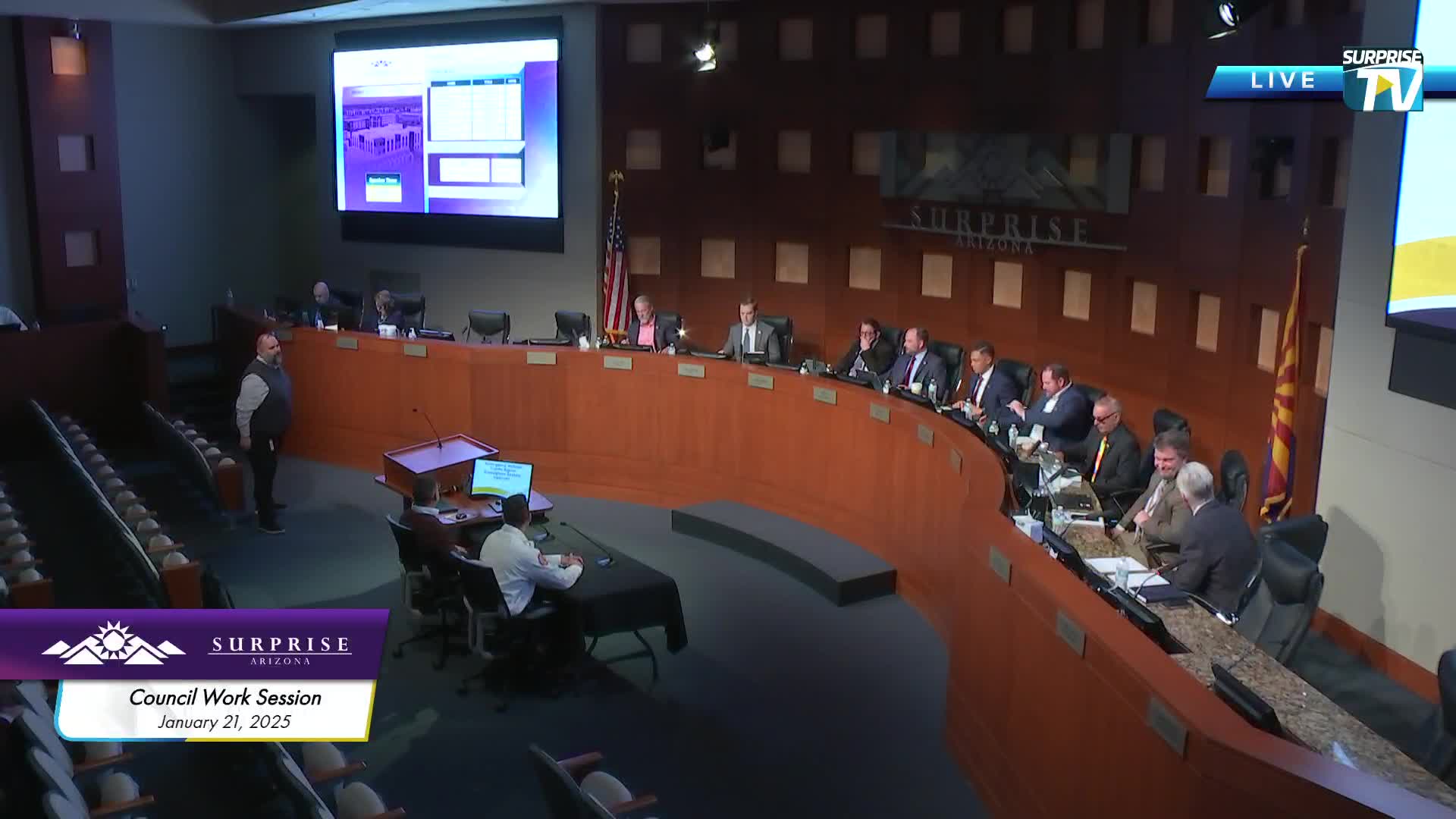
Staff showed software and test-run visuals from a Ladder 305 run, where geofences placed along corridors triggered "get ready" and green phases at successive intersections so the tested apparatus negotiated the route without stopping. Council members expressed support for continued coordination with state and regional agencies (ADOT was noted as using radio/wireless communications on some Grand Avenue signals) and interest in future performance data; Vice Mayor Heaney asked staff to return with measured impacts on response time once sufficient operational data is available.
No formal council action was required during the presentation; staff said the deployment is live and that they will continue to monitor health, collect field feedback, and adjust geofences and timing as needed.
AI generated
The text on this page is AI generated. Summaries, highlights, analysis, and video transcripts are all produced from the original source material.
AI can make mistakes, so if you spot one, and we will fix it for everyone.
Note: the source content is unaltered by us. Any content source we link to, be it a video, an audio recording, or a document, is presented exactly as its publisher released it. That publisher is usually a government body, sometimes an individual official or another organisation.