Get Full Government Meeting Transcripts, Videos, & Alerts Forever!
Get email alerts on the Disability Services topic
No spam. Unsubscribe anytime.
RISE Services outlines local group homes, day programs and employment supports to Surprise commission
Summary
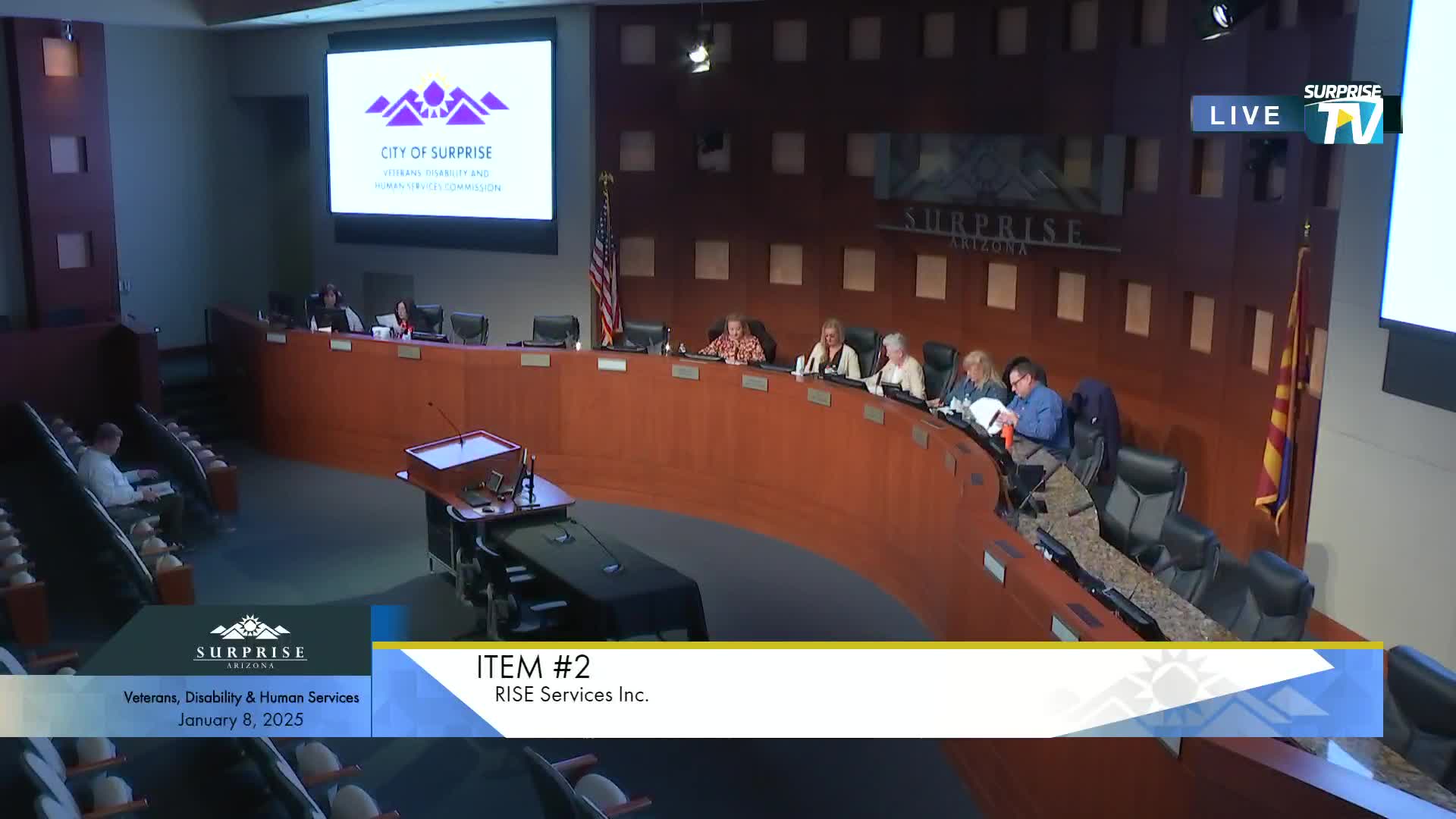
RISE Services Inc. presented its Arizona operations to the Veterans Disability and Human Services Commission on Jan. 8, describing group homes, adult day programs, the Rise Together member council, a supported-employment pathway and plans for a family council pilot in 2025.
Angie Pelton, senior program administrator for RISE Services Inc., told the Veterans Disability and Human Services Commission on Jan. 8 that RISE operates group homes, adult day programs and home- and community-based services (HCBS) in the West Valley and across Arizona.
The presentation said RISE provides trained direct support professionals, an internal quality-assurance team, a dedicated behaviorist for the West Valley and a member-led Rise Together Council that meets monthly across programs. "Our mission is to create opportunities for and with people," Pelton said.
Pelton and Maureen Anderson, RISE regional director for group homes and the day program in the West Valley, described services that range from early intervention therapies to residential supports. The commission heard that RISE seeks to increase community integration for members through social, recreational and employment opportunities and that it is piloting a family council in 2025 to provide training for guardians and family members on topics including Article 9 prevention and supports.
Commissioners were given program figures: RISE reported 64 participants at the Surprise day program and 18 people in Surprise group homes; statewide, the presenter said RISE serves more than 900 members and employs about 1,600 staff. RISE also reported four behaviorists on staff, a newly dedicated West Valley behaviorist, and multiple layers of supervision including coordinators, directors and quality-assurance auditors before state monitoring.
Pelton described a supported-employment (GSE) pathway in which participants receive roughly 20 hours per week of paid work, typically at minimum wage, and transition over time to more independent roles or community employment. The Mesa GSE program was cited as an example; Pelton said that program had 19 participants doing secretarial and janitorial work while building job skills.
RISE told the commission it provides multilingual family and guardian outreach (English, Spanish and Navajo), offers competitive wages and benefits for direct support professionals, and maintains an employee scholarship fund and EAP. The nonprofit also supplies sensory tents at community events and said it would be willing to bring them to future Surprise events.
Commissioners thanked the presenters and asked about tours and fundraisers; Pelton said RISE conducts tours of day programs and group homes and has run golf fundraisers and other events whose proceeds are used to support members in need.
The presentation closed with an offer from RISE to coordinate volunteer involvement in city events and to provide sensory supports for families and individuals with disabilities.