Get Full Government Meeting Transcripts, Videos, & Alerts Forever!
Get email alerts on the Open Meetings topic
No spam. Unsubscribe anytime.
Council reviews open-meeting and conflict-of-interest rules in training session
Summary
An attorney-led presentation reviewed Arizona open-meeting requirements, serial-meeting risks, executive-session limits, gift rules and conflict disclosures; council members asked for case guidance and quarterly refreshers.
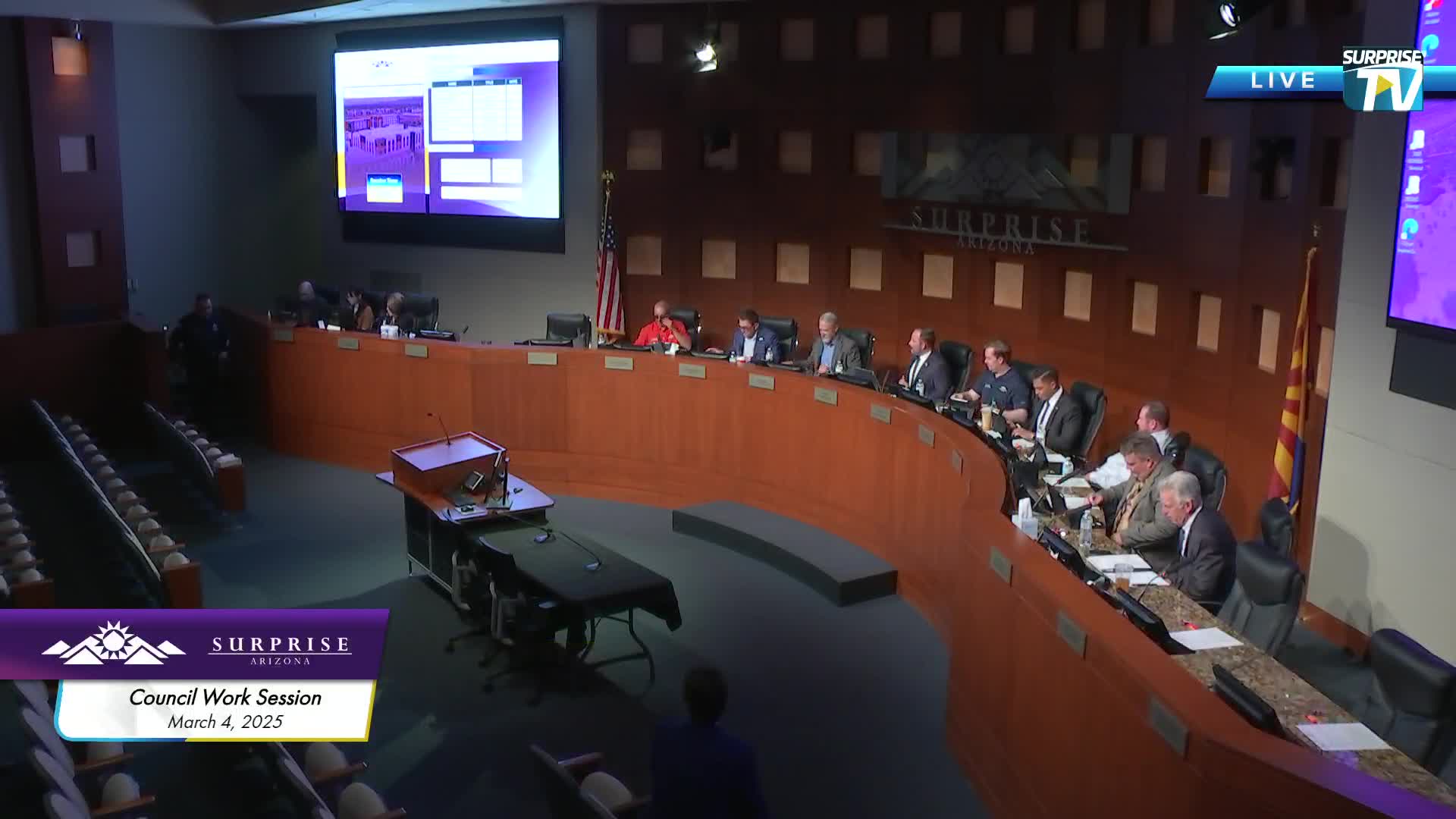
An attorney provided the Surprise City Council an hour-long refresher on Arizona open-meeting law, conflict-of-interest rules and gift guidance at the council’s March 4 work session.
The presentation, delivered by Hobie Wingard, explained that Arizona law requires public meetings to be open and that “all legal action of public bodies must occur during a public meeting,” and said notices and agendas must provide “information reasonably necessary to inform the public of matters to be discussed or decided.”
Wingard told council members the law covers in-person and technological gatherings, serial communications, phone calls, email “reply all” chains, social events where a quorum might be present, and evolving questions around social media use. He said executive session may be used only after a majority vote and only for specific purposes such as legal advice, litigation, contract negotiations or real-property discussions, and that minutes of executive sessions are confidential except in limited circumstances.
Council members pressed for practical clarifications. Vice Mayor Hastings asked whether a long-running matter could make ordinary communications run afoul of the serial-meeting rule; Wingard said the analysis is fact-dependent and he would research whether a serial-meeting inquiry could extend over a multi-year period. Council members also asked whether private individuals, such as zoning attorneys who approach council members, could create a problem; Wingard said the law on that point is evolving and he would provide a recent attorney-general opinion and further guidance.
On conflicts of interest, Wingard described the statute’s disclosure-and-recusal requirement for public officers with a “substantial interest,” and listed relatives specified in the statute (spouse, children, grandparents, siblings and certain in‑laws). He advised that when in doubt officials should disclose potential conflicts. On gifts, he said public officers may not use their position to secure benefits and recommended using a “headline test” — decline or disclose gifts that could reasonably be seen as buying influence.
Council members asked for more concrete guidance on frequent scenarios. Council member Greenberg asked whether the U.S. Supreme Court’s Snyder v. United States decision limits local rules; Wingard described the federal case as distinguishing gratuities from bribery and said state law or local rules might still apply. Council member Haney and others requested clearer written examples and asked that the city attorney’s office be available to advise in specific cases such as campaign contributions from developers or invitations to events or meals; Wingard encouraged members to consult Jeff (city counsel) or himself on a case-by-case basis.
Members supported periodic refreshers. Several council members asked that the attorney return for regular briefings and suggested a rules-committee review of the council’s policies and procedures.
The council took no formal action on the presentation; the session was informational and the council did not vote on policy changes during the meeting.