Get Full Government Meeting Transcripts, Videos, & Alerts Forever!
Get email alerts on the Transportation topic
No spam. Unsubscribe anytime.
Council requests study after lengthy Bell Road traffic update
Summary
Traffic engineers briefed council on Bell Road volumes, left-turn storage and signal timing; council asked staff to return with an evidence-based study and options, including potential dual-left and median modifications at trouble intersections such as Bell and Litchfield.
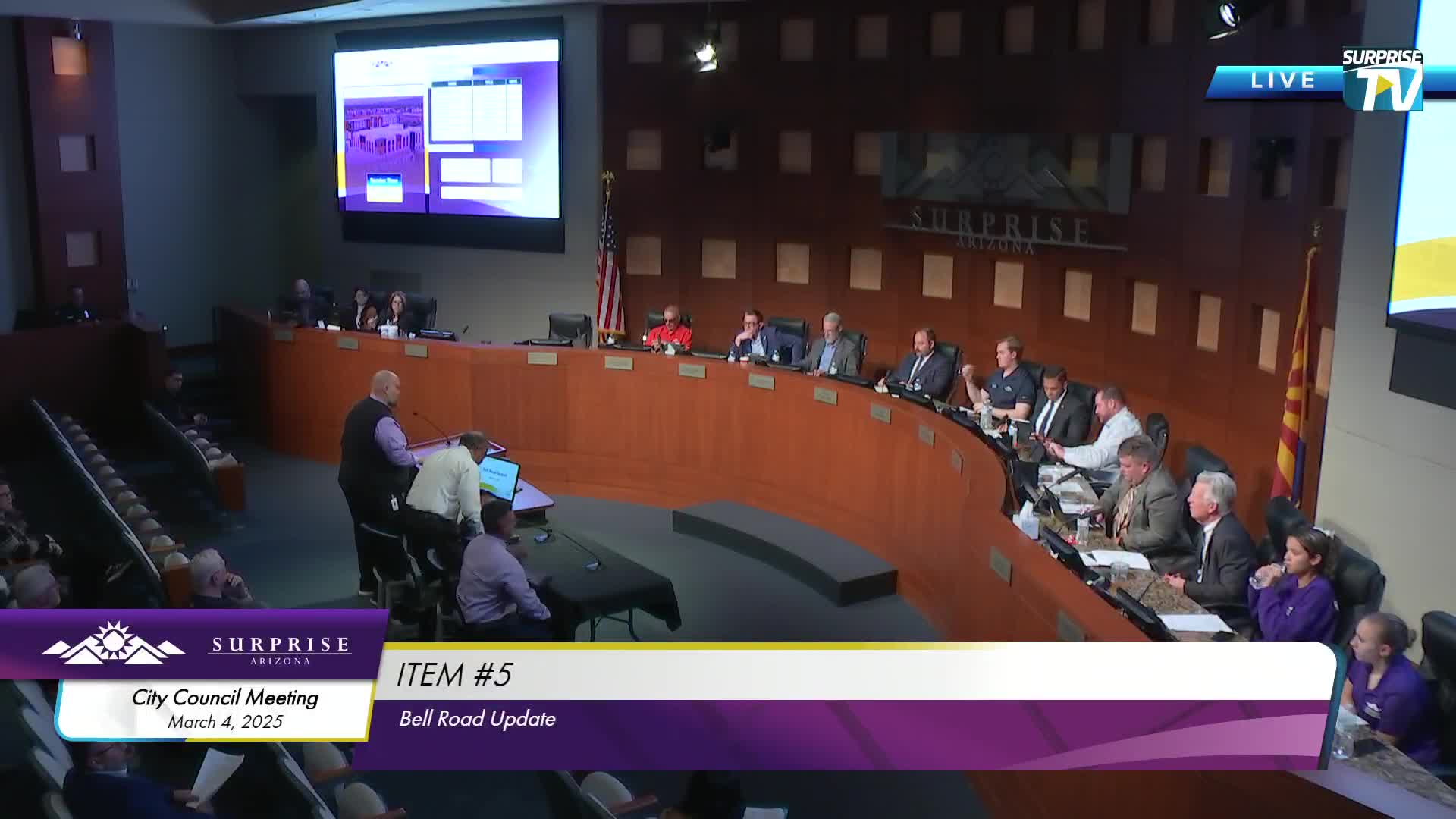
City traffic staff presented a corridor-wide update on Bell Road at the Surprise City Council meeting on March 4, 2025, detailing volumes, left-turn storage limits, previous improvements and potential capital projects. Council directed staff to produce a study with options for safety and congestion improvements at several hot spots, especially the Bell and Litchfield intersection.
"Bell Road carries a very large amount of traffic," said Karan Guntupalli, the city's traffic engineer, describing the corridor as among the region's most heavily traveled east–west arterials. He and Albert Garcia, the city's TISMO manager, told council that major intersections can see about 70,000 vehicle entries per day and that left-turn movements can be substantial during peak hours.
Engineers reviewed treatments already in place, including dual-left additions at other intersections, median adjustments and an adaptive signal-control deployment completed in 2018. Garcia said the adaptive system — which uses high-definition lane-by-lane sensors and centrally processed timing algorithms — was funded largely with grants and costs about $1.5 million to deploy.
Staff gave planners' high-level cost ranges for physical changes: extending left-turn storage at minor or unsignalized approaches was estimated at roughly $500,000–$800,000 per location, while installing dual left-turn lanes at fully signalized intersections was estimated at about $1.5 million per intersection (costs depend on right-of-way, lighting and median work). "Average cost is about 1.5 (million)" for dual lefts, city staff said.
Several council members voiced safety concerns about Bell and Litchfield, which staff named as a top hot spot. Vice Mayor Hastings said he was a proponent of the flashing yellow arrow but acknowledged its limitations in peak traffic: "I love the blinking yellow arrows...they're just not as effective during certain times of the day," he said, adding that he believed Litchfield is the most dangerous intersection in the city.
Council members discussed trade-offs: making left turns protected-only (removing permissive/blinking yellow intervals) would reduce some angle collisions but could increase overall delay during off-peak times and could prompt more red-light violations if drivers become impatient. Staff said protected-only phasing is most appropriate when left-turn demand reaches particular thresholds (about 300 left-turning vehicles during peak hours with heavy opposing flows).
After extended discussion about priorities, coordination with neighboring jurisdictions and the costs of corridor-wide improvements, Vice Mayor Hastings and several council members asked staff to produce a focused study. "I'd like us just to bring back a plan whether we do a study," Hastings said; staff subsequently agreed to prepare options, cost estimates and an evidence-based recommendation for council consideration.
No formal vote was taken on capital funding during the meeting; staff indicated they would present study findings and potential funding strategies at a future work session.