Get Full Government Meeting Transcripts, Videos, & Alerts Forever!
Get email alerts on the Disability Services topic
No spam. Unsubscribe anytime.
Seeds for Autism founder outlines job, life‑skills programs and plans for thrift store and coffee shop
Summary
Mary Anne, founder and executive director of Seeds for Autism, described a Phoenix‑based program that trains adolescents and adults with autism in trades, life skills and supported employment; organizers plan a thrift store opening and later a coffee shop to expand community integration and paid apprenticeships.
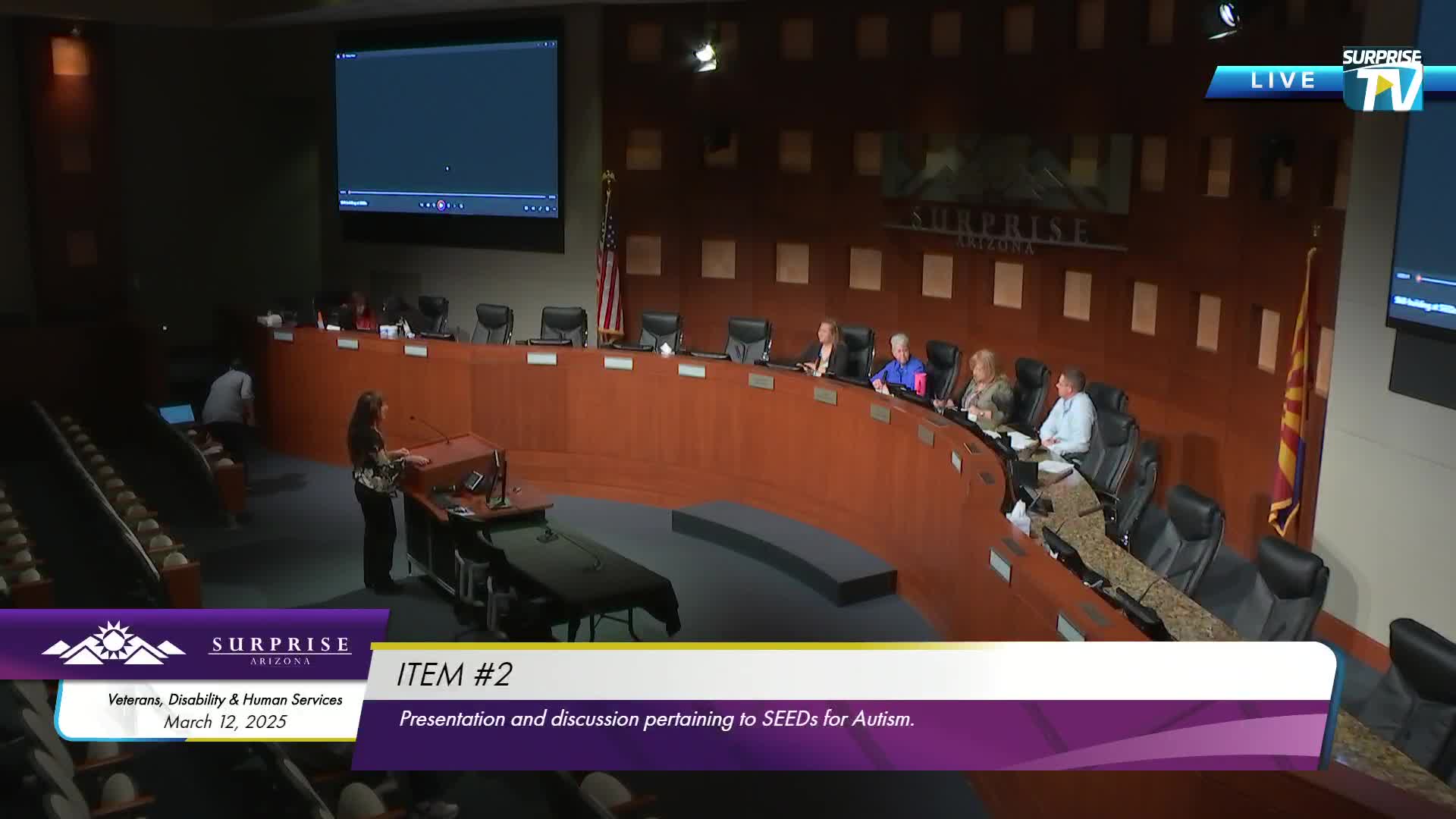
Mary Anne, executive director and founder of Seeds for Autism, told the Veterans Disability and Human Services Commission on March 12 that the Phoenix nonprofit trains adolescents and adults with autism in job skills, life skills and social‑skill development aimed at supported employment and independent living.
The program “was founded in 2010,” Mary Anne said, and grew from “four young adults” working in her backyard to a facility offering woodworking, jewelry making, sewing, weaving, graphic arts, culinary training, blacksmithing and a garden program. She said Seeds pairs participants with job coaches and partners with vocational rehabilitation to pursue employment and on‑the‑job supports.
The organization described a two‑phase expansion. Phase one is a thrift store — “Seeds Garden of Treasures” — planned to open in April (date not specified), where students will work alongside community volunteers and job coaches on sorting, laundry and retail skills. Phase two is a coffee shop that Mary Anne said the program hopes to open in the months ahead; she told commissioners the board’s deadline is September but that they expect to open sooner.
Mary Anne emphasized social‑skill and executive‑functioning development in addition to workplace tasks, noting students range from nonverbal participants to college students and older adults. “SEEDS does stand for success through education, exploration, and development,” she said, and described the thrift store and coffee shop as part of a plan to create apprenticeships and eventual paid positions.
Commissioners asked about placement and outcomes. Mary Anne said Seeds placed 11 students in paid positions last year and that the program works with families and vocational rehabilitation to show “independent employability” where possible. She described typical coaching ratios ranging from one coach to three or four students, with smaller one‑to‑one supports when needed.
She also described community engagement activities: a mobile boutique, summer camps for ages 14–22, an Arizona Author Book Festival fundraiser planned for April 27 and a YouTube/podcast channel produced by program participants. Mary Anne said part of the organization’s mission is to educate employers about reasonable expectations and supports so placements succeed.
Commissioners who spoke praised the program and encouraged other commissioners to visit. Commissioner Michael Tree asked whether job placements were intended to be permanent; Mary Anne replied that placement and independent employment are the goal. A commissioner noted the quality of students’ products and recommended community tours.
Why it matters: Commissioners said Seeds’ model — combining trade instruction, retail experience and employer outreach — could increase employment opportunities for local veterans with service‑connected or other disabilities and provide community‑based training and social supports that fill gaps after school transition.
Ending: Mary Anne invited commissioners and other community members to tour the facility and to attend the Arizona Author Book Festival fundraiser; she said the thrift store is expected to open in April and the coffee shop later in the year.