Get Full Government Meeting Transcripts, Videos, & Alerts Forever!
Get email alerts on the Wind Energy topic
No spam. Unsubscribe anytime.
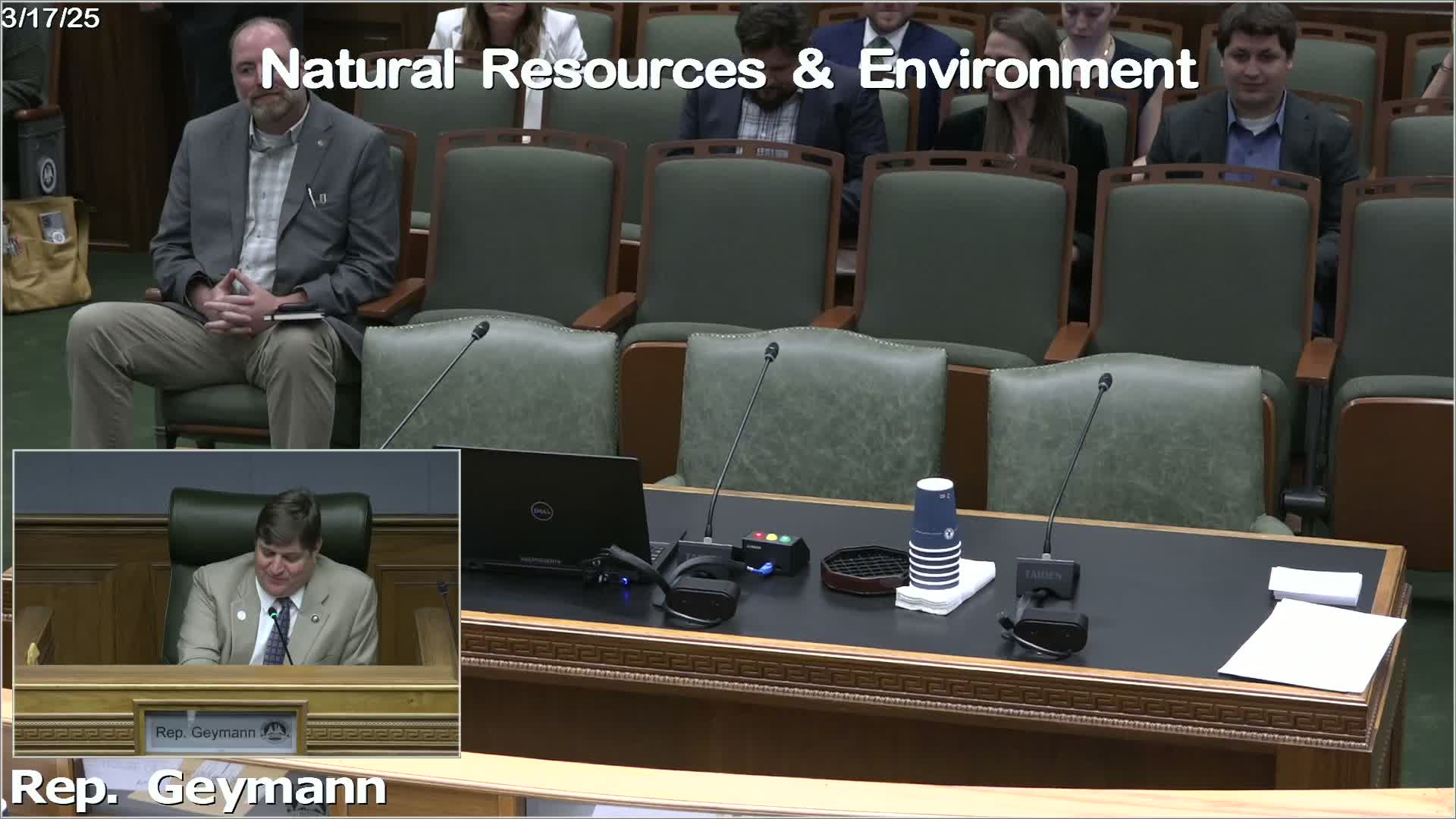
Louisiana Natural Resources Committee holds hearing on offshore and land-based wind; members weigh jobs, permitting and wildlife protections
Summary
A state Natural Resources Committee hearing on March 17 examined offshore and land-based wind development in Louisiana, focusing on permitting gaps, economic opportunity for ports and suppliers, workforce training, and environmental safeguards; no formal actions were taken.
The Natural Resources Committee heard testimony March 17 about offshore and land-based wind development in Louisiana, with state agency officials, industry and conservation groups describing economic opportunity for ports and suppliers, outstanding permitting questions and measures they say are needed to protect wildlife and other ocean and coastal uses.
The hearing, convened by Chairman Guymon, brought state and regional presenters including Blake Gainfield of the Louisiana Department of Natural Resources; Jenny Netherton of the Southeastern Wind Coalition; Cameron Poole of Greater New Orleans, Inc.; Stacy Ortego of the National Wildlife Federation; Monique Gerhardt of Gulf States Renewable Energy Industries; and Scott Eustace of Healthy Gulf.
Committee members and witnesses focused on four topics: (1) who regulates offshore and land-based wind and where permitting gaps exist; (2) the scale and timeline of projects and the workforce and supply-chain opportunities for Louisiana ports and manufacturers; (3) environmental and fishing-industry concerns, including protections for Rice’s whale and other marine life; and (4) model ordinances, buffers and siting rules for land-based projects.
Blake Gainfield, representing the Louisiana Department of Natural Resources, told the committee the department’s role centers on offshore work: leases and operating agreements for state-owned water bottoms through the Office of Mineral Resources and permitting through the Office of Coastal Management. “We we don't have any, wind specific permitting programs,” Gainfield said, adding that coastal permitting applies when projects fall inside the coastal zone but that the department has not established a statewide, wind-specific regulatory program.
Members pressed Gainfield on how nearshore cables would interact with existing and decommissioned pipelines; he said the topic had not been resolved in early operating-agreement discussions and that coastal permitting seeks to encourage use of existing corridors where possible. Gainfield also described a recently created state “roadmap” advisory council with multiple stakeholders that the department has convened to study offshore wind issues.
Industry and economic-development witnesses argued Louisiana’s existing offshore energy supply chain and ports give the state an advantage. Jenny Netherton, who runs the Southeastern Wind Coalition’s Louisiana program, said offshore projects typically take about 10 years from federal lease to power generation, while land-based projects usually take four to five years. Netherton noted that modern, taller land-based turbines can make the Delta region attractive for land-based wind because higher hub heights access stronger wind speeds; she also cited Port of New Orleans and shipbuilding interest in service-operation vessels.
Cameron Poole, energy and innovation manager at Greater New Orleans, Inc., described supply-chain studies the group has commissioned and updated: an initial survey identified about 120 Louisiana companies with high compatibility for offshore-wind work; a later analysis expanded the potential supplier pool to roughly 450 companies. Poole said about 26 percent of domestic offshore-wind contracts so far have involved Louisiana and Gulf Coast suppliers, and he urged long-term planning and training to capture more of the national pipeline of projects.
Conservation and fishing-industry perspectives emphasized mitigation and consultation. Stacy Ortego of the National Wildlife Federation said NWF “stands firmly behind the responsible development of offshore wind energy for Louisiana” but urged avoidance, minimization, mitigation and monitoring for impacts on wildlife and habitat, tribal consultation and protections for underserved communities. Ortego specifically urged protections for the endangered Rice’s whale and said she and partners had urged BOEM to exclude known Rice’s whale habitat from federal Gulf leasing consideration.
Scott Eustace of Healthy Gulf said his group supports offshore wind “when done right,” praising industry approaches to marine spatial planning and noting the smaller nearshore footprint of wind infrastructure compared with many coastal development activities. He and other speakers said careful routing of export cables, avoidance of key fishing grounds and remediation of legacy seabed hazards are among the topics they want addressed during coastal-use and permitting reviews.
Committee members asked several technical and siting questions. Representatives sought clarifications on typical turbine spacing offshore (East Coast projects have tended toward roughly one nautical mile separation), land-based turbine heights and typical per-turbine nameplate capacity (witnesses described modern land turbines at about 4–6 megawatts and offshore machines in the 12–18 megawatt range). Witnesses said typical turbine operational lives are about 20 years and that repowering is common at end of life.
Witnesses repeatedly urged use of existing regulatory and ordinance models. Netherton said model local ordinances and lessons from Texas, Oklahoma and Kansas are available; multiple committee members said they want state guidance so parishes do not face a “Wild West” of inconsistent local rules. Several witnesses and members described workforce training already underway at institutions such as Nunez Community College and noted the compatibility of offshore-wind maritime skills with Gulf mariner training.
No formal motions, votes or directives were recorded at the hearing. Committee members said the session was informational and part of a study resolution passed during the 2024 spring session; members repeatedly framed the topic as forward-looking and intended to identify legislative needs in future sessions rather than take immediate action.
The hearing produced ongoing questions for staff and agencies: whether the Department of Natural Resources should promulgate wind-specific rules for onshore projects outside the coastal zone; how state and federal permitting processes will coordinate on cable corridors, pipeline interactions and habitat protections; and what state-led incentives, workforce programs and port investments may be required to capture a larger share of national offshore-wind contracts.
Committee members thanked presenters and closed the hearing without votes. Several witnesses provided written statements and studies for the committee record and said they would remain available for follow-up questions and to share model ordinances, supply-chain studies and training materials.