Get Full Government Meeting Transcripts, Videos, & Alerts Forever!
Get email alerts on the 303d List topic
No spam. Unsubscribe anytime.
State Water Board holds public hearing on draft 2026 303(d) list; staff outlines methodology, stakeholders press for revisions
Summary
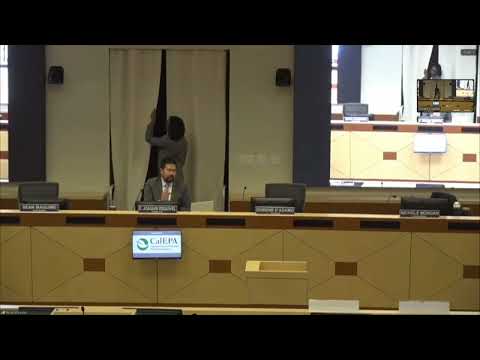
The State Water Resources Control Board on Tuesday, March 18, held a public hearing to receive oral comments on the draft Clean Water Act Section 303(d) list portion of California’s 2026 Integrated Report. Board staff emphasized that the hearing was to gather input and that the board would not take formal action at the session.
The State Water Resources Control Board on Tuesday, March 18, held a public hearing to receive oral comments on the draft Clean Water Act Section 303(d) list portion of California’s 2026 Integrated Report. Board staff emphasized that the hearing was to gather input and that the board would not take formal action at the session.
Anna Maria Saenz, a senior environmental scientist in the State Water Resources Control Board’s Assessment Policy and Process Unit, told the board that the Integrated Report is “an informational record of data and assessments used to inform the status of surface water quality throughout the state.” She said staff reviewed more than 1.4 million rows of data, yielding about 33,000 lines of evidence and more than 15,000 water‑quality assessments covering 983 water bodies for the draft report.
The draft 303(d) list staff presented recommends 426 new pollutant listings and 136 delistings. Saenz said the new listings are concentrated in pesticide and nutrient categories, while many delistings fall in pathogens and pesticide categories; she attributed hundreds of delistings in part to regional changes to objectives and regulatory programs. Staff also described a new approach to ranking Category 5 (TMDL) listings as high, medium or low priority: high priority means a TMDL is planned within two years, medium within two to 10 years, and low indicates no TMDL planned within 10 years or that another regulatory or restoration program is expected to address the impairment.
A major focus of the hearing was the use of benthic biological condition—measured using the California Stream Condition Index (CSCI)—as evidence of impairment when paired with an associated pollutant. Saenz explained staff applied the listing policy to place water body–pollutant combinations in Category 5 where a degraded benthic community (CSCI below 0.79) coincided with an associated pollutant impairment. She said that approach responds to U.S. Environmental Protection Agency (EPA) comments on the 2024 report and follows the State’s listing policy requirement to identify a pollutant association when listing for degraded biology.
Board members and stakeholders pressed staff on whether the 0.79 CSCI threshold should be applied uniformly across California’s widely varied stream types. Nicole Morgan and Laurel Firestone, both board members, and several public commenters noted new draft studies—particularly work by the Central Valley research group (SCORP)—that suggest different reference conditions may be appropriate for heavily modified channels, nonperennial streams, and Central Valley floor streams. Saenz and other staff said those peer‑reviewed studies could be incorporated into future assessment methods and that reassessments could lead to different outcomes if the science supports alternative reference conditions.
Several regulated‑sector representatives and permittees urged caution because a Category 5 listing can trigger permit responses for municipal stormwater (MS4) and other dischargers, including pollutant reduction planning, monitoring and inventory requirements. Karen Cowan, executive director of the California Stormwater Quality Association, told the board that moving water bodies to Category 5 based on degraded benthic scores plus an associated pollutant would immediately impose management and monitoring demands on permittees and could place the burden on those permittees to demonstrate causation rather than correlation.
Other commenters echoed concerns that listing policy changes or EPA differing interpretations could create legal and implementation risks. Multiple speakers said EPA’s partial disapproval letter on the 2024 report and EPA staff statements indicating a willingness to list waters on the basis of degraded biology alone have increased uncertainty. State staff reiterated that the board follows its adopted listing policy, which requires an associated pollutant for biology‑based listings, and said they will continue coordinating with EPA and regional boards.
Staff also described several process and data issues uncovered after the draft release. Saenz said staff discovered about 23 erroneous listings caused by specific‑conductivity data that were assigned incorrect units for assessment; zinc and possibly other pollutant data may also be affected. Additionally, staff found duplicated parent project data submissions that inflated sample counts and said they will correct duplications and propose resolutions in the proposed final draft.
Other key points presented by staff: the Integrated Report is informational and does not itself create regulatory requirements; listings commonly trigger prioritization for TMDL or other regulatory responses; staff have started examining how listings are used in permit implementation and plan to report findings before the board considers adoption; the program has begun a statewide approach to considering tribal data (data collected on tribal lands were considered but not assessed because state standards generally do not apply on federally recognized tribal lands); and staff will collaborate with the Office of Environmental Health Hazard Assessment to query how listings intersect with CalEnviroScreen and disadvantaged and BIPOC communities.
Public commenters raised specific assessment questions. A citizen group representative asked whether all readily available historical sampling data were considered for a coastal beach assessment and whether a stricter statistical test had been correctly applied; board staff offered to meet the commenter and regional staff to review the specific dataset. Representatives from Los Angeles Department of Water and Power, the California Association of Sanitation Agencies (CASA), and other organizations submitted written comments and said they would file additional letters by the April 2 comment deadline.
Saenz reminded the public that the draft Integrated Report and staff report were released Jan. 30, 2025, that the board extended the comment period from 45 to 60 days, and that written comment letters will be accepted until April 2 at noon. Staff said they will prepare responses to oral and written comments, post recommended revisions, and return with a proposed final report for board consideration in early 2026. The State will submit the adopted report to the U.S. EPA no later than April 1, 2026.
Chair Joaquin Esquivel thanked staff and stakeholders for the effort and quality of data work. He said the integrated‑report process represents “bread and butter” work for the board and stressed continuing improvement and public engagement around the science and assessment methods.
Votes at a glance: During the meeting the board also approved two procedural items by roll call vote. In both cases the roll call recorded five ayes and no nays: Board members Sean McGuire, Nicole Morgan, Laurel Firestone, Vice Chair Doreen D'Adamo and Chair Joaquin Esquivel voted “Aye” to adopt the March 4, 2025 meeting minutes and to adopt an uncontested agenda item labeled Item 2. No formal board action was taken on the draft Integrated Report at this hearing.
Next steps: staff will incorporate public and regional input, correct identified data errors, publish responses to comments and recommended revisions, and return to the board with a proposed final Integrated Report in early 2026. The public comment deadline for the draft 2026 Integrated Report is April 2, 2025, at noon.