Get Full Government Meeting Transcripts, Videos, & Alerts Forever!
Get email alerts on the Transportation Funding topic
No spam. Unsubscribe anytime.
Staff outlines countywide sales‑tax option for roads; half‑cent projected to raise about $21.7M annually
Summary
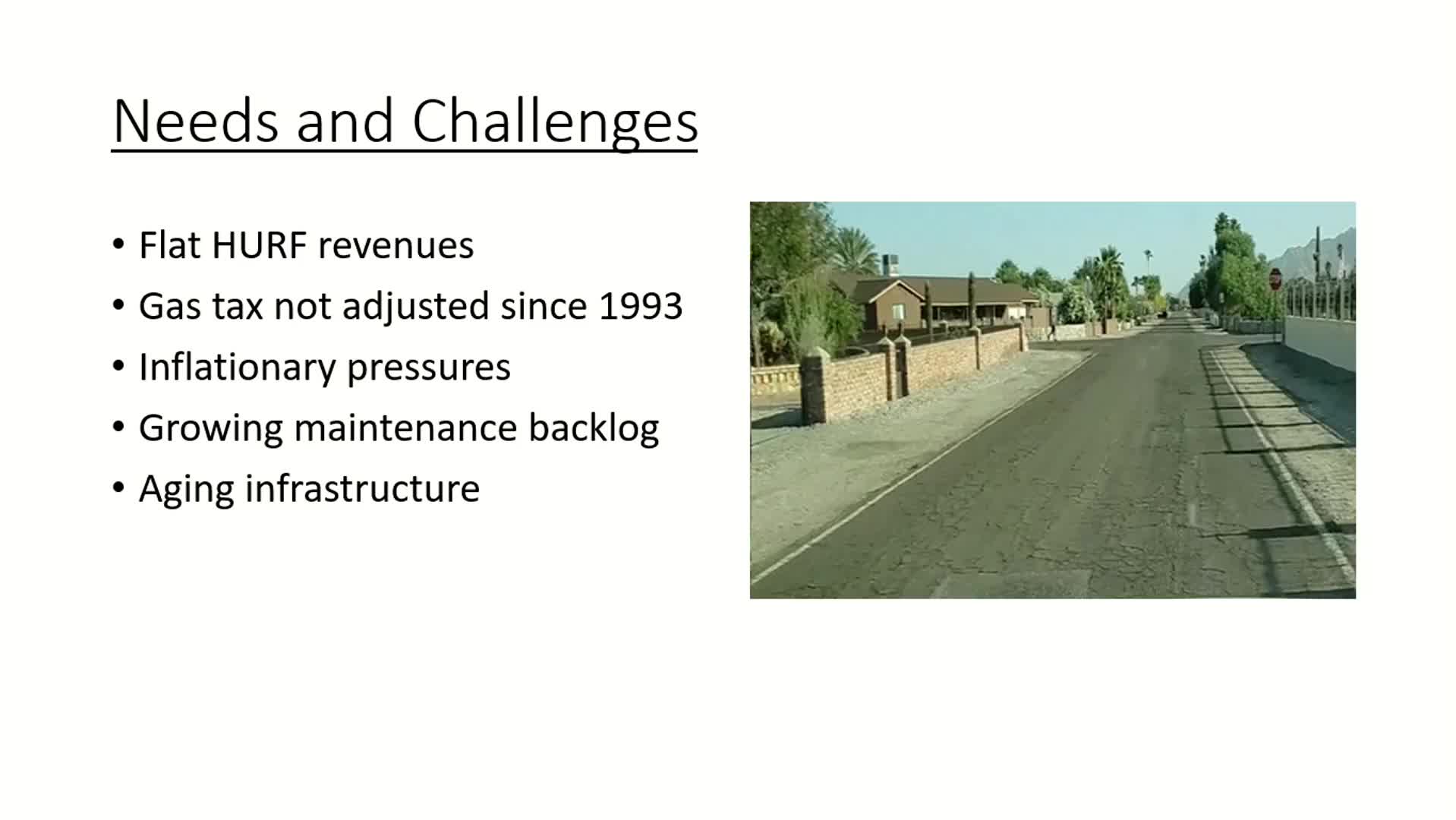
Staff presented a countywide, voter‑authorized transportation sales tax option (statute allows up to 1%) to fund road maintenance and capital needs; the group discussed a half‑cent as a conservative option, projected to generate approximately $21.7 million per year, distribution methods to cities and the role of YMPO for a regional needs study.
Yuma County staff asked the joint meeting for direction on exploring a countywide, voter‑authorized transportation sales tax dedicated to roads and right‑of‑way infrastructure.
Josh Scott, deputy county engineer, said state statute allows counties to place a countywide sales tax on the ballot — up to 1% — dedicated to transportation. Scott and staff described a proposed half‑cent measure as a likely compromise to generate meaningful funding while avoiding the statutory maximum.
"As we had our discussions, we kinda outlined our needs and our costs associated with those. And, generally, we were looking at using a half cent tax," Scott said, adding the county would have flexibility to split revenues with municipalities.
Staff estimated a half‑cent collected countywide would yield about $21.7 million per year based on current taxable‑sales collections scaled to a half‑cent; the group discussed using a population‑based distribution with a proposed minimum allocation of $400,000 for the Town of Wellton and pro rata shares for larger jurisdictions. Scott noted the tax would fund work across the right of way — overlays, bridges, sidewalk and drainage repairs, signals and similar infrastructure — and that it would be authorized for 20 years if voters approve it.
Scott said one advantage of a local sales tax is local control and resistance to state budget sweeps; he also said jurisdictions could use the new funds as local match to leverage federal grants. The group noted other Arizona counties have used road taxes; Coconino and Gila were cited as successful examples and Maricopa County’s experience and legal constraints were discussed.
Councilmembers and supervisors asked about distribution formulas — population, centerline miles, lane miles or pavement area — and staff said population was the easiest to explain and the one the group had gravitated toward, though they said other allocation methods could be modeled. Several participants said they would like to see analyses of what different tax rates (half‑cent, three‑quarters, one cent) would buy and what backlog could be cleared.
Staff proposed next steps that include updating jurisdictional needs lists, a YMPO‑led consultant study to identify regional priorities and a public‑education effort ahead of any ballot measure. Scott said the earliest statutory opportunity for a coordinated measure is a general election in an even year and that, given calendar constraints, a 2028 ballot might be more realistic than 2026 depending on coordination with the expenditure‑limitation question.