Get Full Government Meeting Transcripts, Videos, & Alerts Forever!
Get email alerts on the Planning General Plan topic
No spam. Unsubscribe anytime.
County and city describe how general plans align and guide growth; annual reporting highlighted
Summary
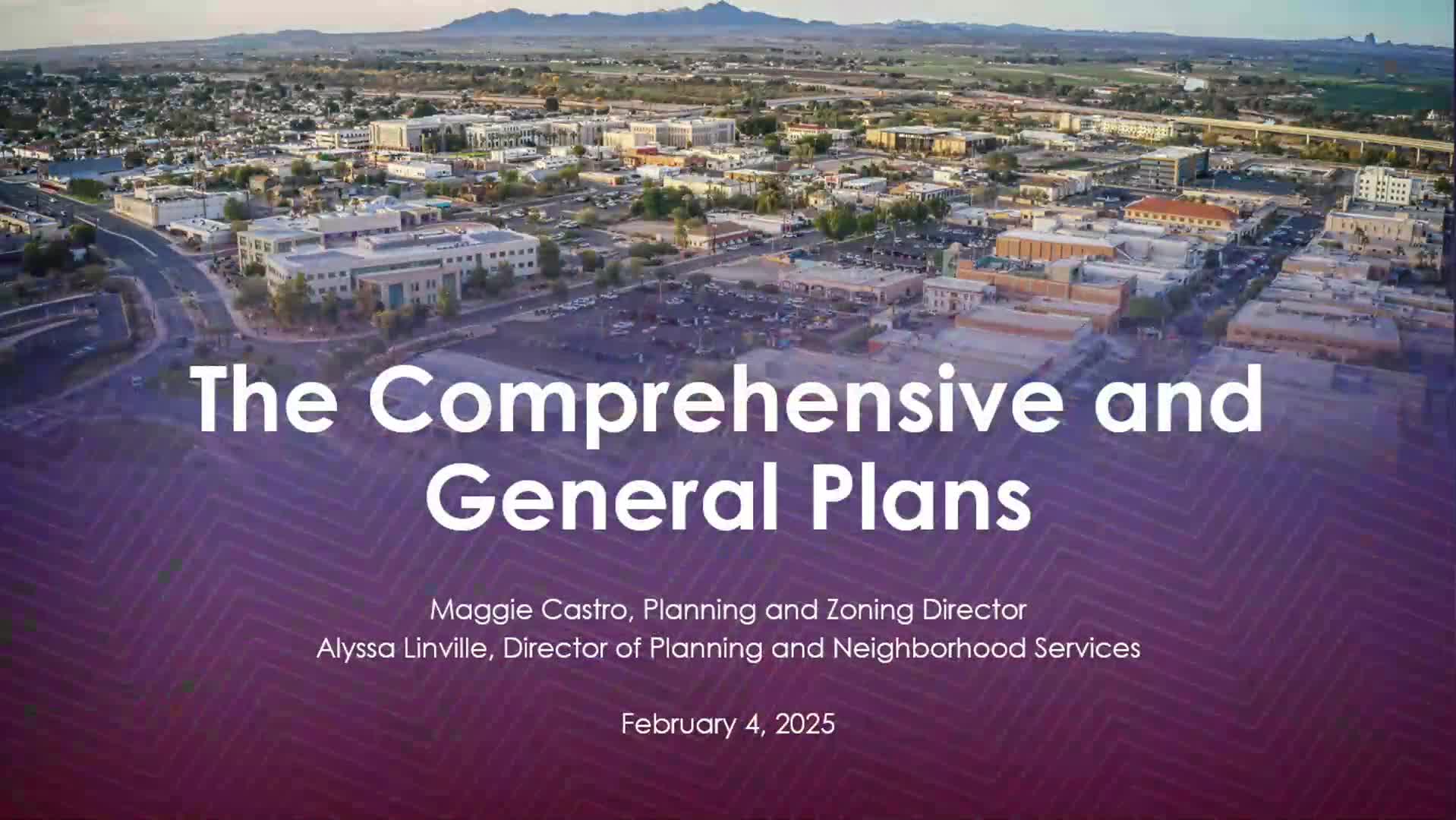
Yuma County planning staff reviewed the county's 2030 comprehensive plan and the City of Yuma's 2022 general plan, how state law shapes required elements, and the city’s annual status reporting and recent general-plan amendments.
County and city planning staff told the joint meeting that the county and the City of Yuma have coordinated planning documents and that both rely on state‑required elements to guide land-use decisions and public investments.
Maggie Castro, Yuma County zoning director, said the county’s primary comprehensive plan used for county decisions is the 2030 comprehensive plan, adopted March 2023, and described the plan’s role in guiding rezoning, capital improvements and other land‑use decisions.
"The plan is used as a basis for policy development, recommendations to adopt policies that accommodate projected growth and establish a planning focus," Castro said, describing the county plan’s application to zoning updates, variances, special‑use requests and subdivision design.
Alyssa Lindell, director of planning and services for the City of Yuma, described the city’s 2022 general plan and its statutory framework. "The general plan is really our guide for development. It represents what the residents of our community hope Yuma will be in the future," Lindell said, and she noted the city divides its planning jurisdiction into the incorporated city limits, a planning area adjacent to the city, and a more narrowly defined focus area where the city expects most growth.
City staff said the general plan is organized by chapters for each required element and that each chapter includes goals, objectives and a 10‑ to 20‑year action plan. Lindell noted the city publishes an annual status report summarizing action‑item progress; staff said the 2023 status work reflected eight general‑plan amendments (six minor and two major), mostly for commercial and residential development.
Castro described how the county and the city compare land‑use designations on planning maps and said that many designations adjacent to the city have been made compatible with city plans. Staff displayed county and municipal planning‑area maps for the City of Yuma, Somerton, San Luis and Wellton and emphasized the role of coordination in managing growth, utilities and public safety investments.
Supervisors and council members raised questions about preserving agricultural land, siting industrial‑scale solar in less conflictive areas and allowing accessory dwelling units (ADUs) where compatible with the military base’s noise contours. City and county staff said they have discussed ADU rules with the local military base and that ADUs have been permitted in parts of the county outside critical noise contours after coordination with federal partners.
Staff said both plans identify required state elements — land use, circulation, water resources and energy for counties above 25,000 population — and a number of optional elements used in local planning. Lindell pointed to chapter 13 in the city plan as the public‑participation mechanism and noted that the city publishes yearly progress updates online so residents can track adopted actions.