Get Full Government Meeting Transcripts, Videos, & Alerts Forever!
Get email alerts on the Land Use topic
No spam. Unsubscribe anytime.
Yavapai supervisors deny use permit for proposed Chino Valley home preschool over road and health concerns
Summary
The Board of Supervisors voted 4-1 to deny a nontransferable use permit that would have allowed a licensed private preschool for up to 18 children in a residential neighborhood off an unmaintained private road in Chino Valley. Board members and neighbors cited increased traffic, road safety, dust and potential health risks to young children.
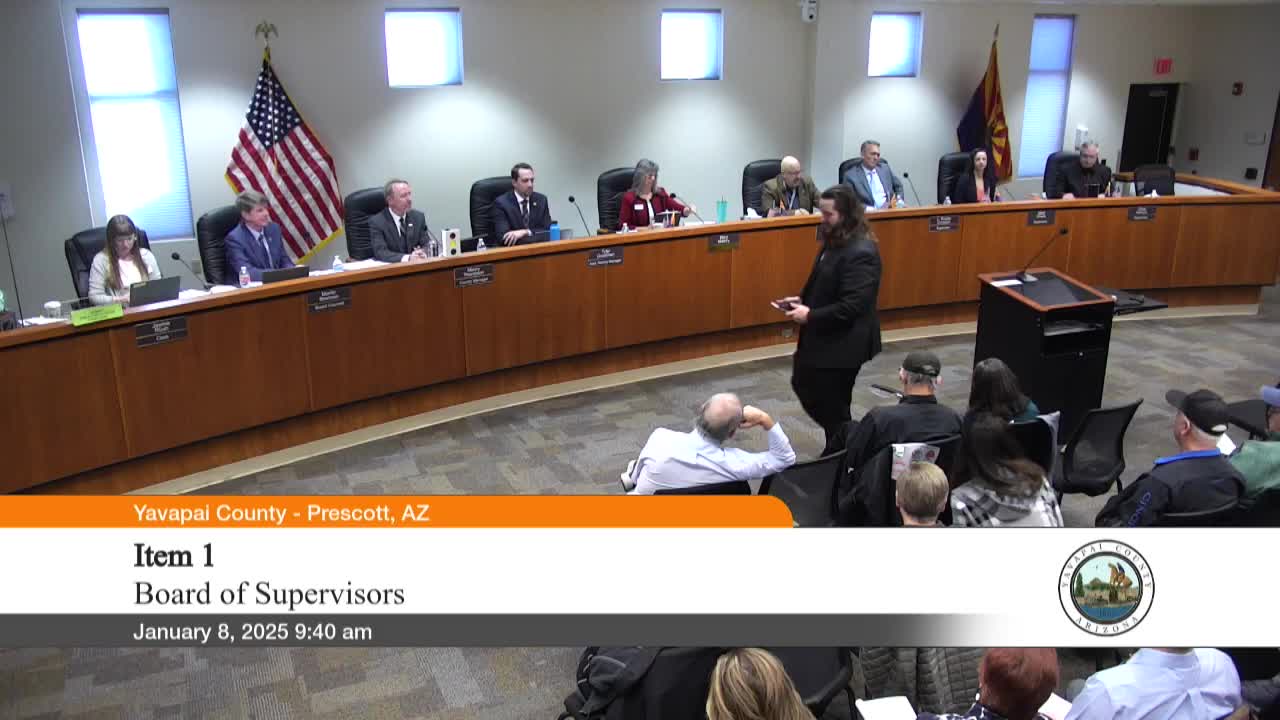
The Yavapai County Board of Supervisors on Wednesday denied a nontransferable use permit application that would have allowed a licensed private preschool and occasional K–6 tutoring for up to 18 children at a private residence west of Chino Valley.
The 4–1 vote came after months of review by county staff and a 5–2 recommendation for approval from the Yavapai County Planning and Zoning Commission. Planners and commissioners stressed that state licensing and building-code reviews would still be required if the board approved the permit, but multiple supervisors and nearby residents said the location’s unmaintained, private dirt road and concentrated drop-off activity made the site unsuitable for a small commercial school.
“It's a dirt road. It's a private road. It's not maintained, and it's a business set up in a residential area,” Supervisor Cook Neal said during the hearing, citing letters of opposition from neighbors. “I'm not for this right now because it is a business in a residential area.”
Susan Aber, planner with Yavapai County Development Services, told the board the applicant had revised a site plan after the Planning and Zoning meeting to add a pull-through drop-off area and additional parking. Aber said the proposed site would use part of the residence (garage, master bedroom and kitchen) and an enclosed playground area and that Arizona Department of Health Services licensing would still be required for more than five children. She noted that the commission recommended approval with conditions including limits on playground hours (8 a.m.–6 p.m.), managed drop-off to prevent vehicles from waiting on the road, and a requirement that licensing be obtained within two years or the permit would terminate.
Applicant Amy Trujillo, a teacher who said several neighborhood families were on a waiting list, said she wanted to follow the proper licensing process and had offered to improve the access on her own property and the immediate driveway approaches. “I want to be licensed. I want to be certified…I want to do it well and right,” Trujillo told the board.
Several supervisors and public commenters pressed on two practical concerns: public-safety and health effects from dust. Supervisor Compton raised the potential for dozens of daily vehicle trips on a narrow, unpaved road and the difficulty of enforcing maintenance conditions. Supervisor Mallory expressed particular concern that silica-containing dust raised long-term respiratory risks for young children unless more extensive paving was done.
Planning and Zoning Commissioner Jim Peterson, who voted with the majority to recommend approval, said the commission treated the proposal as a small start-up operation and prioritized conditions and neighbor mediation rather than a strict enforcement requirement. “This is a small operation. It's a start-up operation. It's complaint driven,” Peterson said.
When the board called for a vote, the motion to deny carried 4–1. Supervisor Marie Mallory cast the lone vote opposing denial, indicating support for the application. The motion maker and second were recorded by the board as part of the public proceedings; the final tally was announced by the chair.
The board’s action closes the county-level use-permit step; the applicant may pursue other locations or address the access and public-health concerns identified at the hearing before seeking future permits.