Get Full Government Meeting Transcripts, Videos, & Alerts Forever!
Get email alerts on the Library District Funding topic
No spam. Unsubscribe anytime.
Yavapai County library district outlines multi-year shortfall, presents levy and service options
Summary
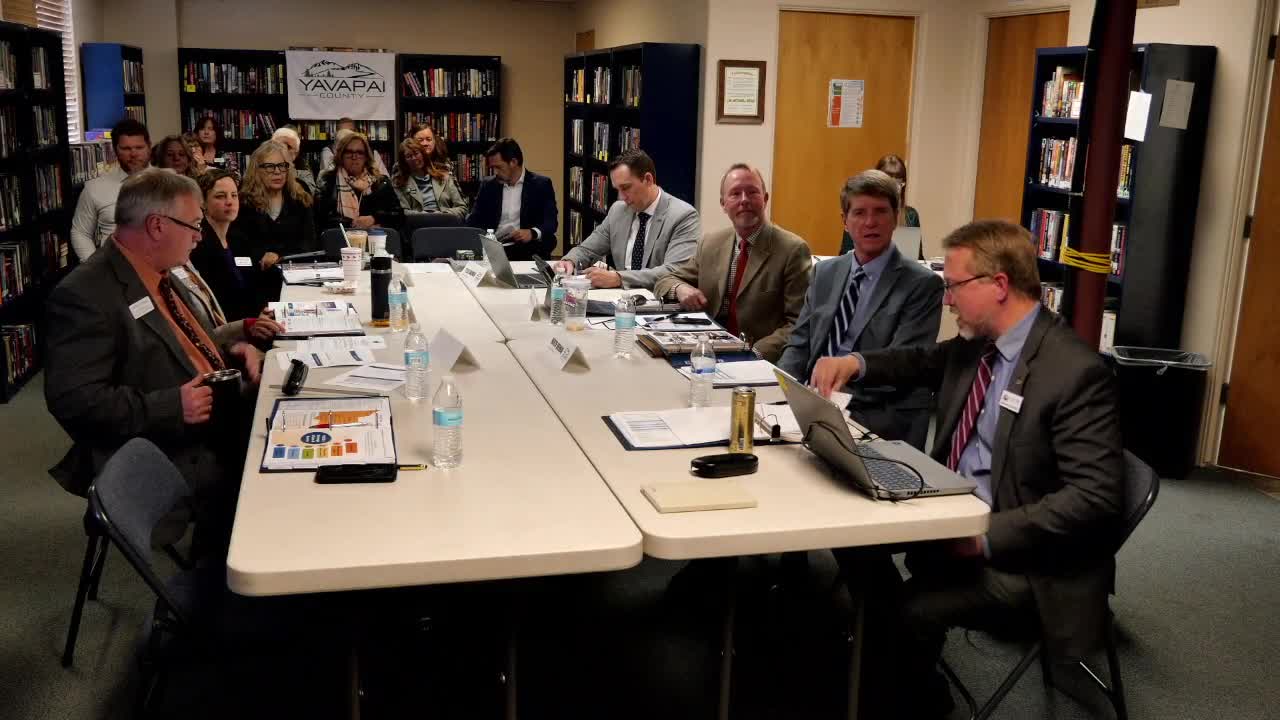
Yavapai County library district staff told the Board of Supervisors at a June work session that the district has faced a multi-year funding gap and presented options to shore up services across 15 branch libraries and a 58-member Yavapai Library Network.
Yavapai County library district staff told the Board of Supervisors at a June work session that the district has faced a multi-year funding gap and presented options to shore up services across 15 branch libraries and a 58-member Yavapai Library Network.
The presentation laid out actions already taken — staffing freezes, deferred capital work and use of reserves — and the open choices going forward: increase the district levy, reduce or eliminate the county''contribution to municipal libraries, or cut branches or hours. Staff said the district''ended fiscal year 2022 with $1,000 in its fund and has since taken reductions and received county relief, but still faces a reserve shortfall and rising operating costs.
Why it matters: the district provides direct services (circulating materials, notary and passport services, public computers, Narcan and programing) in rural communities where travel to larger cities is difficult. Staff described many branches as civic centers that provide services residents cannot easily get elsewhere, and warned that cuts would disproportionately affect remote areas.
Key figures and context
- The library district operates 15 branch libraries and participates in the Yavapai Library Network, a consortium of 58 libraries across 26 governing authorities. - Staff reported an FY22 year‑end fund balance of about $1,000 after several years of drawing reserves. Under the county''reserve policy (17% of expenditures), the district should hold roughly $925,000; staff said the district is about $434,000 below that target. - Over the last four fiscal years staff said the district absorbed about $1.6 million in reductions while receiving an additional $460,000 in new construction revenue. In FY24 the district''reduced its contribution to municipal public libraries by $241,000; staff said the county also forgave roughly $455,000 in administrative overhead reimbursements to provide immediate relief. - Current service and use statistics presented by staff: 44% of county residents have an active library card (active defined as use within two years), countywide circulation is roughly 2.3 million items (physical and digital), and countywide program attendance and offerings are high (staff reported about 3,200 programs with ~27,000 attendees in the most recent reporting year). - Staff cited a return-on-investment analysis for the library network of $6.43 in services for every $1 spent by the district. - Property-tax context: staff reported the district''levy rate has fallen from historic highs (cited 2017 rate of 0.1907) to a current rate staff gave as 0.1346. At present staff said a $250,000 home pays about $33 a year for the library district; staff provided a modeled example that a proposed $2 million funding increase would raise that amount to about $45 per year on the same $250,000 home.
What district staff said they did and why
Staff described a sequence of cost‑saving measures starting in FY22: delaying hires, buying lower-cost technology, deferring capital projects (for example a circulation desk replacement and building remodels), and drawing on reserves. County departments reduced what they billed the library district and the Board of Supervisors lowered some county charges to the district to reduce the district''operating burden. Despite those steps staff said inflation (including wages and operating supplies) and increased service demand have left the district with limited options unless revenue is increased or service is reduced.
Options presented to the board
Staff laid out the core options available to the Board of Supervisors as the district''board of directors: 1) increase the library district levy (which would require the truth-in-taxation notice and process when revenue increases beyond new construction amounts), 2) reduce or eliminate the cash contribution to municipal libraries (staff noted the contribution this year is $1.2 million and that boards could consider restoring it to prior levels if revenue increased), or 3) reduce services, hours or close branches. Staff also proposed targeted investments (safety measures, overlapping staff hours so libraries are not run by single employees, updated cameras, replacement book drops and furniture, and hiring a library network administrator to reduce single points of failure in technology support).
Municipal partners, board reaction and next steps
Multiple supervisors expressed reluctance to again reduce contributions to municipal libraries. At the session one supervisor said they were not willing to take more money away from local municipalities; others urged a fuller conversation about the levy and timing. Staff asked for municipal letters of support if the board elects to pursue a levy increase; staff also said they had already received several such emails.
Staff announced a rural services master plan (the district contracted Gensler for a quick study) that will include community surveys, location assessments and timing for recommendations; staff said the study would report back within roughly three months and would inform a balanced budget proposal that could include phased facility and service changes.
Services affected and community impact
Staff emphasized that many of the district''services are aimed at rural residents: notary work (2,418 notaries last year), passport acceptance (pilot in Beaver Creek, ten passports processed in the first month), computer and Wi-Fi access, digital-literacy and entrepreneurship help, and outreach such as school support (the district provides school librarians for several rural schools). Staff also noted safety concerns for single-staffed branches and rising incidents with disruptive patrons, and said overlapping staffing hours and updated security camera systems were priorities for staff safety.
No formal board vote during this session
The work session was informational: the transcript records no formal motions or votes. Staff said they would return with budget recommendations once the rural services master plan and additional fiscal work are complete.
Ending
District staff asked the Board of Supervisors for direction on whether to pursue a levy increase, restore municipal contributions, or pursue deeper operational cuts. Supervisors and staff agreed to use the rural services study and the upcoming budget cycle to revisit detailed proposals and to seek municipal input and letters of support if a levy measure is pursued.