Get Full Government Meeting Transcripts, Videos, & Alerts Forever!
Get email alerts on the County Budget topic
No spam. Unsubscribe anytime.
Yavapai County supervisors review FY26 budget outlook, warn of structural limits and plan multi‑year CIP
Summary
At a study session, Yavapai County officials reviewed FY26 revenue forecasts, reserves and capital planning, outlined a multi‑year approach to close structural budget gaps and described community and staff engagement used to prioritize nearly $40 million in enhancement requests.
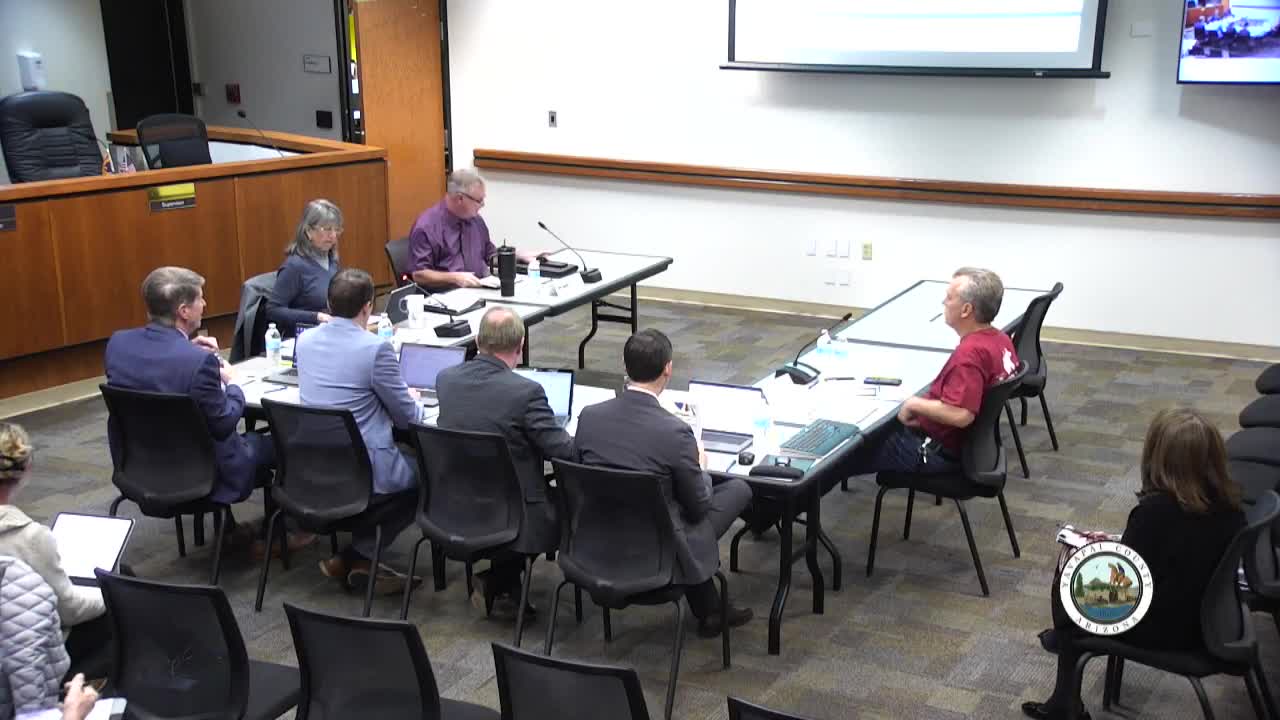
The Yavapai County Board of Supervisors met in a study session to review the county’s fiscal‑year 2026 budget outlook, revenue forecasts and organizational priorities, and to lay out next steps for capital planning and multi‑year budgeting.
Chair Mallory opened the meeting by calling the session to order and welcoming attendees. “Well, good morning, everybody. The board of supervisors welcomes all of you here today,” Mallory said. County Manager Thompson and Budget Manager Zach Wolf then led the presentation and discussion, which covered the budget calendar, revenue trends, reserve policy, capital improvement planning and community engagement exercises used to prioritize department enhancement requests.
The discussion emphasized that while Yavapai County’s reserve position is healthy, revenue growth has moderated and some multi‑year structural pressures remain. Wolf said the county’s general fund continues to rely mainly on property taxes and sales tax (TPT), and that the county currently projects modest growth in those streams: "TPT ... I’m forecasting a little below what we're currently averaging ... preliminary right now at 2% growth." He said excise taxes, the vehicle license (VLT) revenue and Highway User Revenue Fund (HURF) receipts are being monitored but not expected to produce the large increases of prior years.
Wolf also reviewed population and parcel trends cited in the county’s analysis: a 2022 population estimate near 246,000, a recent county growth rate of about 1.7% year over year, and an assessor‑reported parcel‑count average increase of about 1.8% since 2016. He noted that much of recent growth is from in‑migration, with notable increases in residents aged in their mid‑20s and those 65 and older. The budget presentation showed excise tax composition (retail, prime contracting, restaurants/bars and remote retail) and explained how weaker retail and contracting growth have dampened excise revenue growth.
Board members and staff discussed several revenue‑policy items that bear on FY26 planning. The board reviewed how Yavapai County historically adopts a Truth in Taxation (TNT) rate that holds tax collections flat except for new construction; Wolf outlined that adopting the TNT rate would yield a tax levy roughly in line with last year’s collections plus new construction, while adopting a higher rate would raise additional revenue. The board also discussed the recent rebasing of the county’s expenditure limit tied to the voter measure described in the presentation (referred to in the meeting as the county’s spending limit adjustment), and noted staff estimates that the higher limit should help preserve capacity for roughly a decade under current assumptions.
Officials discussed federal and state risks that could affect the budget. Wolf flagged two state legislative items under watch: proposals that would change public‑employee retirement costs and a precinct‑based voting bill that could add substantial recurring election costs if enacted. He also noted that federal Payment‑in‑Lieu‑of‑Taxes (PILT) funding—about $4.3 million in 2024 and budgeted at $4.2 million for the next fiscal year—remains outstanding pending federal authorization, and that late appropriation of PILT is historically possible but not guaranteed.
On the expenditure side, staff described one‑time requests and recurring enhancement requests submitted by departments. Wolf said county departments submitted 217 enhancement requests across funds, with roughly $13.8 million in recurring asks and $21.5 million in one‑time asks in the general fund alone; total requests across all funds approached $39.7 million. To help prioritize those asks, the county ran public and staff engagement exercises (including a Citizens Academy simulation and an executive leadership workshop) that asked participants to allocate constrained resources and surface tradeoffs. Participants, including supervisors and community volunteers, were shown the estimated tax impact on a median‑valued home for various choices.
Board members and staff emphasized capital planning and facilities as priorities. Staff said the county is beginning a multi‑year Capital Improvement Plan (CIP) and facility master planning process to align projects, operating costs and timing. That work will include a five‑year project view and will incorporate operating cost estimates for new or renovated facilities. The county will present a first iteration of CIP materials and a larger budget packet in the coming weeks and scheduled study sessions in late April and early May, with a tentative budget expected June 25 and property‑tax levy adoption on Aug. 11.
Officials reiterated that Yavapai County maintains a formal reserve policy with a minimum reserve target of 17% and maximum of 25% of general‑fund operating revenues. Wolf reported budgeted reserves of roughly $36 million under the policy for FY25 and an undesignated general‑fund balance on the order of $82 million. Staff said those reserves provide capacity to smooth temporary revenue shortfalls (for example, if PILT is delayed) and to invest wisely in capital projects, but that the board should plan to reduce annual reliance on reserves over the next several years as the county moves toward structural balance.
Board members also raised local operational priorities and rural facility needs across districts—examples included courthouse and sheriff substation conditions in Seligman and Ashfork, community centers and Meals‑on‑Wheels funding, and road maintenance pressures on county roads and collaboration needs with ADOT and municipalities. Supervisors asked staff to preserve flexibility in CIP planning to respond to new data from zoning and transportation studies and to pursue partnerships where feasible.
No formal votes were taken during the study session. Staff said they will return with a larger packet for the board’s budget study sessions in late April/early May, a tentative budget on June 4 for board discussion and the finalized FY26 budget adoption schedule leading to the June 25 recommended budget presentation and Aug. 11 property‑tax levy adoption.
The board closed by asking staff to continue public engagement, bring pension and state‑legislative impact briefings as required, and present more detailed CIP and departmental enhancement prioritization at upcoming sessions. “This is an opportunity to for the new board,” Wolf said, adding that staff will present a more detailed recommended budget packet in the weeks ahead.