Get Full Government Meeting Transcripts, Videos, & Alerts Forever!
Get email alerts on the Wildfire Mitigation Psps topic
No spam. Unsubscribe anytime.
APS outlines wildfire tools including public-safety power shutoffs as Walker-area residents urge undergrounding
Summary
Arizona Public Service described vegetation management, grid hardening and public-safety power shutoffs as tools to reduce wildfire risk; residents from Walker and nearby communities urged burying lines rather than adding overhead lines along Walker Road, citing evacuation and insurance concerns.
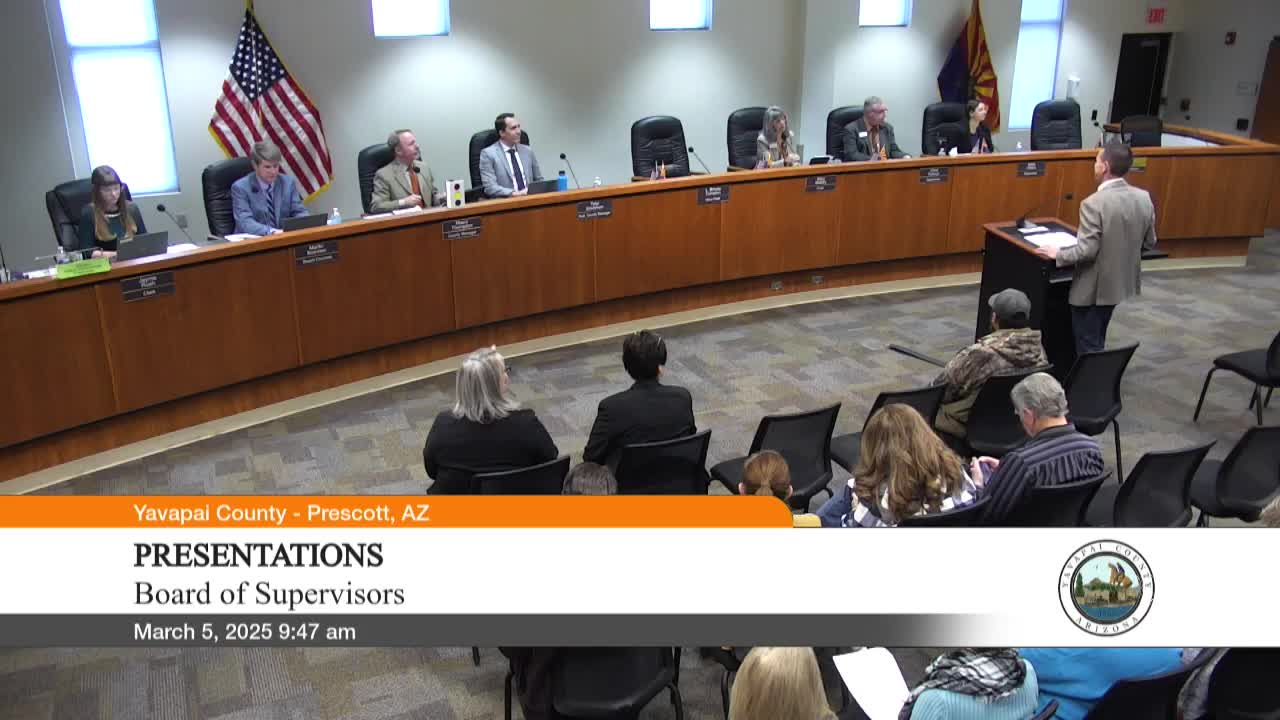
Arizona Public Service on March 5 told the Yavapai County Board of Supervisors it is deploying vegetation management, grid hardening, cameras and a public-safety power shutoff (PSPS) program to reduce wildfire risk — while residents from Walker and other rural communities urged the utility and county leaders to bury new lines rather than install overhead lines along primary evacuation routes.
The presentation by APS Northern Division Director Frank Sanderson and wildfire-mitigation staff outlined multiple mitigation steps, including clearing defensible space around poles, a hazard-tree program coordinated with federal partners, deployment of non‑expulsion fuses that reduce sparking, annual patrols using helicopters and drones, and advanced modeling and weather‑camera networks to detect fires earlier.
"We are committed to safety — that's more important than reliability," Sanderson said during the presentation. He described a PSPS procedure that uses modeling to forecast risk 5 to 7 days ahead, then notifies emergency managers and affected customers daily. If a PSPS is executed, APS said it would patrol lines and dispatch large crews, helicopters and drones to inspect and repair infrastructure before restoring power.
Why it matters: APS officials said PSPS is a tool of last resort that can reduce fire starts caused by electrical equipment, but it can leave customers without power for extended periods while crews patrol and verify lines. Several residents and former first responders told the board that burying new power lines would eliminate large portions of that risk and reduce the chance of a downed overhead conductor blocking a rural evacuation route.
Residents from Walker — a community with a single primary egress, Walker Road — pressed county leaders and APS on the PSPS plan and on proposed overhead line work. Robert Crosswhite, reading a letter from a neighbor, told the board that past wildfires started by overhead lines have destroyed entire towns and that undergrounding is safer. "Lives will be lost in Walker if [overhead lines are installed] and the main evacuation route is compromised," the letter said.
Retired wildland and municipal fire personnel gave the board first‑hand examples. Scott Phillips, who has nearly five decades in fire service, said he has seen many fire ignitions tied to overhead infrastructure and none from properly installed underground lines. "I've never seen a fire from an underground power line in my career in municipal fire," Phillips said, and warned that downed overhead lines can trap residents and block responder access.
Residents also said overhead routes through national forest or along Walker Road could raise homeowners' insurance costs and increase evacuation risk. Richard Tupek noted the county had previously designated Walker Road a scenic historic route and asked the board to weigh whether adding overhead lines along that corridor is consistent with community safety and character.
What APS said about scale and impact: When asked for the likely size of a PSPS impact, Sanderson said the affected area varies by circuit and population density; it could range from a few dozen customers to several thousand. He said the utility is deploying more sectionalizing equipment and weather stations to make shutoffs as targeted as possible and is expanding its PSPS footprint this year because of dry conditions.
County coordination and next steps: APS said it will continue coordinating with county emergency management and municipalities on PSPS notifications and urged residents to sign up for local alerts and to notify APS if anyone in a household relies on electrically dependent medical equipment. Board members and the county manager stressed communication, preparedness and a willingness to consider alternatives that reduce risk to life and property.
Ending: Board members did not take action at the meeting on APS’s network design or an overhead-vs‑underground decision. Several supervisors thanked APS for its cooperation and said they would work with the utility and community representatives to explore the concerns raised, including the feasibility, costs and timelines of burying lines on critical evacuation corridors.