Get Full Government Meeting Transcripts, Videos, & Alerts Forever!
Get email alerts on the Outdoor Lighting topic
No spam. Unsubscribe anytime.
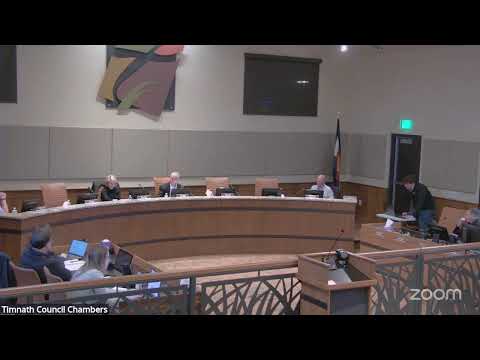
Planning commission approves outdoor-lighting code update, asks staff to add agricultural exemption language
Summary
The Timnath Planning Commission approved a land-use code amendment to tighten outdoor lighting standards (dark-sky–oriented fixtures, warmer color temperature, sensors and dimming), and instructed staff to return with clarified language addressing agricultural lighting.
The Timnath Planning Commission voted to approve a land use code amendment on outdoor lighting with a condition that staff return with a clarified provision addressing agricultural lighting.
The amendment, presented by planning staff, would modernize the town’s outdoor lighting standards to reduce glare and sky glow, promote warmer color temperatures and require fully shielded fixtures in most cases. The update also seeks to require motion sensors for security lights, automatic dimming for parking lights after hours, and defined limits on holiday and decorative lighting. At the meeting, the commission attached a condition directing staff to draft specific agricultural-lighting language and return with that recommendation (target: April 15).
Why it matters: commissioners and members of the public said the changes aim to cut energy waste, protect wildlife and preserve night-sky visibility while maintaining public safety. Staff and public commenters said the revision is intended to align Timnath with regional examples and the model language used by Dark Sky Colorado.
Staff presentation and proposal Planning staff described the town’s existing lighting rules as fragmented and not comprehensive enough to minimize light pollution, energy waste and glare. "The goal of this code update is to modernize the town's outdoor lighting regulations to comply with dark sky standards while ensuring public safety, functionality of commercial and residential outdoor lighting systems, and improving visual comfort," staff said.
Specific elements described by staff and in the draft code include: requiring fully shielded fixtures except for a small set of exceptions; limiting high-blue (high Kelvin) lighting and recommending 2,700–3,000 Kelvin fixtures for most new installations; mandating motion sensors for security lights and automatic dimming for after-hours parking lighting; creating a defined seasonal window for allowable holiday/decorative lighting; and clarifying enforcement via complaint-driven code enforcement.
Public comment and technical input John Garvey, chair of Dark Sky Colorado, praised the draft and told commissioners it was both practicable and beneficial. "This is an economic win, a public health win, a quality of life win, an ecological win, and even a public safety win," Garvey said, while urging staff to revisit an exemption for public-right-of-way lighting so it does not nullify other protections. Garvey and another Dark Sky participant recommended a narrower cutoff angle (for example, 75–80 degrees rather than a 90-degree cutoff) to reduce light trespass.
Commissioner and staff discussion Commissioners raised questions about how the draft aligns with Timnath’s comprehensive plan, how many existing fixtures would have to be replaced, and whether downtown streetlights (some owned by Xcel Energy or other providers) are easily convertible. Staff said the town has begun a survey of fixture Kelvin ratings and is working with a lighting consultant and public works to study conversion feasibility and costs; staff also said some of the town’s fixtures (more than 500 examples cited in the presentation) currently use 4,000 Kelvin or higher and that a downtown LED-conversion proposal will go to council for budget consideration.
Staff noted enforcement will largely be complaint-driven for existing private lighting, and that technical enforcement (e.g., measuring bulb lumens on private property) is limited without property access. For new developments the updated standards would be enforced in plan review and building-permit review.
Action and next steps The commission approved the amendment by voice vote; the motion carried 4–0. Commissioners directed staff to return with explicit, narrow language addressing agricultural lighting (for example, farm irrigation or large field equipment lighting), and to present the recommended agricultural provision to the commission at a future meeting (staff targeted April 15). The approval was made subject to that forthcoming agricultural provision being drafted and presented for the commission’s review.
What the vote does and does not do The approved amendment replaces the town’s existing lighting section (Table 5.3.0.3) with the updated, consolidated standards as presented, except for the agricultural provision staff will add. The commission did not adopt specific enforcement changes beyond using existing code-enforcement channels for complaints; staff said enforcement resources remain limited and that the principal enforcement tool for existing private lighting is addressing light trespass complaints.
A note on terminology and scope Staff and commissioners repeatedly framed the update as an incremental modernization: matching many items to regional standards (Larimer County, Fort Collins) and to model language from Dark Sky Colorado while explicitly prioritizing public safety in street and pedestrian lighting.
Ending: what to expect Staff will draft proposed agricultural-lighting language and return to the commission for review and possible formal adoption. Council consideration of related budget items (for downtown LED conversions) was reported as scheduled; staff said any wider conversion or ownership changes (for examples, conversions of Xcel or Poudre Valley REA fixtures) would require additional feasibility work and budget approvals.