Get Full Government Meeting Transcripts, Videos, & Alerts Forever!
Get email alerts on the Fleet And Charging Infrastructure topic
No spam. Unsubscribe anytime.
Spokane staff seek pre-approval to buy 17 vehicles, cite charging gaps at City Hall
Summary
City staff briefed council on a pre-approval to purchase a first round of 17 vehicles for six departments — including electric models — and described existing charging capacity and remaining gaps, notably at City Hall.
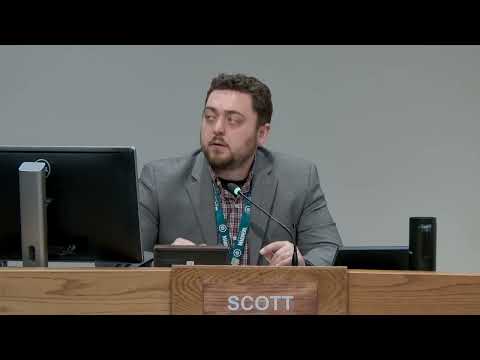
Staff member Rick Giddings told the Spokane City Council on March 24 that the first round of the city’s 2025 vehicle pre‑purchase program includes 17 new vehicles for six departments and that the total cost “is not to exceed $1,769,000.”
The briefing outlined how departments submit fleet data — vehicle age, miles, maintenance history and fuel costs — and how staff use life‑cycle cost, availability and vehicle role to recommend purchases. Giddings said many recommended electric vehicles have fallen in price and that the city’s current fleet includes about 60 electric vehicles and about 80 charging stations.
“The Mach‑E’s and the Lightnings in the fleet right now … have proven themselves to be pretty cost efficient,” Giddings said. He added that for many heavy or specialized vehicles an electric option does not yet exist or does not meet duty requirements, so diesel powertrains are recommended in those cases and that the city uses renewable diesel or renewable natural gas where applicable.
Council members pressed staff on charging infrastructure and vehicle selection. Council Member Dillon asked whether the departments ordering electric vehicles have charging access and whether cheaper sedans were reviewed as alternatives to higher‑priced models. Giddings said the city evaluates whether electricity is available at vehicle duty stations and that in many locations charging can be installed “in a month or so.” He said some previously available small EV models are no longer made and that certain all‑wheel‑drive EVs (for example, the Mach‑E) are currently among the least expensive EVs that meet the departments’ needs.
Tammy Palmquist, speaking later in the briefing, said service vehicles for downtown service crews are typically parked at the closest fire station or at the Nelson Center based on employees’ home addresses; those locations already have charging stations. She also said some city hall vehicles rotate through an existing charger and often only need weekly charging, but added that staff are working on a longer‑term charging solution for City Hall.
Giddings told the council staff are preparing specifications for roughly 22 additional vehicles later this year and are continuing to balance available funding, vehicle supply shortages for some chassis types, and life‑cycle costs. He said availability of heavy truck chassis is uncertain due to recent state rules affecting truck markets, and staff are pricing a modest contingency into requests.
The briefing was informational; no council vote on the purchases was recorded at the briefing.