Get Full Government Meeting Transcripts, Videos, & Alerts Forever!
Get email alerts on the Road Funding Plan topic
No spam. Unsubscribe anytime.
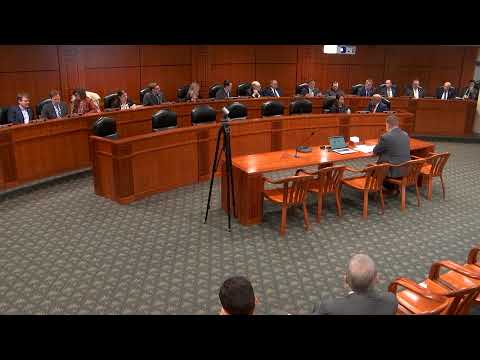
House committee hears MDOT overview and considers eight‑bill, $3.1 billion road funding plan; committee adopts substitute to HB 4183
Summary
The Michigan House Transportation and Infrastructure Committee on March 4 heard a Michigan Department of Transportation overview and initial testimony on an eight‑bill package intended to redirect about $3.1 billion annually to roads without raising taxes and adopted an H‑1 substitute to House Bill 4183 by roll call.
The Michigan House Transportation and Infrastructure Committee on March 4 heard a Department of Transportation overview and initial testimony on an eight‑bill package intended to redirect roughly $3.1 billion annually to road and bridge work without raising taxes, and adopted an H‑1 substitute to House Bill 4183 by roll call.
Chair Rep. Altman opened the meeting by describing the package as a multibill plan intended to “redirect $3,000,000,000 to fix Michigan roads without raising taxes.” The committee then heard a 40‑minute presentation from the Michigan Department of Transportation director and questions from lawmakers before testimony on House Bills 4180–4187 began.
Why it matters: committee leaders said the package aims to stabilize road funding ahead of a projected funding “cliff” in 2026 and to shift existing revenue so more money flows to local roads, county road commissions and cities and villages. Supporters from industry and local chambers urged timely action to avoid losing recently expanded construction capacity and to preserve jobs.
MDOT briefing and context MDOT’s director summarized the department’s mission, structure and funding sources and emphasized performance management and a “people, communities and the economy” focus. The director said the state trunk line system is a small portion of Michigan’s overall road mileage but carries a large share of commercial traffic and highlighted the department’s seven regional engineers and its mix of in‑house and consultant work.
“Everything we do needs to serve people, communities, and the economy,” the director said during the presentation, outlining MDOT responsibility for trunk lines, aeronautics, rail, marine and passenger transportation oversight and for asset‑management practices used to prioritize spending.
Proposal overview and key fiscal mechanics Committee sponsors described an eight‑bill package they said is revenue neutral and would reallocate existing taxes so that the money collected “at the pump” is dedicated to roads under the state’s transportation funding formulas.
Representative Altman said House Bill 4,187 would redirect $2.2 billion in corporate tax revenue to roads; sponsors said other bills would remove the state sales tax on motor fuel at the pump and replace that revenue with a state fuel excise approach (a proposed flat fuel tax, adjusted for inflation) so overall consumer pump prices would not rise. Sponsors repeatedly described the package as a reallocation of current revenue rather than a new tax.
Representative Alexander summarized one element: “My bill, House Bill 4,187, redirects $2,200,000,000 in the corporate income tax revenue to road funding.” Another sponsor explained the sales‑tax‑to‑fuel‑tax change would make fuel revenue more stable and place it directly in transportation accounts rather than the general fund.
Distribution and local emphasis Sponsoring lawmakers said the package would direct substantial new funds to local governments: one presentation slide circulated by sponsors showed about 10% of the reallocated corporate revenue for MDOT trunk lines, 50% to county road commissions and 40% to cities and villages. Sponsors said the plan would also be structured to “hold the school aid fund harmless.”
Questions, concerns and stakeholder testimony Members asked MDOT about innovation, lifecycle costing, permitting timelines (NEPA, EGLE and DNR coordination) and contracting methods (low‑bid, design‑build and CMGC). MDOT said it uses asset management to seek the “right fix, at the right time,” and that the agency pursues design‑build and other procurement tools as appropriate.
Industry representatives and regional chambers testified in favor of the package, urging prompt action to avoid a funding cliff. Lance Ben Onimi of the Michigan Infrastructure and Transportation Association (MITA) said the contractor community has increased capacity and workforce in recent years and stands ready to perform the work: the association “strongly support[s] the legislation in front of you today that will increase road funding by $3,100,000,000 annually.”
The Detroit Regional Chamber endorsed dedicating pump taxes to roads but urged caution on other elements. Brad Williams said the chamber supports “ensur[ing] all taxes paid at the pump go into the road system” while urging the committee not to remove economic development incentives or raise the corporate income tax in ways that could undermine Michigan’s competitiveness.
Formal actions - Committee adopted the minutes of the March 4 meeting by unanimous consent after Representative Herzberg moved to adopt the minutes. - The committee took a roll‑call vote to adopt the H‑1 substitute to House Bill 4183. Members recorded votes on the roll call (excerpted from the transcript): Chair Altman — Yes; Representative Alexander — Yes; Representative Cara — Yes; Representative Brooke — Yay; Representative Coombs — Yes; Representative Nyar — Yes; Representative Preston — Yes; Representative Bonan — Yes; Representative Frisbie — Yes; Representative Works — Yes; Representative Hersberg — Pass; Representative Hope — No / Pass (record shows pass after a no); Representative Colazar — No / Pass; Representative Andrews — Pass; Representative Grant — Yes. The roll call was completed on the record and the substitute was adopted.
What’s next The committee opened testimony on House Bills 4180–4187 and read additional witness cards; committee members said they will continue receiving testimony next week. Sponsors and MDOT representatives said more detailed appropriation and formula work would follow and that implementation timing was intended to begin in October 2025 so construction planning can proceed before the end of current short‑term bond programs.
Ending Lawmakers and stakeholders framed the bill set as an attempt to stabilize road funding and prioritize local pavement work without raising pump prices. Committee leaders said they will return to the proposal in later hearings and coordinate with MDOT on project prioritization and cost‑control measures.