Get Full Government Meeting Transcripts, Videos, & Alerts Forever!
Get email alerts on the Health Data Utility topic
No spam. Unsubscribe anytime.
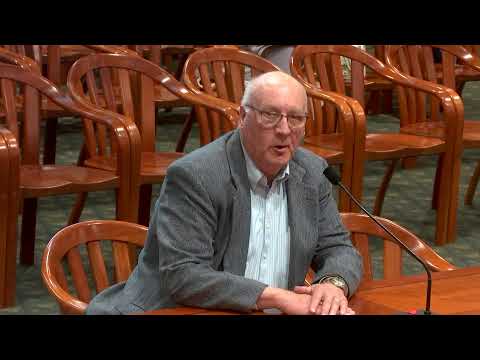
Committee hears testimony on bills to create Michigan health data utility; funding would use insurance assessment
Summary
The Michigan House Health Policy Committee heard testimony on House Bills 4037 and 4038 to establish a statewide health data utility and to fund it through the Insurance Provider Assessment Act. Testimony focused on patient consent, security, funding amounts and how the utility would extend data sharing beyond traditional medical settings.
The Michigan House Health Policy Committee heard extended testimony on House Bill 4037 and House Bill 4038, a package to establish a statewide health data utility (HDU) to expand and standardize electronic health data sharing, and to fund it through the Insurance Provider Assessment Act (IPAA).
The bills, sponsored in the hearing by Representative Julie Rogers (state representative, House District 41) and presented in part by Chair VanderWaal (House Health Policy Committee), would formally establish an HDU to move beyond the current health information exchange model operated by the Michigan Health Information Network (MiHIN) and to add nontraditional data sources such as schools, foster care and community organizations to data sharing that supports treatment, care coordination, quality improvement and public-health uses.
Supporters told the committee the HDU would reduce duplicate testing, improve medication reconciliation and improve care coordination across settings. Representative Rogers recounted a family member’s experience of omitted medication information during a hospital transfer as an example of gaps the legislation aims to address. Dr. Kevin Bosack (physician, executive medical director for population health management and board member of MiHIN representing health systems) and MiHIN officials described current capabilities and the proposed expansion.
Why it matters: Sponsors and witnesses said an HDU would make more complete medical information available to treating clinicians when they need it, reduce unnecessary tests and administrative burden, and enable faster public-health data flows. Supporters argued the structure would be a statewide infrastructure investment tied to existing legal and technical standards rather than a new, standalone consumer database.
Key details and technical points
- Structure and scope: HB 4037 would formally establish the HDU entity and its operational standards, requiring high security protections and vendor certifications; HB 4038 is the funding bill linked to the Insurance Provider Assessment Act (IPAA).
- Funding: Representative VanderWaal (presenting the funding bill) said the proposal would allocate $6,000,000 in the first fiscal year, $7,000,000 in year two and cap at $8,000,000 in year three with inflation adjustments. Witnesses characterized the IPAA funding as a restricted insurance-based fund, not an increase in general taxpayer dollars.
- Consent and access: Committee members sought and received clarification on consent. Witnesses explained the model described during testimony is an opt-in at the point a patient signs privacy/HIPAA forms at a provider, with an option to opt out later. MiHIN representatives said patients could request records directly and could opt out at any time; they stated that data sharing would stop immediately upon a patient’s opt-out.
- Who can request records: Witnesses said medical providers would generally request record transfers between facilities; the bills also include mechanisms for patients to request their records.
- Security and governance: MiHIN executives said the entity would follow federal and state privacy laws (including HIPAA), industry security frameworks (HITRUST and DirectTrust), and would require a competitive bid/RFP to select an operator. MiHIN testified it encrypts data in transit and at rest, conducts regular security assessments and has not experienced a reported data breach in its years of operation. Witnesses described a ‘‘garage-door’’ model that halts data exchange if a breach is detected while an investigation occurs.
- Scope limits for nonmedical partners: Witnesses said nontraditional community partners (for example, a food bank or transportation provider) would not receive full medical records; with patient consent, such partners would receive limited contact or referral information (a flag, contact information and permission to follow up) to enable social supports without exposing clinical detail.
- Small and rural provider participation: MiHIN said it offers portal tools (described as a “My Gateway” portal) and technical support options for smaller providers that lack full electronic health record systems; the funding bill is presented as a mechanism to help connect smaller providers.
- Interoperability and real-time access: Physicians on the panel described the system as ‘‘vendor agnostic’’ plumbing connecting existing EMRs; the HDU/MIHIN model uses single sign-on and an active care relationship check so that a provider treating a patient can view available data in near real time when they have an established care relationship.
Questions and concerns raised
Committee members questioned who bears legal responsibility for data accuracy when records move across settings, and who would be liable in the event of a hack. Witnesses said the selected operating entity would have contractual responsibilities and that further detail would be resolved in the vendor selection process; MiHIN emphasized compliance with federal/state law. Members also sought clarity on opt-in versus opt-out language; witnesses explained the process as an initial opt-in at point of care with an option for patients to opt out later.
Support and personal testimony
The Michigan State Medical Society (via Dr. Bosack) and several clinicians and associations submitted support; a parent and pharmacist, Larry Wagenekt, testified about repeated blood draws for his child and urged passage to reduce unnecessary procedures.
Votes at a glance (committee business recorded earlier in the same meeting)
- House Bill 4077: Committee moved to report the bill to the floor with a recommendation that it pass; the clerk announced the motion prevails (tally reported by the clerk: 15 yes, 0 no, 0 abstain). The motion was presented in committee and carried by voice/roll call per the transcript.
- House Bill 4078: Committee moved to report the bill to the floor with a recommendation that it pass; the clerk announced the motion prevails (tally reported by the clerk: 16 yes, 0 no, 0 abstain).
What the committee did not do today
The committee heard testimony and asked questions but did not vote on HB 4037 or HB 4038 during the hearing recorded in the transcript. Sponsors said implementation would require a competitive bid/RFP to select the operating entity and additional technical work on consent and governance rules before stand-up.
What’s next
Sponsors said they intend to continue work on the bills; no committee vote on HB 4037 or HB 4038 appears in the transcript excerpt. Committee members requested additional detail on definitions (for example, ‘‘trusted data sharing organization’’), the mechanics of opt-in/opt-out, and how funding and participant fees would be recalibrated if the HDU model is adopted. Those follow-ups were left for subsequent hearings or staff work.
Ending
Committee testimony ranged from technical detail (encryption standards, vendor certification) to personal appeals about harm from incomplete records. Sponsors and witnesses framed the bills as a statewide infrastructure step intended to improve care coordination, reduce test duplication and provide limited, consented links to community services. The transcript does not record a committee vote on the HDU bills during this session.